Disdik Picks is reader-supported. When you buy through links on our site, we may earn a commission at no extra cost to you. As an Amazon Associate, we earn from qualifying purchases. Learn more ›
Best Posture Correctors: 5 Braces and a Trainer Compared
Compare the best posture correctors by design, fit range and wear schedule, from the ComfyBrace back brace to the Upright GO 2 electronic trainer.
Nov 19, 2026
Updated Nov 20, 2026
24 min read
0 views
The best posture corrector for most people is the ComfyBrace Posture Corrector, because it publishes the combination this category is bought for: a fully adjustable brace that supports the mid and upper spine, breathable fabric thin enough to sit under a shirt, and a maker’s warranty stated as lifetime coverage, which none of the other braces here match in print. The Upright GO 2 Premium is the technology pick, a small electronic trainer that sticks to the upper back and vibrates when you slouch, with an app that tracks the habit instead of a strap that holds it. The Truweo Posture Corrector is the lightweight pick, a foam-strapped clavicle brace the maker rates at 1.5 ounces, sized for chests from 28 to 44 inches. The Schiara Posture Corrector is the discreet pick, a low profile brace 0.21 inches thick at its published measurement, built for short sessions under clothing. The FlexGuard Support Back Brace is the full coverage pick, the only brace here that wraps the whole back and adds a waist belt, and the only one that ships with an exercise booklet.
As an Amazon Associate, we earn from qualifying purchases.
The mechanism is the first separator, because it decides what the product actually does to your day. Four of the five picks here are passive braces: straps loop the shoulders and pull them gently back, so the brace works only while it is worn and only as well as its fit. The Upright GO 2 takes the other route entirely. It holds nothing. A sensor worn between the shoulder blades learns your calibrated upright position and vibrates when you drift out of it, in a training mode that corrects you and a tracking mode that simply records. That makes it the only pick whose effect is designed to outlast the session, and also the only pick that depends on a phone app, a charge and a supply of adhesive pads. A buyer who wants to be held upright buys a brace; a buyer who wants to be reminded buys the trainer, and the two should not be confused at checkout.
Coverage is the second separator, and it is where listing language needs the most care. The Truweo and the Schiara work at the top of the back only: a clavicle brace crosses the upper back and anchors on the shoulders, and nothing in either design reaches the lower back. The ComfyBrace covers more, describing support for the mid and upper spine. The FlexGuard covers the most, a full back panel with a waist belt that adds lower back compression the other three braces do not offer. Read coverage claims against the shape of the product, not the adjectives: a figure eight strap cannot support a lumbar curve it never touches, whatever the title says, and several listings in this category borrow medical language, naming conditions their brace cannot treat. The checks section below returns to that point, because it is the most important honesty test in this roundup.
Sizing and the wear schedule are the third separator, and they decide month two rather than day one. The braces here size three different ways: the Truweo and the Schiara by chest measurement, the ComfyBrace by strap adjustment across a wide range, and the FlexGuard by body weight and waist in lettered sizes, which makes its size chart the one to read most carefully. Every maker here prescribes the same ramp, short sessions first, building over days, and two of them, the Truweo and the Schiara, publish a ceiling of about two hours. A posture corrector is a training aid worn in doses, not a garment worn all day, and the products that say so in their own copy are the ones describing the category honestly.
1. ComfyBrace Posture Corrector
Top Pick
1. ComfyBrace Posture Corrector
Form: Back brace posture corrector for the mid and upper spine, per the listing title
Adjustment: Fully adjustable straps, per the maker’s copy
Material: Breathable fabric, per the listing title
Product dimensions: 6.3 x 4.72 x 0.39 inches, per the Amazon product block; the figures read as the folded brace
The ComfyBrace is the default recommendation because it is the most completely documented brace in this roundup and the design the rest of the category is measured against. The listing describes a back brace for men and women that works as a straightener for the mid and upper spine, with fully adjustable straps, breathable fabric and a profile thin enough to wear under clothing. The Amazon product block publishes product dimensions of 6.3 x 4.72 x 0.39 inches, which read as the folded brace rather than the brace worn, a first available date of October 29, 2019, and the manufacturer as Comfy Brace. Published coverage of the maker’s terms states a lifetime warranty, a commitment none of the other four products here print, and the listing has the longest continuous sales history in this group, which matters in a category where listings routinely disappear and take their sizing charts with them.
The cautions are about the product block’s odd corners and the limits of the design. The item model number field in the product block prints simply as 1, which is a data entry artifact rather than a model name; the Specs below record it exactly as printed, and the reference table’s identifier is the reliable way to match this product at checkout. The design itself is the standard one, so it inherits the standard limits: the support stops at the mid back, the straps can chafe under the arms if they are overtightened, and the correction is a pull, not a cure, so it works as a daily reminder to sit and stand straighter rather than as treatment for any diagnosed condition. Choose the ComfyBrace if you want the established brace, adjustable across a wide range of bodies, from the maker that puts the strongest warranty words in print.
2. Upright GO 2 Premium Posture Trainer
Runner-Up
2. Upright GO 2 Premium Posture Trainer
Form: Wearable electronic posture trainer; adhesive mount, or the maker’s necklace accessory sold separately
Feedback: Gentle vibration on leaving the calibrated upright range, per the maker’s copy
Modes: Training mode and tracking mode, per the maker’s copy
App: Upright app for iOS and Android, per the Amazon product block
The Upright GO 2 Premium is the technology pick, and its case is that it is not a brace at all. The device is a small sensor, about 1.9 x 1.1 inches in the published coverage, that attaches to the upper back with hypoallergenic adhesive pads, or hangs from the maker’s necklace accessory, which is sold separately. Once calibrated through the Upright app on iOS or Android, it runs in two modes: a training mode that vibrates gently when you leave your upright range and stops when you straighten, and a tracking mode that records posture without correcting, so the app can show the day’s upright and slouched time. The Amazon product block for this listing prints the model number URF01W-IN, the brand as Upright GO, the use as posture correction, and the seller as DarioHealth with shipping from Amazon. The box holds the sensor, a travel case, a USB-C charging cable and ten adhesive pads, per the maker’s published contents.
The cautions are about running costs, battery figures that disagree, and dependence on the system. The adhesive pads are a consumable: the ten in the box are a starting supply, and continued wear means buying more pads or the necklace. The battery figure is printed two ways in the sources reviewed, up to 30 hours in the maker’s published material and 35 hours in some current retail coverage, so the Specs below print both rather than choosing quietly; charging takes about three hours by USB-C, per the published coverage. The trainer also asks for calibration patience, since a sensor set too eagerly vibrates at normal movement, and it does nothing at all on the days it sits in its case. Choose the Upright GO 2 if you dislike braces, spend your day at a desk, and want the feedback and the record rather than a strap, accepting that the habit, not the device, has to do the holding.
3. Truweo Posture Corrector
3. Truweo Posture Corrector
Form: Clavicle brace and back brace with foam straps, per the maker’s product description
Fit: Chest sizes 28 to 44 inches, per the maker’s product description
Closures: Hook and loop, adjustable, per the maker’s product description
Material: Breathable and latex free; hand washable, per the maker’s product description
The Truweo is the lightweight pick, a clavicle brace whose maker’s product description reads like a specification sheet and is quoted here on those terms. The description gives a chest fit from 28 to 44 inches, a weight of 1.5 ounces, soft foam straps with hook and loop closures, breathable and latex free materials, and hand washable care. The wear schedule is printed with unusual precision: start at about 15 minutes a day, increase gradually, and wear up to 2 hours per day. The same description carries the most honest sentence in this category, stating plainly that the corrector is not intended to replace professional medical advice or treatment. The design is the classic figure eight, arms through the straps with the logo facing out, worn over or under clothing, and the maker describes the point of it as muscle memory: the brace reminds, and the habit is supposed to remain when the brace comes off.
The cautions are about the offer and the coverage. Crawls of this listing reviewed for this roundup carried the line No featured offers available in the summary area, while the product description and manual remained fully published; treat the live page as the authority and confirm the offer and the seller before ordering. The coverage caution is structural and shared with the Schiara: a clavicle brace supports the shoulders and the upper back only, so a buyer whose problem sits in the lower back is shopping in the wrong design and should look at the FlexGuard instead. The published weight, 1.5 ounces, is the maker’s figure and is best read as the lightest claim in this roundup rather than a laboratory number. Choose the Truweo if you want the lightest, simplest brace here, your chest falls inside the published range, and you are content to build the habit in short daily sessions.
4. Schiara Posture Corrector
4. Schiara Posture Corrector
Form: Low profile upper back brace and clavicle support, per the maker’s copy
Fit: Chest sizes 30 to 42 inches, per the maker’s copy; some retail coverage prints a wider range across the line’s sizes
Dimensions: 9.84 x 2.75 x 0.21 inches, per the published listing data
Item weight: 0.31 pounds, per the published listing data
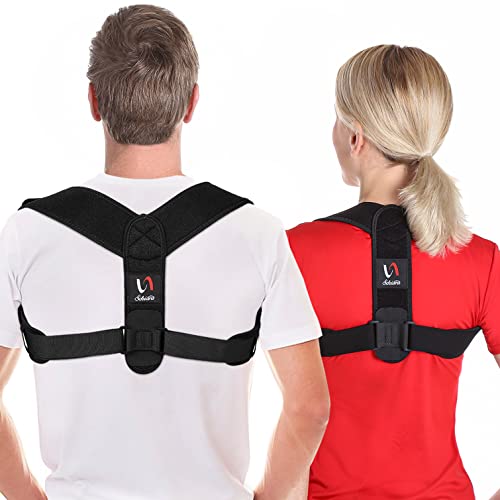
The Schiara is the discreet pick, built around a single published measurement: 0.21 inches. That is the thickness in the listing data reviewed, alongside dimensions of 9.84 x 2.75 x 0.21 inches and a weight of 0.31 pounds, and it explains the product’s whole pitch, an upper back brace thin and light enough to disappear under a shirt for short sessions at a desk. The maker’s copy gives a chest fit from 30 to 42 inches, adjustable straps with a buckle pad on the back that can be repositioned, and a breathable, washable fabric. The maker’s guidance is the most conservative in this roundup: begin at 20 to 30 minutes to an hour a day for two weeks, increase gradually, and do not wear it for more than 2 hours continuously. The same copy carries the category’s clearest stop rule, naming numbness, swelling or discoloration as the signals to take the brace off and leave it off.
The cautions are about conflicting material and range claims, and about what a thin brace cannot do. The listing data reviewed describes the material as neoprene, while other listing copy describes a breathable fabric without naming neoprene; the Specs below print both descriptions rather than settling the point. The fit range also prints two ways, 30 to 42 inches in the maker’s copy and a wider span in some retail coverage that appears to describe the line’s sizes together; measure your chest and order against the maker’s 30 to 42. And the design’s virtue is its limit: a brace this thin cues the shoulders and does nothing for the lower back, and its own two hour ceiling makes it a session tool, not an all day support. Choose the Schiara if discretion under clothing decides the purchase, your chest is inside the published range, and your plan is short, regular sessions rather than long wear.
5. FlexGuard Support Back Brace Posture Corrector
5. FlexGuard Support Back Brace Posture Corrector
Form: Full back brace posture corrector with waist belt, per the maker’s copy
This listing: Size S/M, published for 105 to 140 pounds, per the listing title
Size guidance: Waist 61 to 76 centimeters, about 24 to 30 inches, for the S/M, per the maker’s published size guidance
Material: Breathable neoprene, per the published product data
The FlexGuard is the full coverage pick, the only brace here shaped like a back brace first and a posture cue second. Where the Truweo and the Schiara stop at the shoulders, the FlexGuard wraps the back and closes with a waist belt, so its support runs from the shoulders down through the lower back, and its sizing follows the body it wraps: this listing is the S/M, published for wearers of 105 to 140 pounds, with the maker’s size guidance giving a waist of 61 to 76 centimeters, about 24 to 30 inches, for that size. Published product data gives a breathable neoprene construction, hook and loop closures and an item weight of 7.84 ounces, the heaviest figure here, which is the honest price of the extra coverage. The box adds the category’s only paper extra, a posture booklet with information and exercises, which fits the maker’s framing of the brace as one half of a program rather than the whole of it.
The cautions are about sizing, stock signals and borrowed medical language. The size chart is this product’s known weak point, with published coverage of the line reporting wearers who found the brace smaller than the chart suggested, so measure, and treat the weight and waist figures in the Specs as the authority rather than the letter size alone. A retail mirror of this listing showed the S/M out of stock at the time it was reviewed, so confirm the live offer and your size on the listing itself before ordering. Finally, the maker’s copy reaches furthest in this roundup, naming diagnosed spinal conditions among the things the brace aids; a fabric brace does not treat those conditions, and the checks section below sets out where that line sits. Choose the FlexGuard if your discomfort spans the whole back rather than the shoulders alone, you fall inside this listing’s published size, and you want the booklet’s exercises alongside the brace.
Safety and Accuracy Checks Before You Buy
Run five checks before ordering any posture corrector in this roundup. First, the recall check. None of the five products here appears in a federal recall in the records reviewed, and posture braces as a class carry no CPSC recall record. That is a statement about these models, not about the category’s whole catalogue, so before first use, search the exact model on the federal safer products database, because a recall attaches to a model and a production window, not to a brand as a whole.
Second, the medical claims check, which is this category’s standing honesty problem. Listings for braces in this roundup name conditions including scoliosis, spondylolisthesis and thoracic outlet syndrome among the things a brace aids, and no fabric brace treats a diagnosed spinal condition. A posture corrector is a comfort and training aid: it cues your shoulders, reminds you to sit straighter and can ease the ache that slouching causes. Persistent back pain, pain that travels into an arm or leg, numbness, or a diagnosed curve of the spine belongs with a clinician, and a brace bought instead of that conversation is money spent in the wrong place. The Truweo’s own description says as much, and it is the standard the other listings should be read against.
Third, the wear schedule check. Every maker here prescribes a ramp, short sessions first, and two of them cap the day at about two hours. That is not caution for its own sake: a brace that pulls all day teaches the muscles to let it, which is the opposite of the training effect the category promises. The Schiara’s copy adds the stop rule in plain words, numbness, swelling or discoloration means take it off, and that rule applies to every brace in this roundup, not just hers. If a brace hurts somewhere new, the answer is a looser fit or a shorter session, never a tighter strap.
Fourth, the battery and skin check, which belongs to the Upright GO 2 alone. It is a lithium celled device worn against the skin for hours: charge it off the body on a hard surface with its own cable, retire it if it runs hot or swells, and count its adhesive pads as a running cost, since the ten in the box are a starting supply. Skin that reacts to adhesives has an answer in the maker’s necklace accessory, sold separately, and a buyer who knows their skin should price that accessory into the decision from the start.
Fifth, the offer and evidence check. The Truweo’s crawls carried the line No featured offers available in the summary area while its documentation stayed published, and a retail mirror showed the FlexGuard’s S/M out of stock, so for those two the live page, the seller and the size are the final check before ordering. The ComfyBrace’s product block prints its model field as the single digit 1, an artifact to ignore in favor of the reference table’s identifier. The Upright’s battery life prints as both 30 and 35 hours across sources, and the Schiara’s material and fit range print two ways as well; where this article could not settle a figure, it printed both, and a buyer relying on any single one of them should confirm it on the live listing.
How to Choose the Right Posture Corrector
Start with the mechanism, because it decides whether you are buying a hold or a reminder. If you want your shoulders physically pulled back the moment you put the product on, buy a brace, and the choice narrows to the four strap designs. If straps chafe, bunch under your clothes or simply never get worn, the Upright GO 2 removes the brace from the question and replaces it with a vibration and a phone record, at the cost of charging, calibration and adhesive pads. Be honest about which failure you mind less, a brace you stop wearing or a gadget you stop charging, because either product works only on the days it is used.
Next, match the coverage to where the problem actually sits. Shoulders that roll forward and an upper back that aches by afternoon are clavicle brace territory, and the Truweo and the Schiara are built for exactly that and nothing more. Discomfort that runs into the mid back points to the ComfyBrace, whose support the listing describes across the mid and upper spine. A whole back that tires, lower back included, is the FlexGuard’s case, the only design here with a waist belt. Buying coverage you do not need buys bulk you will not wear, and buying less coverage than the problem needs buys a session of disappointment, so locate the ache before you locate the product.
Then settle the fit with a tape measure, not a guess. The Truweo fits chests from 28 to 44 inches and the Schiara from 30 to 42, measured around the chest as each maker directs; the ComfyBrace adjusts across its range with straps; the FlexGuard sizes by weight and waist, and its chart is the one published coverage warns runs small, so a wearer near a boundary should size by the measurements, not the letter. A posture brace that is almost the right size is the wrong size, because its whole effect runs through strap tension.
Then plan the wear schedule before the product arrives. Every pick here is a session tool: fifteen minutes to two hours, building over days, with the Schiara’s two hour continuous ceiling the strictest printed limit. Desk workers can anchor sessions to the work block that produces the slouch; the Upright’s app does the anchoring for you, with daily statistics that show whether the sessions are happening. Decide whose discipline you trust, yours with a strap or the app’s with a sensor, and buy accordingly.
Finally, weigh the running costs and the paper trail. The braces cost nothing after purchase beyond washing and eventual strap wear. The Upright costs adhesive pads for as long as it is worn on the skin, or the necklace accessory once. Against that, set the documentation: the ComfyBrace prints a lifetime warranty, the Upright a one year term, and the other three print no warranty term in the data reviewed, which is itself information about what each maker will promise in writing. Buy the mechanism first, the coverage second, and let the warranty break ties between braces that otherwise fit the same back.
Frequently Asked Questions
Are posture correctors supposed to be worn all day?
No, and every maker in this roundup says so in its own way. The Truweo prescribes starting at about 15 minutes and building to up to 2 hours a day, the Schiara caps continuous wear at 2 hours, and the other braces prescribe the same gradual ramp without printing a ceiling. The reasoning is built into the category: a brace is a training aid, and a support worn all day does the work the muscles are supposed to learn, which can leave posture worse when it comes off. Short, regular sessions are the published pattern, and a listing that promises all day correction is describing something these five makers do not claim.
Do posture correctors work without exercise or effort?
Partly, and the honest boundary is in the makers’ own copy. A brace cues the shoulders back and makes slouching less comfortable, and the Upright vibrates when you drift, so both designs can build awareness and muscle memory across weeks of short sessions. What none of them does is strengthen anything while you sit still, which is why the FlexGuard ships a booklet of exercises with the brace and why the Truweo’s description states the corrector is not a replacement for professional advice or treatment. Treat the product as the reminder and the exercises as the change, and the expectations match what the category can deliver.
Can a posture corrector treat scoliosis or a diagnosed back condition?
No. Some listings in this category name diagnosed conditions, including scoliosis and spondylolisthesis, among the things a brace aids, and that language overreaches what a fabric brace or a vibrating sensor can do. These are comfort and training aids for posture habits and the aches that slouching causes. A diagnosed curve, pain that travels into a limb, numbness, or pain that persists beyond a few weeks belongs with a clinician, who may well recommend a brace as one part of a plan, but as part of a plan, fitted and supervised, not as a substitute bought from a listing.
How do I choose between a brace and the Upright GO 2 trainer?
Decide by what you want to happen at the moment you slouch. A brace acts immediately and physically: the straps pull, and posture changes because the product is holding it, which suits buyers who want support they can feel during a work block. The Upright acts by information: it vibrates, you correct yourself, and the app keeps the record, which suits buyers who want the habit to survive without anything on their back, and who will keep the device charged and supplied with adhesive pads. If you have already abandoned a brace in a drawer, the trainer is the different bet; if you have already abandoned a fitness gadget the same way, the brace is.
Conclusion
Choose by mechanism first, then by coverage, then by fit. The ComfyBrace is the default pick, the category’s established brace with fully adjustable straps, a breathable build and a lifetime warranty in the maker’s published terms. The Upright GO 2 Premium is the technology pick, a vibrating trainer with an app and a tracking record, bought with its battery figure read as a range and its adhesive pads counted as a running cost. The Truweo is the lightweight pick, a 1.5 ounce clavicle brace with the clearest wear schedule in print, ordered after confirming the live offer its crawls could not show. The Schiara is the discreet pick, a fifth of an inch thick for short sessions under clothing, with the strictest stop rules in the group. The FlexGuard is the full coverage pick, a whole back brace with a waist belt and an exercise booklet, sized carefully against its chart. Whichever you choose, measure before you order, start with short sessions, stop at numbness or swelling, and match the model and the identifier in the reference table on the listing before you pay.
D
Disdik Picks Editorial Team
We compare specs, materials and verified owner reviews before a product earns a spot. Rankings are never paid.
Affiliate disclosure. As an Amazon Associate we earn from qualifying purchases at no extra cost to you. Prices accurate as of the date shown.
Find the best razors for women for legs, underarms and sensitive skin. Compare five cartridge, disposable and shave-kit options and choose a smooth shave.
We compared the best comforters for every sleeper, from light all-season inserts to plush king-size picks, so you can find the right warmth for your bed.
We compared the best calculators for students, professionals, and home offices, covering scientific, graphing, financial, printing, and desktop models.


 4. Schiara Posture Corrector
 5. FlexGuard Support Back Brace Posture Corrector










Write Your Review
No reviews yet. Be the first to share your experience!