
Our Short List of 3
All 4 Picks at a Glance
| Product | Specs | Action |
|---|---|---|
 Texas Instruments TI-84 Plus CE | Check price on Amazon | |
 Texas Instruments BA II Plus Professional | Check price on Amazon | |
 Canon P23-DHV-3 | Check price on Amazon | |
 Amazon Basics 8-Digit Desktop Calculator | Check price on Amazon |
Key takeaways
- We compared the best calculators for students, professionals, and home offices, covering scientific, graphing, financial, printing, and desktop models.
A phone can add numbers, but it cannot sit on an exam desk, print a paper tape, or run a cash flow analysis with dedicated keys. The right model depends on your work: a student needs exam approval and a clear display, an accountant needs tax and printing functions, and a finance student needs time value of money keys. This guide covers five calculators for those jobs, so you can match the model to your work.
As an Amazon Associate, we earn from qualifying purchases.
Quick Answer
For most students, the Casio fx-991CW ClassWiz is the best all-round scientific calculator. The Texas Instruments TI-84 Plus CE is the best graphing calculator for classes that require one. Finance students should pick the Texas Instruments BA II Plus Professional, offices that need a paper record should pick the Canon P23-DHV-3, and anyone who only needs everyday arithmetic should pick the Amazon Basics 8-Digit Desktop Calculator.
How to Choose
Start with the type of work. Scientific calculators handle algebra, trigonometry, statistics, and equation solving, and they suit high school and college math and science. Graphing calculators add a screen that plots functions, which some courses require and others forbid. Financial calculators add dedicated keys for loans, investments, and cash flow analysis. Printing calculators produce a paper tape for bookkeeping. Basic desktop calculators handle the four operations plus a few extras and suit everyday sums.
Check exam rules before you buy. Standardized tests and professional exams publish approved calculator lists, and the rules are strict. Non-graphing scientific models are widely accepted, while calculators with computer algebra systems are banned on many exams. Only two financial models are permitted on the CFA exam, so finance students should confirm approval with their exam body rather than guessing.
Look at the display next. A natural textbook display shows fractions, roots, and exponents the way they appear in a textbook, which makes it easier to spot a typing error before you press equals. Large digits matter on a desktop model you glance at across a desk, and a high-resolution screen matters on a scientific model where expressions get long.
Consider power and build. Solar power with a battery backup is the most forgiving combination, since the calculator keeps working in dim light and the battery covers the rest. Rechargeable graphing calculators charge over USB.
Casio fx-991CW ClassWiz
The Casio fx-991CW ClassWiz is the best scientific calculator for most students because it packs advanced functions into a compact, exam-friendly body. It is the direct successor to the long-running fx-991EX, with an improved menu system and display. With more than 540 functions, it covers algebra, trigonometry, calculus, statistics, matrices, vectors, and equation solving, which is enough for high school math through introductory college engineering courses.
The high-definition display shows expressions in natural textbook form, so a fraction looks like a fraction and a square root looks like a square root. That makes long expressions far easier to read and check. The icon-based menu groups functions into apps, including a spreadsheet app, a table app, and an equation solver.
Power comes from a solar cell with a single LR44 battery as backup, so the calculator keeps running in a dim classroom and does not depend on charging. It stores and recalls up to nine variables, and those variables persist between sessions. A slide-on hard case is included, and the whole unit weighs about 100 grams.
Exam approval is a strong point. The fx-991CW is a non-programmable, non-graphing calculator, and it is approved for the SAT, ACT, and AP exams. The menu system takes a few sessions to learn, and there is no graphing, so courses that require plotted functions will need a different machine. For everyone else, this is the scientific calculator to buy first.
Specs
| Feature | Details |
|---|---|
| Calculator type | Advanced scientific, non-graphing |
| Functions | More than 540 |
| Display | High-definition natural textbook display |
| Power | Solar plus LR44 battery backup |
| Variable memory | 9 variables |
| Extras | Spreadsheet app, QR code graphing, 47 constants, 40 conversions |
| Weight | About 100 grams |
| Included | Slide-on hard case |
Texas Instruments TI-84 Plus CE
The Texas Instruments TI-84 Plus CE is the best graphing calculator for students whose courses require one, and it is the model most teachers build their lessons around. That classroom familiarity is a real advantage: when a teacher demonstrates a keystroke sequence, a TI-84 Plus CE owner can follow along exactly, while owners of other graphing models have to translate each step. The color backlit display makes graphs easy to read, with different functions shown in different colors.
The calculator is thinner and lighter than older TI-84 models, and it charges over USB with a built-in rechargeable battery, so there are no disposable batteries to replace during exam season. It comes with preloaded apps for statistics, finance, and geometry, and it supports Python programming. Files can move between the calculator and a computer over USB.
Exam approval covers the PSAT, SAT, ACT, AP, and IB exams, which is why schools standardize on it. The graphing features go well beyond plotting: it draws tables of values, finds intersections and roots, runs regressions, and handles matrices and lists for statistics work. The trade-off is size and cost. A graphing calculator is heavier and bulkier than a scientific model, and it is overkill for a student who only needs algebra and trigonometry. But if a syllabus says graphing calculator required, this is the safe choice.
Texas Instruments BA II Plus Professional
The Texas Instruments BA II Plus Professional is the best financial calculator for business, accounting, and finance students, and it is one of only two calculators permitted on the CFA exam. It is built around time value of money calculations, with dedicated keys for present value, future value, payments, interest rates, and number of periods. Cash flow analysis covers up to 32 uneven cash flows with net present value, internal rate of return, and modified internal rate of return.
Beyond the core time value functions, the calculator includes worksheets for amortization, bond calculations, depreciation, and compound interest, plus cost-sell-margin and break-even functions that small business owners use for pricing decisions. The ten-digit display is large and easy to read, and the metal case gives the calculator a solid, professional feel that survives years in a briefcase or backpack.
The BA II Plus Professional is also approved for the GARP Financial Risk Manager exam and the Certified Management Accountant exam, so one purchase covers most professional finance qualifications. The calculator runs on a single CR123A battery, which is included. This is a specialist tool, and the financial worksheets take time to learn. For anyone studying finance, accounting, or business, however, there is no better use of desk space.
Canon P23-DHV-3
The Canon P23-DHV-3 is the best printing calculator for offices and small businesses that need a paper record of every calculation. A printed tape is still the simplest audit trail for invoices, tax work, and bookkeeping, and this model produces one in two colors, with black ink for positive values and red ink for negative values, at a steady 2.3 lines per second. The double check function replays entries before they are printed, so a typo gets caught before it lands on the tape.
Tax calculation and currency conversion are built in, which covers the two most common office calculations beyond basic arithmetic. An item counter tracks how many entries went into a total, and the clock and calendar print at the top of the tape, so each record carries its own date stamp.
The P23-DHV-3 runs on AC power with an included adapter, so it never needs batteries and never stops mid-calculation. A paper roll is included in the box, and the machine is compact for a printing calculator, fitting on a desk beside a laptop without crowding it. This model suits bookkeepers, tax preparers, and shop owners. In an office, the combination of a paper tape, a double check function, and tax keys is hard to beat.
Amazon Basics 8-Digit Desktop Calculator
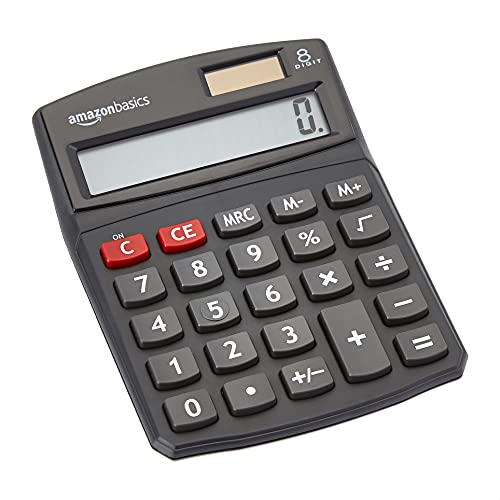
The Amazon Basics 8-Digit Desktop Calculator is the best basic calculator for everyday arithmetic at home, school, and the office. It does exactly six things, addition, subtraction, multiplication, division, percentage, and square root, and it does them with large, well-marked keys and a bright eight-digit LCD that is easy to read at a glance. There is nothing to learn and nothing to configure, which is the whole point.
Solar power with a battery backup keeps the calculator ready without charging or frequent battery changes, and the flat, compact body sits neatly on a desk, a countertop, or a kitchen table. At 2.7 ounces it is light enough to carry between rooms, and the simple plastic casing stands up to daily use.
What it lacks is just as important as what it offers. There is no memory function, no scientific mode, no tax key, and no printing, so it cannot handle algebra homework, financial analysis, or bookkeeping. That is a fair trade for a calculator that costs little and never gets in the way.
Who Should Skip It
Not everyone needs a dedicated calculator. If every calculation you do happens in a spreadsheet or a phone app, and you never sit an exam that bans phones, a calculator adds nothing to your desk. A graphing calculator is the wrong buy for a student whose classes only require algebra and trigonometry, and a financial calculator is the wrong buy for anyone who is not studying or working in finance. Printing calculators are office tools, and they make little sense in a home where no one keeps a paper audit trail. Match the calculator to the work, and if the work does not exist, save the money and the drawer space.
FAQ
Which calculator is best for high school students?
The Casio fx-991CW ClassWiz suits most high school students because it handles algebra, trigonometry, and statistics, shows expressions in textbook form, and is approved for the SAT, ACT, and AP exams. Students whose classes require graphing should buy the Texas Instruments TI-84 Plus CE instead, since teachers usually teach to that model.
Can I use a graphing calculator on the SAT and ACT?
Yes, most graphing calculators are allowed on the SAT and ACT, including the TI-84 Plus CE, as long as they do not have a computer algebra system. Calculators with CAS are banned on both exams. Always check the current approved list from the College Board or ACT before test day, since rules change and the exact model matters.
What is the difference between a scientific and a financial calculator?
A scientific calculator handles algebra, trigonometry, statistics, and equation solving, which suits math and science classes. A financial calculator adds dedicated keys for time value of money, cash flow analysis, amortization, and depreciation, which suits business and finance work. The two types overlap on basic arithmetic but are built for different jobs.
Do printing calculators need special paper?
Printing calculators use standard calculator paper rolls, and the Canon P23-DHV-3 ships with a paper roll in the box. Replacement rolls are widely available in office supply stores and come in the width the calculator requires. Check the roll width in the manual before ordering spares, since widths differ between models.
Final Verdict
The best calculator is the one that matches your work. For most students, the Casio fx-991CW ClassWiz is the right first purchase: it covers the full high school and early college math curriculum, it is approved for major exams, and it fits in a pocket. Students whose courses require graphing should step up to the Texas Instruments TI-84 Plus CE. Finance students and professionals should buy the Texas Instruments BA II Plus Professional, which is approved for the CFA exam. Offices that need a paper trail should buy the Canon P23-DHV-3, and anyone who only needs everyday arithmetic should buy the Amazon Basics 8-Digit Desktop Calculator.
Product and ASIN Reference
| Product | ASIN |
|---|---|
| Casio fx-991CW ClassWiz | B0BSJ33C4R |
| Texas Instruments TI-84 Plus CE | B00TFYYWQA |
| Texas Instruments BA II Plus Professional | B0001EMLZW |
| Canon P23-DHV-3 | B0746VB8D9 |
| Amazon Basics 8-Digit Desktop Calculator | B08DRS8MNF |
More from Amazon
Programs that pair well with the guide above. Offers and eligibility are set by Amazon and may change.
Set up recurring deliveries of everyday items on eligible products. Terms and savings are set by Amazon.
Explore Subscribe & SaveCollect the home and kitchen items you want in one registry that guests can shop from.
Create a wedding registryFree shipping on eligible items, Prime Video and more. Eligible new members can start with a free trial.
Start a Prime free trialAudiobooks and podcasts to listen to on the go. Eligible new members can start with a free trial.
Try Audible freeAs an Amazon Associate we earn from qualifying purchases.










Write Your Review
No reviews yet. Be the first to share your experience!