Disdik Picks is reader-supported. When you buy through links on our site, we may earn a commission at no extra cost to you. As an Amazon Associate, we earn from qualifying purchases. Learn more ›
Best Neck Stretchers: 5 Cervical Traction Picks for Home
Compare the best neck stretchers for home use, from foam cradles and inflatable collars to a door hammock and a knob-controlled traction unit.
Nov 19, 2026
Updated Nov 20, 2026
12 min read
0 views
The best neck stretcher for most people is a simple molded foam cradle: you lie on a firm surface, rest the curve of your neck on it, and let the weight of your head create a gentle stretch for about ten minutes. If you want adjustable force instead, inflatable collars let you dial in air pressure while seated, a door-anchored hammock cradles the back of the head, and one knob-controlled unit in this guide delivers measured traction up to 50 pounds. The five picks below cover each design, from a budget foam cradle to a premium supine traction machine, so you can match the device to your routine, your space, and the kind of stretch you prefer.
As an Amazon Associate, we earn from qualifying purchases.
Neck stretchers fall into four families, and the family matters more than any single feature. Passive foam cradles, like the RESTCLOUD below, support the neck in extension while gravity does the work. They ask nothing of you beyond lying still, they involve no moving parts, and the stretch stays mild because the only load is the weight of your own head. They suit daily posture care after long hours at a desk.
Inflatable collars work while you sit upright. You wrap the collar around your neck, secure the straps, and pump in air. The expanding chambers lift the chin and lengthen the neck, and you control the intensity by adding or releasing air. Because you can wear one at a desk or in a car seat, inflatables are the most flexible option for people who cannot set aside floor time.
Door-anchored hammocks take a third approach. A fabric sling cradles the back of your head and hangs from straps fixed to a door, so your head rests suspended while you lie on the floor. The pull stays gentle, and the whole kit packs flat, which makes it the natural travel pick.
Mechanical traction units sit at the top of the range. You lie on the device, settle your head into padded wedges, and turn a knob that draws the head carriage away from your shoulders with a measured force. The WeTrac in this guide reaches up to 50 pounds of traction and offers four incline angles, which puts it in a different league from foam and fabric. Choose this family when a clinician has suggested traction with controlled force and you want repeatable settings at home.
Whichever family you pick, check the fit numbers first. Collars list a neck circumference range, cradles list dimensions, and every maker publishes session guidance, usually around ten minutes at a time. Follow that guidance, build up gradually, and stop if you feel pain, numbness, or dizziness.
The RESTCLOUD is the reference point for foam cradle stretchers, and it earns the opening slot here for its plain, well-published design. The molded polyurethane foam body carries a V-shaped curvature with concave and convex contours and six massage nodes, shaped to match the natural C-curve of the cervical spine. You place it on a hard, flat surface such as a floor or a yoga mat, lie back so the curve of your neck settles into the cradle, and the weight of your head produces vertical and horizontal support with a curvature stretch.
There is nothing to inflate, charge, hang, or assemble, which makes the RESTCLOUD the easiest device in this guide to fold into a daily routine. The maker is equally clear about the limits: use it for ten minutes at a time, no more than 30 minutes across a day, and never as an ordinary pillow for a full night of sleep. Mild discomfort during the first sessions is described as normal while muscles and joints adjust, with a firm instruction to stop and consult a healthcare professional if pain, numbness, or dizziness appears. For desk workers whose stiffness comes from posture rather than injury, this budget cradle is the sensible first purchase.
The Siwei collar, sold under the brand initial S, is the classic inflatable design that defined this category on Amazon. The collar wraps around the neck and fastens with two hook-and-loop straps, and you then inflate the inner chamber to the level that feels supportive. Because the amount of air sets the amount of lift, the stretch is fully adjustable in the moment: add air for a firmer lift, release some for a gentler one.
Sizing is the detail to check before ordering. The listing states a fit range of 12 to 17 inches around the neck, which covers most adults but is worth confirming with a tape measure. The contact surface is a soft flocking fabric chosen for comfort against the skin, and the whole collar deflates flat when you are done, so it slides into a bag or suitcase without taking up meaningful space. No assembly is required, and the upright format means you can use it seated at a desk, in a recliner, or as a passenger on a long drive. As a budget inflatable with a published fit range and simple strap closure, it is the straightforward pick for anyone who wants traction while sitting up.
3. AUVON Inflatable Neck Stretcher
AUVON takes the inflatable collar in a more structured direction with a three-layer design. Where a single-chamber collar inflates as one balloon, the AUVON stacks three air layers in graduated sizes, so the collar builds height in stages as you pump. That staged lift gives finer control over how much lengthening you feel, and the listing offers the model in more than one size so the fit can match your neck rather than forcing one circumference on everyone.
The published figures are refreshingly concrete: the model number is NI3663, and the packaged unit measures 17.4 x 11 x 9.9 cm with a weight of 320 g, light enough to live in a desk drawer or a carry-on between uses. Like the Siwei, it works while you sit upright and deflates for storage, but the layered chambers and size choice make it the mid-range step up for buyers who found single-chamber collars too coarse in their adjustment. If you plan to wear an inflatable daily and want the inflation to feel progressive rather than all at once, this is the collar to shortlist.
Specs
Type: Inflatable neck stretcher collar
Model: NI3663
Design: Three-layer inflatable chambers in graduated sizes
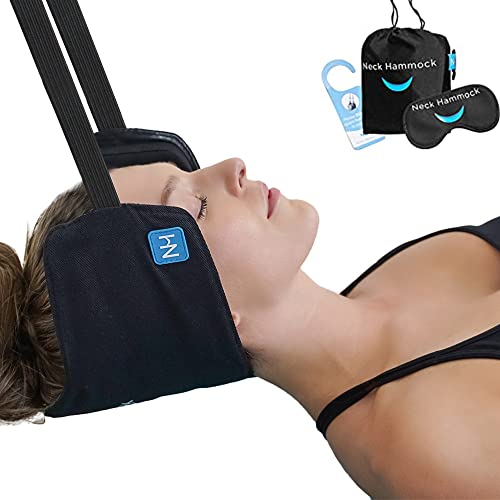
The Neck Hammock replaces foam and air with fabric and gravity. A padded sling cradles the back of your head, and adjustable straps measuring 100 cm anchor the sling to a door handle, a door jamb, or a sturdy railing. You lie on the floor, settle your head into the sling, and let it hang suspended. The result is a gentle, even pull with no pressure under the jaw, which is the detail that sets hammocks apart from collars and halters.
The device was developed by a doctor and a physical therapist, and the construction is deliberately simple: the sling and straps are polyester, there are no pumps or mechanisms to maintain, and the full kit packs flat enough to travel in a laptop bag. Setup takes moments once you have a suitable door, and strap length sets the height of the cradle, so you can tune how much of your head weight the sling carries. Choose the Neck Hammock if you want a supine stretch without lying on a firm foam block, or if you need a mid-range option that follows you between home, office, and hotel rooms.
5. iSTIM WeTrac Cervical Neck Traction Device
5. iSTIM WeTrac Cervical Neck Traction Device
Type: Supine mechanical traction unit
Traction force: Knob-controlled, up to 50 lb
Incline settings: 4 angles, 10, 13, 15, and 18 degrees
Session guidance: 10 minutes, 1 to 2 times per day
The WeTrac is the one true mechanical traction unit in this guide, and its published numbers show the gap. You lie on the unit, seat your head firmly against the adjustable neck wedges, and turn a knob that drives the traction carriage with a controllable force of up to 50 pounds. Four incline settings, at 10, 13, 15, and 18 degrees, let you set the angle of pull, and the maker recommends sessions of ten minutes, once or twice a day.
The hardware is correspondingly substantial: the unit weighs 9.26 pounds, ships in a package measuring 22.2 x 10.8 x 8.9 inches, and arrives ready to use with no assembly required. A travel bag is included, though at this weight it is luggage rather than a carry-on extra. The design is patented and made in Taiwan by Everyway Medical. The maker also prints a firm operational note: your head must be fully seated before you turn the knob, and the knob should never be turned while the device is releasing. As the premium pick, the WeTrac suits readers who have discussed traction with a clinician and want measured, repeatable force instead of the approximate stretch of foam, air, or fabric.
Safety Notes Before You Stretch
Every maker in this guide prints the same core warnings, and they deserve a direct summary. These devices are sold to support cervical spine health and everyday comfort; they are not presented as treatments for diagnosed conditions. Begin with shorter sessions than the maximum, increase gradually, and treat pain, numbness, tingling, or dizziness as a stop signal rather than something to push through. Anyone with a recent neck injury, a diagnosed disc problem, prior neck surgery, or symptoms that travel into the arms should speak with a doctor or physical therapist before using any traction device, including the gentle foam cradle. Session limits exist for a reason: the RESTCLOUD caps use at 30 minutes a day, and the WeTrac maker recommends ten-minute sessions once or twice daily. More time under stretch is not better.
FAQ
How long should a neck stretcher session last?
Most makers in this guide land on about ten minutes per session. The RESTCLOUD advises ten minutes at a time with a daily ceiling of 30 minutes, and the WeTrac maker recommends ten minutes once or twice a day. Build up from shorter sessions, and keep the device off your bed, since none of these products is designed for overnight use.
Which type of neck stretcher suits desk workers with posture-related stiffness?
A passive foam cradle such as the RESTCLOUD is the usual fit, because posture-related stiffness responds well to a gentle daily stretch and the cradle asks for nothing but floor space and ten minutes. If you cannot get to the floor during the day, an inflatable collar like the Siwei or the AUVON delivers an adjustable stretch while you sit at your desk.
Can a neck stretcher replace care from a doctor or physical therapist?
No. These are home comfort and posture-support devices, and the makers state plainly that they are not treatments for cervical conditions. Persistent pain, symptoms that spread into the shoulders or arms, or any history of neck injury calls for a professional assessment first, and a clinician can also tell you whether measured traction, like the WeTrac provides, belongs in your plan.
Who should skip cervical traction devices?
Skip traction, or clear it with a clinician first, if you have a recent neck injury, a diagnosed herniated disc, prior neck surgery, spinal instability, or unexplained numbness and weakness. During any session, pain, dizziness, or tingling is a signal to stop at once. When in doubt, the conservative choice is to get assessed before you stretch.
Conclusion
Match the mechanism to your day and the choice makes itself. The RESTCLOUD foam cradle is the budget default for gentle, daily posture care. The Siwei collar adds adjustable air-driven lift in an upright position, and the AUVON refines that format with three graduated layers and size options. The Original Neck Hammock trades the floor block for a suspended fabric cradle that travels anywhere. The iSTIM WeTrac stands alone as the premium mechanical unit, with knob-controlled force up to 50 pounds and four incline angles for readers who need measured traction at home. Whichever you choose, respect the published session limits, build up slowly, and let comfort, not intensity, set the pace.
D
Disdik Picks Editorial Team
We compare specs, materials and verified owner reviews before a product earns a spot. Rankings are never paid.
Affiliate disclosure. As an Amazon Associate we earn from qualifying purchases at no extra cost to you. Prices accurate as of the date shown.
Find the best razors for women for legs, underarms and sensitive skin. Compare five cartridge, disposable and shave-kit options and choose a smooth shave.
We compared the best comforters for every sleeper, from light all-season inserts to plush king-size picks, so you can find the right warmth for your bed.
We compared the best calculators for students, professionals, and home offices, covering scientific, graphing, financial, printing, and desktop models.


 5. iSTIM WeTrac Cervical Neck Traction Device










Write Your Review
No reviews yet. Be the first to share your experience!