Disdik Picks is reader-supported. When you buy through links on our site, we may earn a commission at no extra cost to you. As an Amazon Associate, we earn from qualifying purchases. Learn more ›
Best Blood Pressure Monitors: 5 Picks for Home Readings
Compare the best blood pressure monitors for home use, from a one-piece Omron design to a complete Greater Goods kit, with cuff, memory and app details.
Nov 19, 2026
Updated Nov 20, 2026
12 min read
0 views
Compare the best blood pressure monitors for home use, from a one-piece Omron design to a complete Greater Goods kit, with cuff, memory and app details.
⭐ Key Takeaways
Quick answer: Our top pick is Omron Evolv Wireless Upper Arm Blood Pressure Monitor (BP7000), with Omron 5 Series Wireless Upper Arm Blood Pressure Monitor (BP7250) as a strong alternative.
The best blood pressure monitors for home use share three traits: an upper arm cuff that fits your arm properly, clinical validation behind the measurement, and a memory or app system that makes your readings easy to share with a clinician. The five monitors below cover the main ways people track at home, from a one-piece Omron unit with no tubes at all, to a complete boxed kit with a wall adapter and travel case, to a screen-free design that lives entirely in a phone app. Each one is a dedicated blood pressure device rather than a general wellness gadget, and each publishes the cuff range, memory capacity, and power details that matter when you compare them side by side.
As an Amazon Associate, we earn from qualifying purchases.
Table of Contents
How to Choose a Blood Pressure Monitor
Omron Evolv Wireless Upper Arm Blood Pressure Monitor (BP7000)
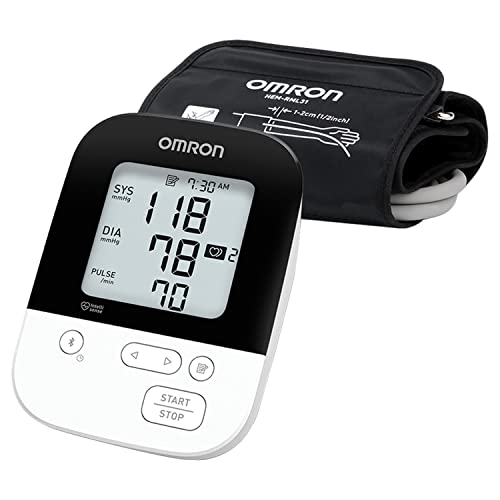
Omron 5 Series Wireless Upper Arm Blood Pressure Monitor (BP7250)
Greater Goods Blood Pressure Monitor Kit (0602)
iHealth Track Smart Upper Arm Blood Pressure Monitor (KN-550BT)
QardioArm Wireless Blood Pressure Monitor (A100)
Which Monitor Fits Your Routine
Frequently Asked Questions
Conclusion
Product and ASIN Reference
How to Choose a Blood Pressure Monitor
Begin with the cuff, not the screen. An upper arm cuff gives the most dependable home readings, and it only works when it matches your arm. Measure around the middle of your upper arm and compare the number with the cuff range in the listing. Most standard cuffs cover arms from about 9 to 17 inches, while compact designs may top out lower. A cuff that is too small tends to read high, and a cuff that is too loose can fail to complete a measurement at all.
Look for validation you can check. Reputable monitors state that they are clinically validated or cleared by a regulator for home measurement, and many appear on independent validated device listings. That backing matters more than extra display modes, because the whole point of home tracking is a number your clinician can act on.
Decide how your readings will be kept. Simple monitors hold a limited set of readings on the device itself, which suits one person taking occasional checks. Two-user memory helps couples share one unit without mixing numbers. Bluetooth models move everything into an app, where storage is effectively unlimited and trend charts and file exports make it easier to hand a tidy history to a doctor.
Think about power and daily friction. Battery-powered monitors with included cells are ready the moment the box opens. A kit with a wall adapter removes battery swaps from the routine. One-piece and roll-up designs remove tubes and separate display units, which makes a monitor easier to keep on a shelf and easier to pack for travel.
Omron Evolv Wireless Upper Arm Blood Pressure Monitor (BP7000)
Top Pick
Omron Evolv Wireless Upper Arm Blood Pressure Monitor (BP7000)
Model: BP7000
Design: one-piece monitor and cuff, no separate display unit or air tube
Cuff fit: upper arms 9 to 17 inches in circumference
Connectivity: Bluetooth with the Omron Connect app for iOS and Android
The Evolv removes the most fiddly part of home measurement: the separate monitor box and its air tube. The display, pump, and cuff are built into a single wrap-around unit, so you slide it onto your upper arm, press one button, and read the result on the unit itself. Omron calls the design tubeless, and the published dimensions show why it travels well, at roughly the size of a thick paperback. Bluetooth sends each reading to the Omron Connect app, where storage is unlimited and trends can be shared with a clinician as a file.
This is the premium pick in the group for people who measure daily and want the fewest steps between sitting down and having a logged reading. The cuff covers the common 9 to 17 inch arm range, and the model carries clinical validation from a brand long associated with home blood pressure measurement. The trade-off is that the experience leans on the app for history, since the unit itself is built around syncing rather than deep on-device memory.
Omron 5 Series Wireless Upper Arm Blood Pressure Monitor (BP7250)
Runner-Up
Omron 5 Series Wireless Upper Arm Blood Pressure Monitor (BP7250)
Model: BP7250
Memory: 60 readings for 1 user on the device; unlimited in the Omron Connect app
Cuff fit: wide-range D-ring cuff for arms 9 to 17 inches
Connectivity: Bluetooth with the Omron Connect app; Alexa skill supported
The 5 Series is the traditional layout done thoroughly: a desktop display unit, a wide-range D-ring cuff, and Bluetooth for anyone who wants app records without giving up a full on-device memory. It holds 60 readings for one user on the unit itself, which covers about two months of once-daily checks before the oldest numbers roll off, and pairing with the Omron Connect app lifts that limit entirely. Omron publishes that its Advanced Accuracy approach measures five times more data points, which is the company’s stated method for keeping readings steady when breathing or slight movement would otherwise disturb them.
For a single person building a long home record, this mid-range model is the balanced choice in the lineup. The cuff spans 9 to 17 inches, the unit runs on four AA batteries that come in the box, and an AC adapter is supported if you would rather park it on a nightstand. It also works with the Omron Health skill for Alexa-enabled devices, so readings can be pulled up by voice once the account is linked.
Greater Goods Blood Pressure Monitor Kit (0602)
Greater Goods Blood Pressure Monitor Kit (0602)
Model: 0602
Memory: 60 readings each for 2 users
Cuff fit: comfort cuff for arms 8.75 to 16.5 inches
Display: digital LCD with blue backlight, viewing area 60 x 40.5 mm
Greater Goods sells this monitor as a complete kit rather than a bare device, and the box contents are the headline: the monitor, a comfort cuff, four AAA batteries, a wall adapter, and a travel case all arrive together, so nothing else needs to be ordered before the first reading. The monitor itself is a straightforward upper arm unit with a blue backlit LCD, memory for two users at 60 readings each, and an irregular heartbeat indicator worked into the normal measurement cycle.
That two-user memory makes this mid-range kit the natural household pick, especially for couples who both track and want their numbers kept apart on one shared device. The cuff fits arms from 8.75 to 16.5 inches, the published measurement range covers pressure from 40 to 230 mmHg with pulse from 40 to 199 beats per minute, and the company backs the kit with a two-year limited warranty. There is no Bluetooth or app here, which many buyers will read as a benefit: readings stay on the device, and the routine is simply cuff, button, result.
iHealth Track Smart Upper Arm Blood Pressure Monitor (KN-550BT)
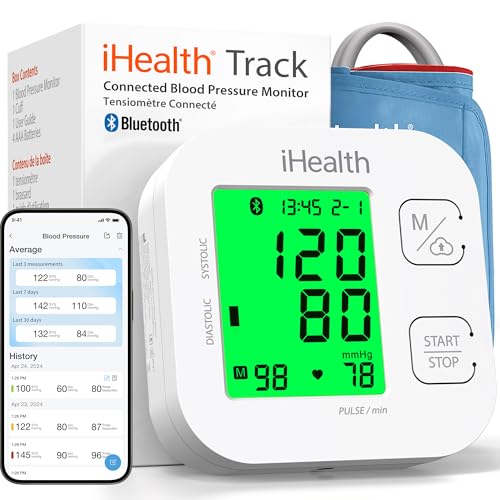
iHealth Track Smart Upper Arm Blood Pressure Monitor (KN-550BT)
Model: KN-550BT
Memory: 99 readings on the device; unlimited in the iHealth MyVitals app
Cuff fit: wide range cuff for arms 8.7 to 16.5 inches (22 to 42 cm)
Display: large multi-color backlit display with green, yellow, and red coding
The iHealth Track is the budget-friendly connected option, built around a large multi-color backlit display that codes each result green, yellow, or red so the category of a reading is visible at a glance. It stores 99 readings on the device, far more than most simple monitors, and Bluetooth moves the full history into the iHealth MyVitals app for unlimited storage on iOS and Android phones. The listing states the monitor is FDA cleared and meets ESH 2010 performance standards, and it flags heart rhythm disturbances with a warning symbol after a measurement.
For buyers who want app tracking without moving into premium territory, this is the efficient route. The wide range cuff covers arms from 8.7 to 16.5 inches, the unit is compact at just under four inches square, and four AAA batteries are included. Two-button operation keeps the routine simple, and the color coding is genuinely useful for anyone who has been told to watch which zone their readings fall into rather than memorize threshold numbers.
QardioArm Wireless Blood Pressure Monitor (A100)
QardioArm Wireless Blood Pressure Monitor (A100)
Model: A100
Design: screen-free unit that rolls up inside its cuff; phone app acts as the display
Cuff fit: upper arms 8.7 to 14.6 inches in circumference
Measurement range: pressure 40 to 250 mmHg; pulse 40 to 200 beats per minute
QardioArm takes the opposite approach to a big display: it has no screen at all. The compact unit rolls up inside its own cuff, every reading appears in the Qardio app, and the whole device is about the size of a sunglasses case. It is FDA cleared and clinically validated, measures across a published range of 40 to 250 mmHg with pulse from 40 to 200 beats per minute, and the app supports multiple users, reminders, and an average of three readings taken in a row for people whose clinician asks for averaged numbers.
This premium design pick suits travelers and anyone who dislikes medical-looking hardware on the counter. The cuff fits arms from 8.7 to 14.6 inches, which is a narrower range than the others here, so larger arms should look at the Omron or Greater Goods cuffs instead. Four AAA batteries are supplied, Bluetooth pairing covers iOS, Android, and Apple Watch, and because the phone is the display, a charged phone becomes part of the measuring routine.
Which Monitor Fits Your Routine
Daily measurers who want the fewest physical steps should look at the Omron Evolv, since the cuff and monitor are one piece and every result lands in the app automatically. A single user who wants deep on-device memory plus optional app sync is best matched by the Omron 5 Series. Households with two people tracking on one device should choose the Greater Goods kit, the only pick here with true two-user memory and a wall adapter in the box. Anyone watching spending while still wanting Bluetooth records will find the iHealth Track covers that ground, and frequent travelers who value a tiny footprint above a built-in screen are the audience for the QardioArm.
Across all five, the habits around the device matter as much as the device itself. Sit with your back supported and feet flat, rest for a few quiet minutes first, keep the cuff on a bare arm at heart level, and take readings at the same times each day. Bring the stored history to appointments rather than single numbers, and let a clinician interpret what the trend means for you.
Frequently Asked Questions
Are upper arm monitors better than wrist monitors for home use?
Upper arm models are the widely recommended format for home tracking because the cuff sits at heart level on the brachial artery, which removes much of the positioning guesswork. Wrist devices can work when an upper arm cuff does not fit, but they are more sensitive to wrist height. All five monitors in this guide use upper arm cuffs.
How do I choose the right cuff size for my arm?
Measure the circumference of your upper arm at its midpoint and match that number to the cuff range printed in the listing. A cuff that is too small can push readings higher than they should be, while one that is too large may fail to inflate correctly. If your arm falls near the top of a standard range, pick a model whose cuff extends to 17 inches.
Do I need a smartphone to use a connected blood pressure monitor?
Not always. The Omron 5 Series and iHealth Track both show readings on their own displays and keep memory on the device, so a phone only adds long-term storage and charts. The QardioArm is the exception in this group, since it has no screen and relies on its app for every reading.
How often should I take readings at home?
Follow the schedule your clinician gives you, since the right pattern depends on why you are tracking. A common routine is two readings a minute apart, morning and evening, at the same times each day. Consistency in timing and posture makes the stored trend far more useful than occasional extra checks.
Conclusion
The best blood pressure monitor is the one whose cuff fits your arm, whose validation you can verify, and whose routine you will actually repeat every day. The Omron Evolv leads on convenience, the Omron 5 Series on balanced features, the Greater Goods kit on shared household use, the iHealth Track on connected value, and the QardioArm on compact design. Match the monitor to your household and your clinician’s requests, keep your technique consistent, and the numbers you collect will be worth sharing.
D
Disdik Picks Editorial Team
We compare specs, materials and verified owner reviews before a product earns a spot. Rankings are never paid.
Affiliate disclosure. As an Amazon Associate we earn from qualifying purchases at no extra cost to you. Prices accurate as of the date shown.
Find the best razors for women for legs, underarms and sensitive skin. Compare five cartridge, disposable and shave-kit options and choose a smooth shave.
We compared the best comforters for every sleeper, from light all-season inserts to plush king-size picks, so you can find the right warmth for your bed.
We compared the best calculators for students, professionals, and home offices, covering scientific, graphing, financial, printing, and desktop models.



 iHealth Track Smart Upper Arm Blood Pressure Monitor (KN-550BT)
 QardioArm Wireless Blood Pressure Monitor (A100)










Write Your Review
No reviews yet. Be the first to share your experience!