Disdik Picks is reader-supported. When you buy through links on our site, we may earn a commission at no extra cost to you. As an Amazon Associate, we earn from qualifying purchases. Learn more ›
Best Weighted Blankets for Kids: Safe Picks by Weight
Compare the best weighted blankets for kids by weight, size and fabric, plus key safety rules: correct sizing, no use under three, and pediatrician advice.
Compare the best weighted blankets for kids by weight, size and fabric, plus key safety rules: correct sizing, no use under three, and pediatrician advice.
⭐ Key Takeaways
Quick answer: Our top pick is hazli Super-Soft Kids Weighted Blanket, with Harkla Kids Weighted Blanket as a strong alternative.
A weighted blanket for a child is not a smaller adult blanket. The weight has to match the child’s body, the size has to stay on the bed instead of sliding onto the floor, and the construction has to keep its fill sealed inside small, even pockets. Get any of those wrong and the blanket is either useless or unsafe.
This guide compares five kids’ weighted blankets sold on Amazon, from a light 5 lb starter size up to a 10 lb blanket for bigger kids. Every pick follows the standard sizing guidance used by makers: choose a blanket that weighs roughly a tenth of the child’s body weight. None of these blankets is for a child under three, none is for an infant, and none should be used by a child who cannot lift and remove the blanket on their own.
As an Amazon Associate, we earn from qualifying purchases.
Quick Answer
For most families, the hazli Super-Soft Kids Weighted Blanket is the simplest start: a 5 lb blanket, 36 by 48 inches, sized for younger school-age children. Bigger kids should look at the TONGDADA 10 lb blanket, hot sleepers at the cotton Luna or YnM. Match weight to roughly a tenth of your child’s body weight, never use one under age three, and ask your pediatrician first.
How to Choose
Start with weight, because it decides everything else. Maker guidance for children is consistent: the blanket should weigh about a tenth of the child’s body weight, sometimes stated as a tenth plus one pound. A child who weighs around 50 pounds lands near a 5 lb blanket; a child near 70 pounds lands near 7 lb; a child near 100 pounds lands near 10 lb. Going heavier than the guideline does not make the blanket work better. It makes it harder for the child to move, reposition, or push off, which is exactly what they must be able to do.
Age matters as much as weight. Weighted blankets are not for children under three years old, and they are never for infants. The American Academy of Pediatrics advises against weighted blankets, swaddles, and sleep sacks for infant sleep, and federal safety officials recommend against weighted sleep products for babies. For older children, talk to your pediatrician before the first use, especially if your child has breathing problems, sleep apnea, reflux, or limited mobility. Some families use a weighted blanket as part of a bedtime routine, but it is a comfort product, not a treatment, and it should never be presented as one.
Construction is the next check. Look for small quilted pockets that hold the fill in place, tight stitching, and glass beads rather than plastic pellets, because glass beads are smaller, denser, and distribute more evenly. Avoid any design with a zippered cover that a child can open and climb inside; a child must never be able to get into the blanket. A removable, washable cover with corner ties is a practical plus, since most weighted blankets themselves should be washed gently and infrequently.
Finally, check size. A kids’ weighted blanket should cover the child and the top of the bed, not hang over the edges, because overhang pulls the weight off the body and onto the mattress. Twin-bed sizes around 36 by 48 inches suit younger children; 41 by 60 inches suits older kids. Supervise the first several uses, confirm your child can remove the blanket easily, and stop using it if they cannot.
The hazli blanket is the lightest pick here at 5 lb, sized 36 by 48 inches, which makes it a sensible first weighted blanket for a younger school-age child whose body weight puts them near the 5 lb mark. One side uses a smooth microfiber and the other a dotted minky surface, so a child who prefers one texture can simply flip it over.
The fill is glass beads held in quilted compartments, and the listing describes the blanket as breathable rather than heavily insulated, which suits kids who run warm. Because it is the smallest blanket in this roundup, check the size against your child’s height before ordering; taller children will outgrow the coverage quickly even if the weight still fits.
Harkla is a brand built around children’s sensory products, and its kids’ blanket pairs a cotton outer layer with a soft minky inner layer in a 5 lb weight. The lavender colorway is one of several, and the construction uses glass bead fill sewn into pockets so the weight stays spread across the blanket instead of pooling at one end.
At 5 lb, this is again a blanket for younger children rather than tweens. Harkla’s own sizing guidance follows the same tenth-of-body-weight rule, so treat the blanket as matched to a child of roughly 50 pounds who can move it and remove it without help. The two-sided design is the main reason to pick it over the hazli: cotton on one side sleeps cooler than an all-minky surface.
The Luna blanket is the pick for families who want natural fabric against the skin. It uses a cotton shell rather than microfiber or minky, with glass bead fill distributed through quilted stitching, and the materials carry OEKO-TEX certification, which means the components have been checked for harmful substances.
Luna sells this line in sizes for both kids and adults, so read the size and weight on the listing carefully and order the child-appropriate combination, not the adult one. Cotton also breathes better than synthetic plush, which makes this the strongest option here for a child who kicks off ordinary blankets because they overheat. It is not the softest-feeling option, so a child who wants a plush surface may prefer a minky pick with a cotton duvet cover added.
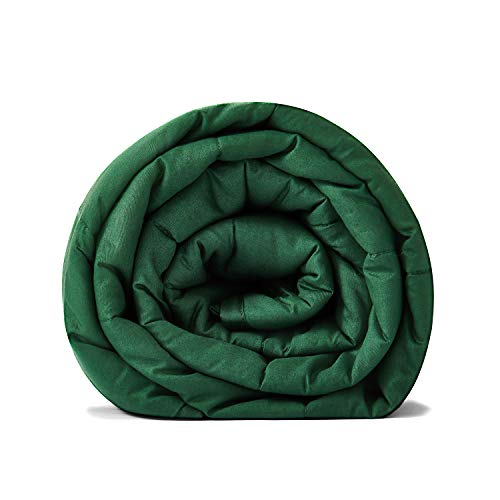
Most kids’ weighted blankets stop at 7 lb, which leaves bigger children and young tweens underserved. The TONGDADA blanket fills that gap at 10 lb in a 40 by 60 inch size, shown here in dark green. Following the tenth-of-body-weight guideline, it is aimed at a child of roughly 100 pounds, and it would be far too heavy for a small child, so match it to the child, not to the bed.
The blanket uses glass bead fill in stitched compartments and a soft outer fabric with a printed design, which makes it feel more like ordinary bedding than a plain therapeutic-looking throw. Because of its weight, plan on a duvet cover to stretch the time between washes, and confirm your washing machine is rated for the load before laundering it at home. For the right-sized child, this is the most straightforward step up from the 5 and 7 lb class.
YnM is one of the best-known names in weighted blankets, and its kids’ model uses the brand’s seven-layer construction with glass beads locked into small gridded compartments. The 7 lb blanket measures 41 by 60 inches in the navy colorway, which places it between the 5 lb starters and the 10 lb TONGDADA for a child of roughly 70 pounds.
The cotton fabric is OEKO-TEX certified, and the small pocket size is the detail that matters most in daily use: beads shift less, so the weight stays even from corner to corner. YnM includes loops for tying the blanket inside a duvet cover, sold separately, which is the easiest way to keep it clean. If your child falls between the common sizes, this mid-weight option is the natural fit.
Specs
Spec
Detail
Blanket weight
7 lb
Dimensions
41 x 60 inches
Color shown
Navy
Construction
Seven-layer, gridded pockets
Fill
Glass beads in cotton shell
Who Should Skip It
Skip weighted blankets entirely for any child under three, for infants of any age, and for any child who cannot lift the blanket and get out from under it unaided. Skip them if your child has sleep apnea, significant reflux, breathing difficulties, or mobility limitations, unless your pediatrician has specifically said otherwise. Skip the category if you are hoping it will treat a medical or developmental condition; these are comfort products with no established therapeutic claims. And skip any blanket, at any weight, that your child finds distressing rather than settling.
FAQ
How heavy should a kids’ weighted blanket be?
Use the maker guideline of roughly a tenth of the child’s body weight, sometimes stated as a tenth plus one pound. A 50 lb child points to about 5 lb, a 70 lb child to about 7 lb, and a 100 lb child to about 10 lb. When between sizes, choose the lighter blanket, and confirm the child can remove it easily.
Are weighted blankets safe for toddlers?
No. Weighted blankets are not for children under three years old, and weighted products should never be used for infant sleep. The American Academy of Pediatrics advises against weighted blankets, swaddles, and sleep sacks for infants, and federal safety officials recommend against weighted infant sleep products. For children over three, ask your pediatrician before starting.
Can a weighted blanket help my child sleep through the night?
Some families use one as part of a calming bedtime routine, and some children simply like the feel of even pressure. That is the extent of what can honestly be said. A weighted blanket is not a treatment for anxiety, autism, ADHD, or any sleep disorder, and no child should be given one with that expectation. Raise persistent sleep problems with your pediatrician instead.
How do I wash a kids’ weighted blanket?
Check the care label first, because methods vary by weight and fabric. Lighter blankets can usually be machine washed on a gentle cycle and dried on low, while heavier ones may need a commercial machine or spot cleaning. Using a removable duvet cover, washed on its own, is the simplest routine. Inspect seams regularly, and stop using the blanket if beads leak.
Final Verdict
Match the blanket to the child, not the other way around. The hazli 5 lb blanket is the easiest first step for a younger child, the Luna and YnM cotton models suit kids who sleep hot, the Harkla adds a plush minky side, and the TONGDADA 10 lb covers bigger kids the smaller sizes leave out. Keep the weight near a tenth of body weight, stay above age three, and get your pediatrician’s view before the first night.
D
Disdik Picks Editorial Team
We compare specs, materials and verified owner reviews before a product earns a spot. Rankings are never paid.
Affiliate disclosure. As an Amazon Associate we earn from qualifying purchases at no extra cost to you. Prices accurate as of the date shown.
Find the best razors for women for legs, underarms and sensitive skin. Compare five cartridge, disposable and shave-kit options and choose a smooth shave.
We compared the best comforters for every sleeper, from light all-season inserts to plush king-size picks, so you can find the right warmth for your bed.
We compared the best calculators for students, professionals, and home offices, covering scientific, graphing, financial, printing, and desktop models.

 hazli Super-Soft Kids Weighted Blanket
 Harkla Kids Weighted Blanket
 Luna Cotton Weighted Blanket for Kids and Adults
 TONGDADA Kids Weighted Blanket
 YnM Kids Weighted Blanket










Write Your Review
No reviews yet. Be the first to share your experience!