Disdik Picks is reader-supported. When you buy through links on our site, we may earn a commission at no extra cost to you. As an Amazon Associate, we earn from qualifying purchases. Learn more ›
Best Baby Swings for Infants: Soothing Motions Compared
Compare the best baby swings and rockers for infants, with side-to-side and multi-motion settings, several speeds, music and portable folding frames.
Nov 19, 2026
Updated Nov 20, 2026
10 min read
6 views
A good baby swing buys tired arms a break and gives a fussy newborn a steady, rhythmic motion that feels familiar from the womb. Swings differ more than they first appear: some sway side to side, others glide front to back, rotate between directions, or imitate the movements of a car ride or a parent’s arms. Speed range, seat recline, sounds, and how small the frame folds all shape daily life with one. This guide compares five popular swings across motion types and portability, explains the safety limits every parent should know, and helps you pick the right soother for your space and your baby.
As an Amazon Associate, we earn from qualifying purchases.
Quick Answer
The Graco Simple Sway is the dependable classic, with six speeds and two-way power for most nurseries. The Graco Soothe and Sway LX adds a rotating seat and a portable bouncer in one frame. The 4moms MamaRoo offers five parent-inspired motions with app control. For travel and small rooms, the Ingenuity Comfort 2 Go folds flat, and the Ingenuity Anyway Sway rotates for multi-direction soothing in a portable frame.
How to Choose
Motion type comes first, because babies have opinions. Traditional swings move front to back like a playground swing or side to side like a cradle. Side-to-side motion feels gentler to many newborns, while front-to-back gives a stronger ride that older babies often enjoy. Multi-direction seats rotate so you can try both, and premium motion seats imitate several parent-held movements, which helps when one baby rejects every standard pattern.
Speed range matters as much as motion style. Look for at least five or six settings, because the right speed for a sleepy newborn is far slower than the one that entertains an alert four-month-old. Timers help too: a swing that shuts off after thirty or sixty minutes saves batteries and avoids waking a baby with sudden silence hours later.
Power source shapes placement. Plug-in swings run indefinitely but tether you to an outlet; battery models move anywhere but consume batteries quickly unless they use efficient drive technology. Some swings offer both. Vibration, music, and nature sounds are useful extras, though many babies care about motion far more than melodies.
Portability splits the category. Full-size frames stay in one room and offer the widest weight ranges, while portable swings fold flat, weigh far less, and suit travel, small apartments, and moving between floors. Finally, respect the limits: most swings serve babies up to about twenty to thirty pounds, and use must stop when a baby tries to climb out or sit up unassisted. Swings are for supervised, awake-or-dozing time, never for overnight or unsupervised sleep.
The Simple Sway is the swing many grandparents picture: a sturdy frame, a deep padded seat, and a gentle side-to-side motion with six speeds. It plugs into the wall for unlimited run time or runs on batteries when an outlet is not handy, and it adds two-speed vibration in the seat plus a library of songs and nature sounds to layer over the motion.
Specs
Feature
Detail
Motion
Side-to-side sway
Speeds
Six swing speeds
Power
Wall plug or batteries
Extras
Two-speed vibration, songs and sounds
Weight range
Wide range from small newborn upward
The seat is roomy and well padded, with a head support for young babies and a five-point harness to keep them secure. The frame footprint is smaller than many full-size swings, which helps in apartments, and the weight limit reaches higher than most competitors, extending its useful life well past the newborn stage. Controls are simple dials and buttons that anyone can run at 3 a.m.
It does one motion only, so a baby who insists on front-to-back swinging will not be converted here. The frame does not fold, making it a leave-it-up fixture. For a proven, no-drama swing that simply works every day, the Simple Sway remains the category’s safe pair of hands.
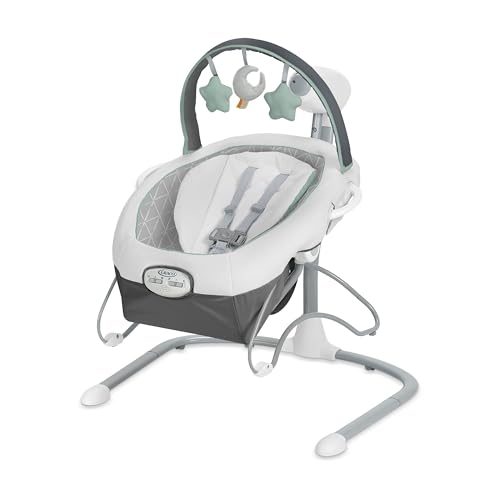
The Soothe and Sway LX solves the direction question by letting the seat rotate. Turn it one way for side-to-side cradling, turn it the other for front-to-back swinging, and adjust between three swing speeds and two vibration settings. When you need the baby with you in another room, the seat lifts off the frame and works as a portable bouncer with its own soothing vibration.
Specs
Feature
Detail
Motion
Multi-direction, rotating seat
Modes
Swing plus removable portable bouncer
Speeds
Three swing speeds
Vibration
Two-speed seat vibration
Extras
Songs, sounds, and plush toys
That two-in-one design is the real value here: one purchase covers both the stationary soother and the movable seat, which is ideal for smaller homes where two separate products would crowd the floor. The seat is plush, the harness is a secure five-point design, and the frame plugs in for the swing motion so batteries are only needed for the bouncer’s vibration.
Three speeds is fewer than some rivals offer, and the bouncer mode is manual rather than motorized, so it bounces with your hand or foot rather than on its own. Neither drawback undermines the concept. For parents who cannot decide which motion their baby will love, the Soothe and Sway LX hedges the bet elegantly.
The MamaRoo does not swing on an arc at all. Its seat bounces and sways in five distinct patterns modeled on how parents actually move: car ride, kangaroo, tree swing, rock a bye, and wave. Each motion runs at five speeds, the seat reclines through several positions from upright play to laid-back rest, and Bluetooth control lets you change settings from your phone across the room.
Specs
Feature
Detail
Motion
Five unique motions
Speeds
Five speeds per motion
Control
Bluetooth app and onboard controls
Seat
Adjustable recline, machine-washable fabrics
Extras
Built-in sounds, MP3 plug-in
The footprint is dramatically smaller than a frame swing, with no overhead bar, which makes the MamaRoo the easiest premium seat to fit into a living room corner. The toy mobile uses reversible, high-contrast balls designed for developing vision. Fabrics zip off for washing, an essential feature after the first major spit-up.
It runs on wall power only, so placement follows your outlets, and the price sits at the top of the category. The weight limit also arrives sooner than on the biggest frame swings. For babies who fuss in ordinary swings but settle in arms or the car, the MamaRoo’s varied motions give you five more chances to find the one that works.
The Comfort 2 Go is the travel-ready member of this group. It folds nearly flat, weighs little, and sets up in moments, so it moves between rooms, houses, and car trunks without a production. Despite the compact frame it offers six swing speeds, a set of melodies with volume control, and a pivoting toy bar with plush toys to keep the baby company.
Specs
Feature
Detail
Motion
Side-to-side portable swing
Speeds
Six swing speeds
Power
Battery powered with efficient drive
Frame
Folds flat for travel and storage
Extras
Music with volume control, toy bar
Ingenuity’s drive technology stretches battery life far beyond older portable swings, so the battery-only design is less of a burden than it sounds. The seat pad is cushioned and machine washable, the harness is a proper five-point design, and the low frame keeps the baby close to the floor, which many parents prefer for a portable seat used in kitchens and living rooms.
Portable swings cap out at a lower weight than full-size frames, so this is a first-months product rather than a long-term one, and there is no plug-in option. As a second swing for travel, grandparents, or daytime use downstairs, though, the Comfort 2 Go covers the brief beautifully.
The Anyway Sway brings the rotating-seat idea into a portable, folding frame. The seat turns so the baby can sway side to side or front to back, and it doubles as a stationary infant seat when the motion is locked. Five speeds, gentle vibrations, and a library of melodies and nature sounds round out the soothing menu, all in a package that folds for storage.
Specs
Feature
Detail
Motion
Rotating seat, two directions
Speeds
Five swing speeds
Modes
Swing and locked infant seat
Frame
Foldable portable design
Extras
Vibrations, melodies, and nature sounds
Flexibility is the theme: direction, speed, vibration, and sound can be combined until you find the recipe your baby prefers, and the seat’s two-in-one nature means it stays useful for quiet sitting even when swinging loses its charm. Power options include a USB cord, which suits modern homes and travel adapters better than a drawer full of batteries.
Like other portables, it serves the lower weight range and asks you to stop once the baby gets bigger or more mobile. The fold and the rotation mechanism also mean a few more moving parts to keep clean. For families who want multi-direction soothing without a full-size frame, the Anyway Sway is the clever compromise.
Who Should Skip It
Skip a swing if your baby is already near the weight limit or is trying to sit up and climb, since the useful window will be too short to justify the purchase. Parents short on floor space should skip full-size frames and go straight to a folding portable. If your baby will only ever be soothed in arms or a carrier, borrow a swing before buying one. And everyone should skip using any swing for overnight sleep or leaving a sleeping baby unattended in one; move a sleeping baby to a firm, flat crib or bassinet.
FAQ
When can a newborn start using a baby swing?
Most swings accept babies from birth when they meet the minimum weight, using the deepest recline and the included newborn insert or head support. Keep early sessions short, always use the harness, and stop the motion once the baby falls asleep so you can move them to a flat sleep surface.
How long can a baby stay in a swing each day?
Short, supervised sessions are best. Many experts suggest limiting total swing time to about an hour a day in stretches of twenty to thirty minutes, since babies also need floor time to build strength and head control. Treat the swing as a helper, not a container.
What is the difference between side-to-side and front-to-back swings?
Side-to-side swings rock like a cradle and feel gentle, which suits many newborns. Front-to-back swings follow the classic playground arc and feel more pronounced. Babies often prefer one over the other, which is why rotating seats that offer both directions are popular.
When should I stop using a baby swing?
Stop when your baby reaches the weight limit, tries to climb out, or can sit up unassisted, whichever happens first. Those milestones usually arrive well before the first birthday, and continuing past them risks tipping or falls.
Final Verdict
Pick the Graco Simple Sway for a reliable full-size swing, the Graco Soothe and Sway LX if you want two directions plus a bouncer, and the 4moms MamaRoo when your baby needs motions that mimic real arms. Choose the Ingenuity Comfort 2 Go for travel and tight spaces, or the Ingenuity Anyway Sway for portable multi-direction soothing. Match the motion to your baby, respect the limits, and a swing becomes the extra pair of arms every new parent wishes for.
D
Disdik Picks Editorial Team
We compare specs, materials and verified owner reviews before a product earns a spot. Rankings are never paid.
Affiliate disclosure. As an Amazon Associate we earn from qualifying purchases at no extra cost to you. Prices accurate as of the date shown.
Find the best razors for women for legs, underarms and sensitive skin. Compare five cartridge, disposable and shave-kit options and choose a smooth shave.
We compared the best comforters for every sleeper, from light all-season inserts to plush king-size picks, so you can find the right warmth for your bed.
We compared the best calculators for students, professionals, and home offices, covering scientific, graphing, financial, printing, and desktop models.

 Graco Simple Sway Baby Swing
 Graco Soothe ‘n Sway LX Baby Swing
 4moms MamaRoo Multi-Motion Baby Swing
 Ingenuity Comfort 2 Go Portable Swing
 Ingenuity Anyway Sway Portable Swing










Write Your Review
No reviews yet. Be the first to share your experience!