Disdik Picks is reader-supported. When you buy through links on our site, we may earn a commission at no extra cost to you. As an Amazon Associate, we earn from qualifying purchases. Learn more ›
Best Baby Activity Centers: Stationary Picks for Play
The best baby activity centers are stationary, with no wheels: compare Skip Hop, Oribel, Evenflo, Fisher-Price and Bright Starts by age, bounce and toys.
The best baby activity centers are stationary, with no wheels: compare Skip Hop, Oribel, Evenflo, Fisher-Price and Bright Starts by age, bounce and toys.
⭐ Key Takeaways
Quick answer: Our top pick is Specs, with Oribel PortaPlay Activity Center as a strong alternative.
An activity center gives a baby who cannot yet sit or stand alone a safe place to play upright, spin, bounce, and reach for toys, while a parent gets both hands back for a few minutes. The category sits next to a dangerous neighbor, though: wheeled baby walkers. This guide covers stationary activity centers only. None of the picks has wheels, and none lets a baby move across the floor.
That distinction is the whole ballgame. The American Academy of Pediatrics advises against wheeled baby walkers, which let babies move fast, reach higher hazards, and fall down stairs, and walkers are banned for sale in Canada. A stationary center keeps the baby in one spot on a stable base. Used on a flat floor, away from stairs and cords, for short supervised sessions, it is the safer way to offer the same upright play.
As an Amazon Associate, we earn from qualifying purchases.
Quick Answer
The Skip Hop Explore & More is the best all-around stationary activity center: it adjusts as your baby grows, converts to a play table, and lets you watch your baby’s feet through its window. The Oribel PortaPlay folds flat for small homes, and the Evenflo ExerSaucer is the classic bouncing saucer. Whichever you choose, keep sessions short, and stop when your child can walk or climb out.
How to Choose
First, confirm the design is genuinely stationary. A proper activity center has a wide, stable base that stays planted, a seat that rotates and bounces in place, and no wheels or casters of any kind. If a product lets a baby scoot, roll, or stride across the floor, it is a walker regardless of what the listing calls it, and it does not belong in this category. The American Academy of Pediatrics has long advised against wheeled walkers because of head injuries from falls, especially down stairs, and because wheels put babies within reach of stoves, heaters, and pools faster than a caregiver can react.
Second, check the fit and the exit rules. Most centers suit babies from about four to six months, once they hold their head up steadily. The seat height should adjust so your baby’s feet rest mostly flat on the base or floor pad, with weight on the soles rather than the toes; tiptoe-only contact, session after session, is the wrong setup. Every center has maker limits, typically a maximum weight and height, and one absolute rule: stop using it when your child can walk, can climb out, or can stand flat-footed against the frame, whichever the manual states. A child who can escape the seat has outgrown the product.
Third, think about what happens after the baby stage. Babies use a stationary center for a handful of months, so models that convert into a toddler play table deliver much more value. Folding designs matter in small homes, since these products have a wide footprint. Removable, washable seat pads and wipeable toy trays matter everywhere, because the whole apparatus lives at spit-up height.
Finally, place and use it correctly. Set the center on a flat, level floor, away from stairs, dangling cords, and anything hot or reachable, and keep sessions short with plenty of floor time in the day as well. Always supervise. And before buying, check your exact model against the CPSC recall database; a few activity centers and jumpers from various brands have been recalled over the years for breaking straps and detachable toys.
Skip Hop Explore & More 3-Stage Activity Center
The Explore & More, model 303325, is the most thoughtfully designed center here. It grows through three stages: a seated activity center from about four months, then a cruiser setup, then a smooth play table for toddlers. The seat rotates a full circle, the toys clip on and can be repositioned, and a discovery window in the base lets you watch your baby’s feet and legs as they play, which also helps you set the foot platform height correctly.
The foot support platform adjusts as your baby grows, which is the detail that supports proper positioning. It does not fold flat, so it claims real floor space for its whole life, first as a center and then as a table. Given how short the seated stage is, the conversion to a table is what makes this one easy to recommend as the main pick.
The PortaPlay, shown here in the Forest Friends theme, is built for homes where floor space is precious: the legs fold flat, so the whole center stores against a wall or under a sofa, and it converts into a play table when the baby stage ends. Its seat has a patented bounce with a flat foot platform beneath, designed so a baby pushes against a stable surface.
The toy set is smaller and calmer than the light-and-sound competition, with development-focused toys that clip around the tray. Setup and folding are quick enough that packing it away between sessions is realistic, which is rare in this category. If you live in an apartment, or the center needs to disappear when guests arrive, this is the design to choose.
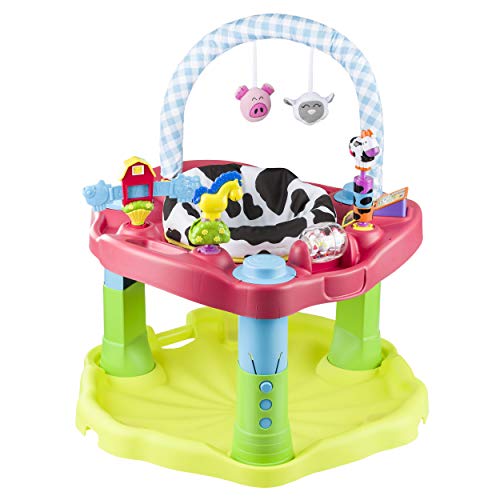
The ExerSaucer is the original activity saucer, and the Seaside Splash version, model 61612364, keeps the classic formula: a wide round base, a seat that spins a full circle, bounces, and rocks gently, and a ring of toys at reaching height. Height adjustments in the legs let the saucer keep fitting as your baby grows through the stage.
It does not convert to a table, and it does not fold, so it is a single-stage product with a big footprint. What it offers instead is the most energetic bounce of any pick here, which many babies plainly prefer. Follow the maker’s limits closely, and move on as soon as your child can walk or climb out. For a straightforward, proven saucer at the simpler end of the category, this remains the reference point.
The Fisher-Price 3-in-1 Sit-to-Stand, shown here in the Jazzy Jungle version sold as an Amazon Exclusive, takes a different route through the stages. It starts as a seated activity center with music, lights, and sounds, then converts so a cruising baby can play standing, and finally becomes a toddler activity table built around a spiral ramp with balls and vehicles.
That ramp gives it the longest toddler life of any pick here, because the play pattern keeps changing as skills grow. The seated stage works like its rivals, with a spinning seat and a machine-washable pad. It is a larger, more electronic toy than the Oribel, so expect batteries and a bigger footprint. Families who want one purchase to stretch from first sits to toddler play will get the most from it.
Specs
Spec
Detail
Version shown
Jazzy Jungle
Stages
3, seated to standing to table
Features
Music, lights, spiral ramp
Seat pad
Removable, washable
Wheels
None, stationary
Bright Starts Bounce Bounce Baby 2-in-1 Activity Jumper and Table
Bright Starts Bounce Bounce Baby 2-in-1 Activity Jumper and Table
The Bounce Bounce Baby, shown here in Playful Palms, is the value pick: a stationary bouncer-style center whose seat sits on a bounce pad, so babies can jump in place while the wide base stays planted. When the bouncing stage ends, it converts into a play table, extending its useful life well past the first year.
The seat adjusts to multiple heights as your baby grows, the seat pad comes off for washing, and the toy set covers the basics with links for attaching favorites. It has less bounce travel than the ExerSaucer and fewer growth stages than the Skip Hop, but it covers the essentials at the simpler end of the category. As with every pick here, there are no wheels, and the base belongs on a flat floor away from stairs.
Specs
Spec
Detail
Theme shown
Playful Palms
Starting age
About 6 months
Seat
Bounce pad, height adjustable
Converts
To play table
Wheels
None, stationary
Who Should Skip It
Skip wheeled baby walkers entirely; the American Academy of Pediatrics advises against them, and no convenience justifies the fall and reach hazards. Skip any activity center if your baby cannot yet hold their head up steadily, and stop using one the moment your child can walk, climb out, or exceeds the maker’s height or weight limits. Skip the category if your home cannot offer a flat spot away from stairs and cords. And skip long sessions: activity centers are for short, supervised play breaks, not a place for a baby to spend the day.
FAQ
Are baby walkers and activity centers the same thing?
No, and the difference is safety-critical. A walker has wheels and lets a baby move across the floor, reach hazards, and fall down stairs; the American Academy of Pediatrics advises against walkers, and Canada bans their sale. A stationary activity center has no wheels. The baby bounces and spins in one place on a stable base. Only buy the stationary kind.
When can my baby start using an activity center?
Most models start at about four to six months, once your baby holds their head up steadily and has the trunk control to sit in the seat with support. Set the height so their feet rest mostly flat rather than on tiptoe, keep sessions short, and balance center time with plenty of free floor play, which is where rolling, crawling, and pushing up develop.
When should we stop using an activity center?
Stop as soon as your child can walk, can climb or lean out of the seat, or reaches the maker’s stated height or weight limit, whichever comes first. Those limits are printed in the manual and on the product labeling. Continuing past them risks the child tipping the unit or climbing out and falling, which is why the manual’s numbers govern, not your child’s enthusiasm.
How long can a baby stay in an activity center each day?
Keep sessions short, around 15 to 20 minutes at a time, and treat the center as one short play break among many. Babies develop strength and skills through unrestricted floor time, tummy time, and reaching for toys at ground level. If your baby fusses, arches, or tires in the seat, take them out; the center should never be a parking spot.
Final Verdict
Buy the Skip Hop Explore & More for the most complete package, the Oribel PortaPlay if it must fold away, the Evenflo ExerSaucer for classic bounce, the Fisher-Price if you want the longest toddler afterlife, and the Bright Starts for simple value. Keep every one of them stationary, on flat floors, in short supervised sessions, and retire them on schedule.
D
Disdik Picks Editorial Team
We compare specs, materials and verified owner reviews before a product earns a spot. Rankings are never paid.
Affiliate disclosure. As an Amazon Associate we earn from qualifying purchases at no extra cost to you. Prices accurate as of the date shown.
Find the best razors for women for legs, underarms and sensitive skin. Compare five cartridge, disposable and shave-kit options and choose a smooth shave.
We compared the best comforters for every sleeper, from light all-season inserts to plush king-size picks, so you can find the right warmth for your bed.
We compared the best calculators for students, professionals, and home offices, covering scientific, graphing, financial, printing, and desktop models.

 Oribel PortaPlay Activity Center
 Evenflo ExerSaucer Activity Center
 Fisher-Price 3-in-1 Sit-to-Stand Activity Center
 Bright Starts Bounce Bounce Baby 2-in-1 Activity Jumper and Table











Write Your Review
No reviews yet. Be the first to share your experience!