Disdik Picks is reader-supported. When you buy through links on our site, we may earn a commission at no extra cost to you. As an Amazon Associate, we earn from qualifying purchases. Learn more ›
Best TENS Units: 5 Picks for Drug-Free Pain Relief at Home
Compare the best TENS units for home pain relief with channel counts, modes, pad bundles and battery details for backs, necks, knees, shoulders and joints.
Nov 19, 2026
Updated Nov 20, 2026
10 min read
0 views
Compare the best TENS units for home pain relief with channel counts, modes, pad bundles and battery details for backs, necks, knees, shoulders and joints.
⭐ Key Takeaways
Quick answer: Our top pick is TENS 7000 Digital TENS Unit — Mid-Range, with OMRON Max Power Relief TENS Unit (PM500) — Premium as a strong alternative.
The short answer: on published specifications, the TENS 7000 is the most capable all-round pick for most home users, with dual isolated channels, five therapy modes and fully adjustable pulse rate and pulse width. The OMRON Max Power Relief suits anyone who prefers a simple single-area device from a long-established healthcare brand. The MEDVICE MV950 splits the difference with dual channels and a rechargeable battery, while the AUVON and Belifu dual channel units cover the budget tier with 24 modes each and USB charging.
A TENS unit sends low-voltage electrical pulses through adhesive pads placed on the skin near an area of pain. The pulses are widely used as a drug-free way to manage sore muscles and joints at home, and most modern units add preset programs, timers and rechargeable batteries. The five models below were chosen because their published specifications cover the main buying angles: manual control versus preset modes, one treatment area versus two, replaceable batteries versus rechargeable cells, and compact travel formats versus fuller home kits.
As an Amazon Associate, we earn from qualifying purchases.
The TENS 7000, sold by Roscoe Medical, follows the layout used in clinics for years: two isolated channels, a clear digital display and direct controls for the pulse itself rather than a menu of preset programs. Its five modes are Burst, Normal, Modulation, Strength Duration 1 and Strength Duration 2, and both the pulse rate (2 to 150 Hz) and pulse width (50 to 300 microseconds) adjust across wide ranges, with output up to 100 mA per channel. That breadth makes it the most flexible unit in this group for people whose needs change from one area of the body to another.
The timer runs from 1 to 60 minutes or can be set to continuous, and the unit is powered by a single 9V battery, so there is no charging routine to keep up with. The kit includes lead wires, four electrode pads and a carrying case. Buyers who want fine manual control over each session, rather than one-tap presets, will find this the most suitable design here.
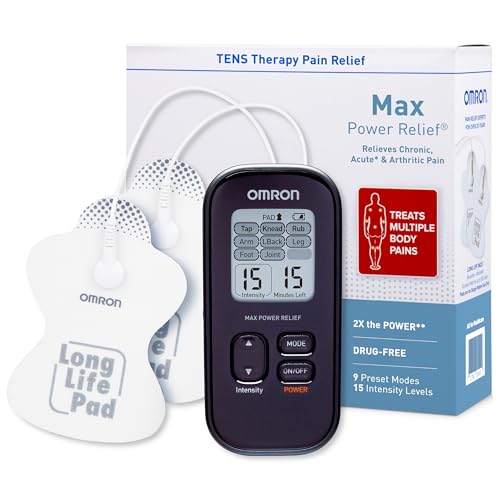
2. OMRON Max Power Relief TENS Unit (PM500) — Premium
Runner-Up
2. OMRON Max Power Relief TENS Unit (PM500) — Premium
Channels: 1
Modes: 9 (6 body pain modes and 3 massage-like modes: tap, knead, rub)
OMRON builds the Max Power Relief around simplicity. It is a single-channel unit with nine modes: six body pain modes aimed at the arm, lower back, leg, foot, joint and shoulder, plus three massage-like modes named tap, knead and rub. Intensity adjusts across 15 levels, and therapy runs through two reusable Long Life Pads sized 4 by 2.5 inches, the same pad family used by the OMRON Pocket Pain Pro PM400.
The unit runs on two AAA batteries and weighs about 0.22 pounds, so it travels easily and needs no charging cable. The trade-off for that simplicity is coverage: with one channel and two pads, it treats one area at a time. For buyers who want a compact device from a healthcare brand with a long record in home medical equipment, and who mainly treat a single sore spot, this is the cleanest option in the roundup.
3. MEDVICE Dual Channel Rechargeable TENS Unit (MV950) — Mid-Range
3. MEDVICE Dual Channel Rechargeable TENS Unit (MV950) — Mid-Range
The MEDVICE MV950 is a second-generation pocket unit with two outputs, 16 pre-programmed modes and 20 strength levels, so each of two pad pairs can be set to suit a different area. It ships with eight pads, which is enough to cover two areas at once and still have spares ready. The listing describes the model as FDA cleared, and the built-in lithium battery is rechargeable, rated in the listing description at up to 6 hours of use per charge.
Because the programs are preset, there is less to learn than on the TENS 7000: pick a mode, set the strength and let the session run. Buyers who want dual-area coverage in a small rechargeable body, without managing separate batteries, are the natural audience for this one.
AUVON pairs TENS pain relief programs with EMS muscle stimulation programs in one dual channel unit with 24 modes in total. It comes with 12 pads, a generous count that suits households where pads wear out across several regular users or several treatment areas. The battery is rechargeable, and the bundle includes an ABS pads holder that gives the pads a clean storage surface between sessions, a USB charging cable and a dust-proof storage bag.
Independent channel control means the two pad pairs do not have to run the same program at the same strength, which helps when one area is more sensitive than the other. For buyers who want both TENS and EMS in a single rechargeable device with plenty of pads in the box, this is a strong budget-tier package.
The Belifu dual channel unit (model SM9126) also offers 24 modes across TENS and EMS, with 20 intensity levels and independent control of each channel, so two areas can be treated at once at different strengths. Ten pads are included, and the built-in lithium battery charges over USB, which keeps it easy to top up from the same chargers used for phones and other small devices.
A timer adjustable from 10 to 60 minutes ends sessions automatically, and the bundle adds a drawstring storage bag and fastening cable ties to keep leads tidy. It covers the same ground as the AUVON for buyers comparing the two: the deciding points are pad count, the storage extras in the box and the feel of the controls.
How to Choose a TENS Unit
Channels. A single-channel unit like the OMRON treats one area through one pair of pads. A dual channel unit runs two pad pairs, and models with independent control let each pair use its own mode and intensity, which matters when treating, for example, a knee and a shoulder in the same session.
Modes versus manual control. Preset programs, counted in modes, are the simplest route: the device sets the pulse pattern for you. Manual units like the TENS 7000 expose pulse rate and pulse width directly, which takes a little more attention but allows finer adjustment. Neither approach is better in absolute terms; the right pick depends on how much control you want over each session.
Pads. Pad count in the box ranges from two with the OMRON to twelve with the AUVON. Pads lose adhesion over time, so a larger bundle delays the first replacement purchase. Check pad size as well: larger pads suit broad areas like the lower back, while smaller pads fit joints and limbs. Replacement pads must match the connector style of your unit.
Battery. Replaceable cells (9V or AAA) are easy to swap and keep the unit ready at all times. Rechargeable lithium batteries remove that errand but tie the unit to a charging cable and a finite run time per charge, so frequent travelers may prefer whichever system matches the rest of their kit.
Timer and shut-off. A session timer with automatic shut-off is worth having for anyone who tends to relax or doze during therapy. Timers across this group run from about 10 minutes up to 60 minutes, and the TENS 7000 adds a continuous setting for supervised longer sessions.
Safety Notes
Published guidance on these product listings is consistent on a few points. TENS units should not be used by people with a pacemaker, implanted defibrillator or other implanted electronic or metallic devices, and they are not for use during pregnancy. Pads should never be placed on the front of the neck, across the eyes, or on broken or irritated skin. Anyone with an undiagnosed or chronic condition should speak with a clinician before using electrical stimulation, and the manual supplied with each model is the final word on placement and session length for that device.
FAQ
What does a TENS unit do?
A TENS unit delivers low-voltage electrical pulses through adhesive pads placed on the skin near an area of pain. The pulses are intended to interfere with pain signals on their way to the brain and to prompt the body to release its own pain-relieving chemicals, which makes TENS a drug-free option for managing sore muscles and joints at home.
How long should a single TENS session run?
Most units in this roundup offer timers between about 10 and 60 minutes, and many people use sessions in the 15 to 30 minute range. The manual for your model gives the recommended session length for that device, and intensity should feel strong but comfortable rather than painful at any point in the session.
Where should TENS pads never be placed?
Pads should not be placed on the front of the neck, over the eyes, on the head, or on broken, irritated or infected skin. They should also stay away from the chest area near the heart unless a clinician advises otherwise, and people with implanted electronic devices such as pacemakers should not use a TENS unit at all.
How often do electrode pads need replacing?
Pads are replaced when they no longer stick evenly to the skin, which depends on how often they are used and how they are stored. Keeping skin clean before each session and returning pads to their holder or a sealed bag afterward extends their life. When buying replacements, match the pad size and the connector type used by your unit.
Conclusion
For the widest control over pulse settings, the TENS 7000 remains the standout pick, and its dual isolated channels cover two areas at once. The OMRON Max Power Relief is the simplest route for single-area relief from an established healthcare brand. The MEDVICE MV950 brings dual channels and a rechargeable battery in a pocket format, while the AUVON and Belifu units deliver 24 modes, independent dual channels and USB charging at the budget tier. Match the channel count, pad bundle and battery style to how and where you plan to use the device, and any of the five will cover everyday home pain relief needs.
D
Disdik Picks Editorial Team
We compare specs, materials and verified owner reviews before a product earns a spot. Rankings are never paid.
Affiliate disclosure. As an Amazon Associate we earn from qualifying purchases at no extra cost to you. Prices accurate as of the date shown.
Find the best razors for women for legs, underarms and sensitive skin. Compare five cartridge, disposable and shave-kit options and choose a smooth shave.
We compared the best comforters for every sleeper, from light all-season inserts to plush king-size picks, so you can find the right warmth for your bed.
We compared the best calculators for students, professionals, and home offices, covering scientific, graphing, financial, printing, and desktop models.



 4. AUVON Dual Channel TENS EMS Unit, 24 Modes — Budget
 5. Belifu Dual Channel TENS EMS Unit, 24 Modes — Budget










Write Your Review
No reviews yet. Be the first to share your experience!