
Our Short List of 3

- Type: Wooden snap trap with metal pedal
- Pack size: 12 traps
- Base material: Sustainably sourced FSC wood
- Trigger: Metal bait pedal
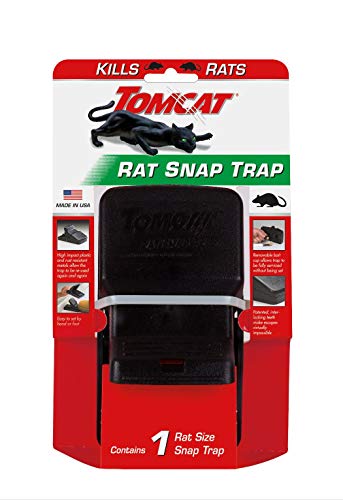
- Type: Plastic snap trap in rat size
- Pack size: 1 trap
- Setting: Sets in one motion with hand or foot
- Body material: Durable plastic

- Type: Battery-powered electronic trap with enclosed chamber
- Pack size: 1 trap
- Power: 4 D batteries required
- Kills per battery set: Up to 20 rats per set of batteries, according to the maker
All 5 Picks at a Glance
| Product | Specs | Action |
|---|---|---|
| 1. Victor Metal Pedal Rat Trap M200, 12 Pack |
| Check price on Amazon |
| 2. Tomcat Rat Snap Trap, 1 Pack |
| Check price on Amazon |
| 3. Victor Rat Zapper Classic RZC001-4, 1 Pack |
| Check price on Amazon |
 4. Catchmaster Jumbo Rat and Mouse Glue Traps, 6 Pack |
| Check price on Amazon |
 5. JT Eaton Jawz Plastic Rat Traps, 12 Pack |
| Check price on Amazon |
Key takeaways
- Compare the best rat traps for indoor and garage use, from classic wooden snap traps and plastic snap traps to electronic and glue-board options.
The best rat trap for most homes is the Victor Metal Pedal Rat Trap M200, a classic wooden snap trap sold in a pack of twelve so you can place several traps at once along the routes rats travel. If you would rather set a trap with your hand or foot and reuse it many times, the Tomcat Rat Snap Trap is a sturdy plastic snap trap in rat size that sets in one motion. For a no-see, no-touch catch, the Victor Rat Zapper Classic RZC001-4 kills rats with a high-voltage shock inside an enclosed chamber and flashes a light when a catch has been made. Households that want to monitor a garage or basement often add the Catchmaster Jumbo Rat and Mouse Glue Traps, a six-pack of large adhesive trays that also catches snakes, mice, and spiders. And for a bulk plastic snap trap that is easy to bait and clean, the JT Eaton Jawz Plastic Rat Trap in a twelve-pack covers a large area without a large outlay. Each of these five traps suits a different household, and the sections below explain how they differ, where to place them, and how to use them safely around children and pets.
As an Amazon Associate, we earn from qualifying purchases.
Table of Contents
- Why Rat Traps Are Not Mouse Traps
- How to Choose the Right Rat Trap
- The 5 Best Rat Traps
- Where to Place Rat Traps
- Rat Trap Safety Around Children and Pets
- Frequently Asked Questions
- Conclusion
- Product and ASIN Reference
Why Rat Traps Are Not Mouse Traps
Rats are larger, stronger, and more cautious than mice, and a trap built for a mouse will not do the job on a rat. A mouse snap trap is too small, its spring is too weak, and its kill bar cannot close with enough force on a rat-sized animal. Worse, a rat that escapes a mouse trap learns to avoid traps altogether, which makes the next attempt harder. That is why every trap in this guide is built in rat size, with a larger base, a stronger spring, and a trigger that a rat cannot trip by accident while stealing bait from the edge.
Rats also travel differently from mice. Mice squeeze through gaps as narrow as a pencil and explore openly, while rats are neophobic, which means they avoid new objects in their environment for days at a time. A rat will walk past a brand-new trap for several nights before it trusts the object enough to approach it. That caution is why placement matters more than the trap itself. A trap set in the open center of a room will sit untouched, while the same trap set flush against a wall, along a greasy rub mark, or beside a gnawed opening will catch a rat within a few nights once the animal has grown used to it.
A rat trap also gives you evidence that poison cannot. When a trap catches a rat, you know where the rat was traveling, how large it was, and whether more rats are using the same route. When you use poison, a rat may die inside a wall cavity, where it cannot be found and where the smell lingers for weeks. Traps contain no poison, so there is no bait block that a rat can carry away and drop somewhere unexpected, and no risk of a poisoned rat dying out of reach. For households with children and pets, that difference is often the deciding factor.
Finally, rats are strong enough to drag a light trap away. A mouse trap stays where you put it because a mouse cannot move it, but a rat can pull a small trap across a floor or into a gap. That is why rat traps are heavier, why many of them have mounting holes or a wide base, and why some households anchor a trap to a board or a pipe. A trap that moves after a catch tells you nothing about where the rat was traveling, and a trap that is dragged into a wall void is a trap you have lost. Weight, size, and a stable base are not minor details in a rat trap. They are the features that make the difference between a catch and a missing trap.
How to Choose the Right Rat Trap
Start with the room where you have seen signs of rats. Droppings the size of a large bean, gnaw marks on wood or plastic, greasy rub marks along baseboards, and scratching sounds in a wall or ceiling at night all point to active routes. The best trap is the one that fits that route. A snap trap needs a flat surface and clearance for the kill bar to swing, so it works well on open floor along a wall, under a sink, or on a garage shelf. A glue board is thinner and can slide into the gap between an appliance and the wall, under a stove, or behind a refrigerator. An electronic trap is taller, so it needs a spot with headroom, such as the floor of a pantry, a garage corner, or a basement.
Next, decide how much contact you want with the catch. If you are comfortable handling a trap, a classic wooden snap trap or a plastic snap trap is the simplest choice, and disposal is quick. If you would rather not see the rat at all, an electronic trap keeps the catch out of sight inside an enclosed chamber, and disposal is a matter of tipping the chamber over a trash bag. Glue boards are the most visible option, since the rat remains on the board, so they suit households that do not mind that, or that place the boards in out-of-sight spots such as a garage or an attic.
Think about who else uses the space. In a home with small children or pets, an enclosed electronic trap is the safer choice, because the killing mechanism sits inside a chamber that fingers and paws cannot easily reach. Snap traps and glue boards can still be used in such homes, but they belong in places children and pets cannot reach, such as behind heavy appliances, inside closed cupboards, or in a locked garage. The safety section near the end of this guide covers placement in detail.
Consider how many traps you need. Rats rarely travel alone, and a single trap in a kitchen will not tell you whether rats are also using the basement or the pantry. Most pest-control guidance suggests placing several traps at once, spaced a few feet apart along the same wall, rather than a single trap. That is why pack size matters: a twelve-pack of snap traps covers a kitchen, a utility room, and a garage in one purchase, while a six-pack of glue boards lets you monitor a whole house. An electronic trap is usually bought singly, and it works best as a targeted tool for a known hotspot rather than as the only trap in the house.
Bait choice also affects results. Peanut butter, chocolate spread, hazelnut spread, dried fruit, and bacon are all common choices, because they are sticky and aromatic and they stay on the bait pedal. Use a small amount, about the size of a pea, and press it firmly onto the pedal so the rat must work at it. Avoid loose bait such as seeds or crumbs, which a rat can carry away without triggering the trap. For glue boards, the adhesive itself is often scented, so no extra bait is needed, though a small dab of peanut butter in the center can help.
Finally, think about maintenance. Wooden snap traps should be checked daily, since a caught rat should be removed promptly. Plastic snap traps can be rinsed and reused, but they should be inspected for cracks or a weakened spring. Electronic traps need fresh batteries and a wiped interior between uses, and the indicator light tells you when to check. Glue boards lose their stickiness when they collect dust, so they should be replaced every few weeks even if nothing has been caught. A trap that is checked and maintained regularly catches more rats than a trap that is set and forgotten.
The 5 Best Rat Traps
The five traps below cover the main designs available today: a classic wooden snap trap in a bulk pack, a reusable plastic snap trap, a battery-powered electronic trap, a bulk glue-board pack, and a bulk plastic snap trap for large areas. Each one is described on its own, with its strengths, its limits, and the household it suits best.
1. Victor Metal Pedal Rat Trap M200, 12 Pack
- Type: Wooden snap trap with metal pedal
- Pack size: 12 traps
- Base material: Sustainably sourced FSC wood
- Trigger: Metal bait pedal
The Victor Metal Pedal Rat Trap M200 is the classic wooden snap trap in rat size, and it remains the most widely used rat trap for a reason. It is a simple device: a wooden base, a metal kill bar, a strong spring, and a metal bait pedal. When a rat steps on the pedal to reach the bait, the bar snaps shut. There are no batteries, no electronics, and no moving parts to program. You bait it, set it, place it against a wall, and check it the next morning. That simplicity is also why it is so reliable. There is almost nothing to go wrong, and a trap that has been stored in a dry place will work just as well next season as it did this one.
The M200 uses a metal pedal rather than a plastic one, which gives it a sensitive trigger. A light touch on the pedal releases the bar, so even a cautious rat that only nibbles at the bait is likely to set it off. The wooden base is made from sustainably sourced FSC wood, and the trap is sturdy enough to be reused several times or disposed of after a catch, depending on your preference. Many households keep a pack on hand for exactly this reason: the traps are cheap enough per trap to treat as disposable, yet durable enough to reset and use again.
The twelve-pack is the real strength of this listing. Rats travel in groups and use several routes at once, so a single trap rarely solves the problem. With twelve traps, you can place two or three along the kitchen wall, two more in the pantry, two in the garage, and still have spares for the basement and the attic. Spacing traps a few feet apart along the same wall covers more of the route than a single trap ever could, and it tells you quickly which routes are active, because the traps that catch rats mark the busiest paths.
Placement is straightforward. Set the trap with the bait pedal facing the wall, since rats run along baseboards and will approach the trap from the side. Place two or three traps a few feet apart along the same wall, rather than a single trap in the middle of the room. Good spots include the kitchen floor behind the trash can, the pantry floor, the utility room, the garage, and the basement. Under a sink or behind a stove are also productive, as long as there is enough clearance for the kill bar to swing freely. Avoid placing the trap in the open center of a room, where rats rarely travel.
Baiting matters more with this trap than with any other design. A pea-sized dab of peanut butter pressed firmly onto the metal pedal works well, as does a small smear of chocolate spread or a tiny piece of dried fruit wedged onto the pedal. The bait must be attached firmly, because loose bait lets a rat eat and leave without triggering the mechanism. Check the trap each morning, and reset it with fresh bait if the bait has been taken without a catch. If a trap goes untouched for a week, move it a few feet along the same wall or to another room where you have seen droppings.
The main limitation of the M200 is that the catch is visible, and the trap must be handled to dispose of it. Households that are uncomfortable with that should consider an electronic trap instead. The trap also needs to be kept out of reach of children and pets, since the snap mechanism is powerful enough to injure a finger or a paw. Placed behind an appliance or inside a cupboard, however, it is one of the most effective tools available. One more detail to note is that the maker lists a California warning about lead for this trap, so wash your hands after handling it and keep it away from food preparation surfaces. For a household that wants several traps at once and a design that has been used for generations, this twelve-pack is hard to beat.
2. Tomcat Rat Snap Trap, 1 Pack
- Type: Plastic snap trap in rat size
- Pack size: 1 trap
- Setting: Sets in one motion with hand or foot
- Body material: Durable plastic
The Tomcat Rat Snap Trap is a plastic snap trap in rat size that is built for households that want one reliable trap rather than a bulk pack. It sets easily in one motion with your hand or foot, which removes the fiddly part of a wooden snap trap, where you must hold the kill bar back with one hand while you latch the arm bar with the other. With this trap, you press the pedal or the setting lever down until it clicks, bait it, and place it against the wall. That ease of setting matters most for anyone who has struggled with a wooden trap, or who wants to set a trap without getting their fingers near the kill bar.
The plastic body is the second strength of this design. Wood absorbs moisture, swells, and can warp in a damp basement or garage, while plastic stays the same shape in humidity and can be rinsed clean after a catch. The trap is reusable, so after a catch you can empty it, wash it, and set it again. That makes it a good choice for a household that expects to trap rats over several weeks, since a single trap can be used again and again through a season without losing its spring tension.
The trap is sized for rats, not mice. Its kill bar is longer and its spring is stronger than a mouse trap, and its bait area is large enough to hold a firm dab of peanut butter or a small piece of dried fruit. That size matters, because a mouse-sized trap will not kill a rat cleanly and will teach the rat to avoid traps. The Tomcat trap is also easy to place, since its flat plastic base sits steadily on a floor, a shelf, or a workbench, and it does not tip over when a rat brushes against it.
Setting the trap is simple, but placement still decides whether it works. Place it flush against a wall with the bait end facing along the baseboard, so a rat running along the wall walks straight onto the trigger. Good spots include the garage floor beside a door, the basement floor along a foundation wall, the pantry floor, and the space behind a trash can. Because it is a single trap, it works best as a targeted tool for a known hotspot, such as a spot where you have found droppings or gnaw marks, rather than as the only trap in a large house. If you find that one spot is active, adding a second trap a few feet away will catch more rats than moving the single trap around.
The main limitation is pack size. One trap covers one route, and rats use several routes at once. Households with signs of rats in more than one room will need more than one trap, or a bulk pack such as the Victor M200 or the JT Eaton Jawz twelve-pack. The Tomcat trap is also an open snap trap, so the catch is visible and the trap must be handled for disposal. Households that would rather not see the rat should consider the electronic trap in this guide instead. For a household that wants a single, reusable, easy-to-set rat trap for a known hotspot, though, this Tomcat trap is one of the most straightforward choices available.
3. Victor Rat Zapper Classic RZC001-4, 1 Pack
- Type: Battery-powered electronic trap with enclosed chamber
- Pack size: 1 trap
- Power: 4 D batteries required
- Kills per battery set: Up to 20 rats per set of batteries, according to the maker
The Victor Rat Zapper Classic RZC001-4 is a battery-powered electronic trap that kills rats with a high-voltage shock inside an enclosed chamber. It is the most hands-off option in this guide: you bait it, switch it on, place it against a wall, and wait for the indicator light to tell you a catch has been made. There is no snap bar to set, no spring to tension, and no need to handle the trap with force. For anyone who finds a traditional snap trap fiddly or intimidating, the electronic design removes that barrier entirely.
The trap works with a smart circuit that detects when a rat has fully entered the chamber and then delivers a continuous shock for two minutes. That long shock matters, because rats are able to restart their hearts after a brief shock, so a short burst is not always enough. The two-minute cycle is designed to make the kill reliable. A built-in bait area holds a small amount of peanut butter or another sticky bait on the back wall of the chamber, and the rat must step onto the metal plates inside the chamber to reach it, which completes the circuit. An indicator light on the top of the unit shows whether the trap is armed and whether a catch has been made, so you can check its status at a glance without opening it. When the light signals a catch, you simply tip the chamber over a trash bag to dispose of the rat without touching it.
Power comes from four D batteries, which are required for operation. The maker states that one set of batteries can kill up to twenty rats, which makes the trap economical for a household dealing with a larger infestation, since a single set of batteries lasts through many nights of monitoring. It is worth keeping spare batteries on hand, and checking the indicator light regularly, so the trap is never sitting unpowered on a night when rats are active. The trap is designed for indoor use, and it should be kept dry, since moisture and electronics do not mix well.
The enclosed chamber makes this trap a strong choice for homes with children or pets. The electric plates sit deep inside the unit, and the entry tunnel is sized for a rat, so fingers and paws cannot easily reach the plates. That said, the trap should still be placed where children cannot pick it up and open it, such as on a pantry floor, behind a storage shelf, or in a garage. The chamber also contains any mess, so the floor stays clean and there is no debris to deal with. Because the rat is hidden inside the chamber, this is also the best choice in this guide for households that do not want to see the catch.
Size is the main consideration. The Rat Zapper Classic is larger than a flat snap trap, so it needs a clear patch of floor with headroom. It works well in a pantry, a kitchen corner, a basement, or a garage, and it is best used as a targeted tool for a known hotspot rather than as the only trap in a large house. For a household that wants a reusable, low-contact trap and does not mind buying batteries, it is the most convenient option here, and its indicator light makes monitoring almost effortless. If you catch a rat, wipe the interior clean, replace the bait, and set the trap again in the same spot, since rats often use the same route repeatedly.
4. Catchmaster Jumbo Rat and Mouse Glue Traps, 6 Pack
- Type: Large glue board trap with plastic tray
- Pack size: 6 traps
- Target species: Rat, mouse, snake, and spider, according to the maker
- Use: Indoor monitoring and catching
The Catchmaster Jumbo Rat and Mouse Glue Traps are large adhesive trays in a six-pack, and they fill a different role from the snap traps in this guide. A glue trap does not kill on contact. It holds the rat on a sticky surface until you find it, which makes it a monitoring tool as much as a catching tool. Every rat it catches tells you where rats are traveling, and that information is often more valuable than the catch itself, because it shows you where to place snap traps, where to seal an entry point, and whether the problem is growing or shrinking.
The jumbo size is what makes this listing suitable for rats. Standard mouse glue boards are too small for a rat, which can pull free from a small board or drag it away. These jumbo trays are larger and heavier, with a plastic tray base that keeps the adhesive flat and stable on the floor. The tray design also keeps the adhesive off the floor, so the board does not stick to the surface beneath it, and it makes the trap easier to pick up and dispose of after a catch. The six-pack is enough to monitor several rooms at once, which is how glue boards work best, since a single board in a single room tells you very little about the rest of the house.
The adhesive is strong enough to hold a rat, a mouse, a snake, or a spider, and the listing notes that the traps are used by professionals as well as homeowners. That broad catch range is useful in a garage or basement, where several kinds of pests travel the same routes, but it also means you should check the traps daily, since a non-target animal can be caught as well. Place the trays flat on the floor, along walls, under sinks, behind appliances, and in the corners of a garage or attic. The traps work indoors, and they are best placed in dry spots, since dust and moisture reduce the stickiness of the adhesive over time.
One advantage of glue traps is that they need no setting, no batteries, and no baiting skill. You open the pack, peel off the cover if there is one, and place the tray where rats travel. A small dab of peanut butter in the center can help, but the adhesive itself is often scented, so many households use the trays without bait at all. That simplicity makes them a good choice for a household that wants to confirm where rats are traveling before investing in snap traps or an electronic trap for each route.
The main limitation is that glue traps are the most visible and the least hands-off option in this guide. The rat remains on the board, and disposal means handling the whole tray. Households that are uncomfortable with that should choose a snap trap or an electronic trap instead. Glue boards also lose their stickiness when they collect dust, so they should be replaced every few weeks even if nothing has been caught. Check local rules before using glue traps, since some areas restrict them, and keep them out of reach of children and pets, since the adhesive is very strong. Used as a monitor in a garage, basement, or attic, however, this six-pack is one of the most practical ways to map rat activity in a house.
5. JT Eaton Jawz Plastic Rat Traps, 12 Pack
- Type: Plastic snap trap in rat size
- Pack size: 12 traps
- Body material: Durable plastic
- Trigger: High-tension spring with bait area for solid or liquid bait
The JT Eaton Jawz Plastic Rat Traps are a bulk pack of plastic snap traps in rat size, and they are built for households that need to cover a large area at once. Twelve traps in one purchase is enough to place two or three along every active wall in a house, a garage, and a basement, which is how rat trapping works best. A single trap in a single room rarely solves a rat problem, because rats use several routes at once, and the Jawz twelve-pack is designed around that reality.
The plastic body is the main advantage over a wooden snap trap. Plastic does not absorb moisture, swell, or warp in a damp basement or garage, and it can be rinsed clean after a catch and reused many times. The trap is easy to set, bait, and clean, and its high-tension spring closes with enough force for a rat-sized animal. The bait area accepts solid or liquid bait, so you can use peanut butter, chocolate spread, or a small piece of dried fruit, and the bait stays in place while the rat works at it. A trap set indicator shows whether the trap is set, so you can check its status at a glance without touching it.
The Jawz rat trap is a different size from the Jawz mouse trap, and that distinction matters. The mouse version is smaller, with a weaker spring, and it will not kill a rat cleanly. The rat version in this guide is the 410 model in a bulk twelve-pack, with a larger base and a stronger spring built for rats and chipmunks. When you buy, check that the listing states rat size, because the two sizes look similar in a photograph and the model numbers are close. The rat trap is the one to choose for any sign of rats, including droppings larger than a grain of rice, gnaw marks on wood, or scratching in a wall at night.
Placement follows the same rules as any snap trap. Set the trap flush against a wall, with the bait end facing along the baseboard, and place two or three traps a few feet apart along the same wall. Good spots include the garage floor beside a door, the basement floor along a foundation wall, the pantry floor, and the space behind a trash can. Because the traps are plastic, they can also be used in a shed or another sheltered outdoor spot, as long as they are kept out of rain. Check the traps each morning, and reset any that have been triggered with fresh bait.
The main limitation is that the catch is visible, and the trap must be handled for disposal, even though the design allows for no-touch disposal by tipping the trap over a trash bag. Households that would rather not see the rat should consider the electronic trap in this guide instead. The Jawz traps are also open snap traps, so they need to be kept out of reach of children and pets, in places such as behind heavy appliances, inside closed cupboards, or in a locked garage. For a household that wants a bulk pack of durable, reusable, easy-to-clean rat traps for a large area, this twelve-pack is one of the most practical choices available.
Where to Place Rat Traps
Placement decides whether a rat trap works, and the rules are simple once you know how rats travel. Rats follow walls, pipes, and edges, and they rarely cross the open center of a room. Place every trap flush against a wall, with the bait end facing along the baseboard, so a rat running along the wall walks straight onto the trigger. A trap set in the middle of a room will sit untouched for weeks, while the same trap set against a wall will catch a rat within a few nights.
Look for the signs that mark an active route. Droppings, gnaw marks, greasy rub marks, and scratching sounds all point to a route that rats use every night. Place traps near those signs, not near where you think rats ought to be. Two or three traps spaced a few feet apart along the same wall work better than a single trap, because a rat that avoids one trap may step onto the next. If a trap goes untouched for a week, move it a few feet along the same wall, or to another room where you have seen droppings.
Good spots in a house include the kitchen floor behind the trash can, the pantry floor, the utility room, the space under a sink, and the floor behind a stove or refrigerator, as long as there is enough clearance for the kill bar to swing. In a garage, place traps along the foundation wall, beside the door, and in the corners where rats enter. In a basement, place them along the foundation wall and near pipes. In an attic, place them along the eaves and near any opening where rats enter from outside. Electronic traps need a clear patch of floor with headroom, while glue boards can slide into narrow gaps where a snap trap will not fit.
Leave a new trap unset and baited for a few nights before you set it. Rats avoid new objects, and a trap that is baited but not set lets the rat learn that the object is safe and that food is available. Once the bait has been taken for two or three nights in a row, set the trap, and the rat will return to the same spot. This patience is the single most useful trick in rat trapping, and it is the reason many households report that their traps caught nothing for a week and then caught a rat on the first night after the trap was set.
Check every trap each morning. A caught rat should be removed promptly, and the trap should be reset with fresh bait in the same spot, since rats often use the same route repeatedly. Wear gloves when you handle a trap, and wash your hands after disposal. If you find that one spot is catching rats night after night, that route is the busiest one in the house, and it is worth sealing the entry point nearby once the trapping has reduced the numbers.
Rat Trap Safety Around Children and Pets
Rat traps are powerful devices, and they need to be placed with care in any home with children or pets. A rat snap trap can injure a finger or a paw, a glue board can stick to fur or skin, and an electronic trap delivers a shock inside its chamber. None of these traps should be placed where a child or a pet can reach them, and none of them should be left where a toddler can pick them up and open them.
The safest choice for a home with children or pets is an enclosed electronic trap, because the killing mechanism sits inside a chamber that fingers and paws cannot easily reach. The Victor Rat Zapper Classic in this guide is the best example, since its electric plates sit deep inside the unit and its entry tunnel is sized for a rat. Even so, place the trap where children cannot reach it, such as on a pantry floor behind a storage shelf, in a locked garage, or in a basement that children do not use.
Snap traps and glue boards can still be used in homes with children and pets, but they belong in places that children and pets cannot reach. Behind heavy appliances, inside closed cupboards, in a locked garage, in an attic, and in a crawl space are all good spots. A trap placed behind a refrigerator or a stove is out of reach of a child and a dog, and it is also on a route that rats use, since rats travel behind appliances to reach food and warmth. Never place a snap trap or a glue board on an open floor where a child plays or a pet sleeps.
Wear gloves when you set, check, and dispose of a trap. Gloves protect your hands from the snap mechanism, from the adhesive on a glue board, and from contact with a caught rat. Wash your hands after handling any trap, and keep traps away from food preparation surfaces. The maker of the Victor wooden traps lists a California warning about lead, so wash your hands after handling those traps and do not place them where they can come into contact with food.
Finally, store unused traps out of reach. A snap trap that is set and left on a shelf is a hazard, and a glue board left on a counter can stick to anything that touches it. Keep spare traps in a closed box on a high shelf or in a locked cupboard, and set them only when you are ready to place them in their final spot. A trap that is stored safely is a trap that cannot hurt anyone by accident.
Frequently Asked Questions
What size trap do I need for rats?
You need a trap built in rat size, with a larger base and a stronger spring than a mouse trap. A mouse trap is too small and too weak for a rat, and a rat that escapes a mouse trap will learn to avoid traps. Every trap in this guide is built in rat size, so check the listing for the words rat size before you buy.
How many rat traps should I set at once?
Set several traps at once, spaced a few feet apart along the same wall, rather than a single trap. Rats travel in groups and use several routes at once, so a twelve-pack or a six-pack covers a house far better than a single trap. Place two or three traps along each active wall, and add more traps in the rooms where you have seen droppings or gnaw marks.
Where is the best place to put a rat trap?
Place the trap flush against a wall, with the bait end facing along the baseboard, near droppings, gnaw marks, or greasy rub marks. Good spots include the kitchen floor behind the trash can, the pantry floor, the garage floor beside a door, and the basement floor along a foundation wall. Avoid the open center of a room, where rats rarely travel.
Are rat traps safe to use around children and pets?
Rat traps need to be placed with care in any home with children or pets. An enclosed electronic trap is the safest choice, because the mechanism sits inside a chamber that fingers and paws cannot easily reach. Snap traps and glue boards belong in places children and pets cannot reach, such as behind heavy appliances, inside closed cupboards, or in a locked garage.
Conclusion
The best rat trap is the one that fits the route rats are using, the room you are protecting, and your comfort level with handling the catch. For most homes, the Victor Metal Pedal Rat Trap M200 in a twelve-pack is the best starting point, because it covers several rooms at once and its classic wooden design has been used for generations. The Tomcat Rat Snap Trap is the best single trap for a known hotspot, because it sets in one motion and its plastic body can be cleaned and reused. The Victor Rat Zapper Classic is the best choice for households that want a no-see, no-touch catch, because its enclosed chamber hides the rat and its indicator light tells you when to check. The Catchmaster Jumbo Glue Traps are the best monitoring tool, because they show you where rats are traveling and cover several rooms at once. And the JT Eaton Jawz twelve-pack is the best bulk plastic option for a large area, because its durable body can be rinsed and reused through a season. Place several traps at once, bait them firmly, check them each morning, and keep them out of reach of children and pets, and you will know within a few nights whether the plan is working.
Product and ASIN Reference
| Product | ASIN |
|---|---|
| Victor Metal Pedal Rat Trap M200, 12 Pack | B000I210B8 |
| Tomcat Rat Snap Trap, 1 Pack | B012RGM7BO |
| Victor Rat Zapper Classic RZC001-4, 1 Pack | B002665ZTC |
| Catchmaster Jumbo Rat and Mouse Glue Traps, 6 Pack | B07YQ8RGYL |
| JT Eaton Jawz Plastic Rat Traps, 12 Pack | B00DLKL26M |
More from Amazon
Programs that pair well with the guide above. Offers and eligibility are set by Amazon and may change.
Set up recurring deliveries of everyday items on eligible products. Terms and savings are set by Amazon.
Explore Subscribe & SaveCollect the home and kitchen items you want in one registry that guests can shop from.
Create a wedding registryFree shipping on eligible items, Prime Video and more. Eligible new members can start with a free trial.
Start a Prime free trialAudiobooks and podcasts to listen to on the go. Eligible new members can start with a free trial.
Try Audible freeAs an Amazon Associate we earn from qualifying purchases.










Write Your Review
No reviews yet. Be the first to share your experience!