Disdik Picks is reader-supported. When you buy through links on our site, we may earn a commission at no extra cost to you. As an Amazon Associate, we earn from qualifying purchases. Learn more ›
Best Baby Gates for Stairs and Doorways: 5 Safe Picks
Compare the best baby gates for stairs and doorways, from hardware-mounted top-of-stair gates to walk-through and play yard options for wider spaces.
Nov 19, 2026
Updated Nov 20, 2026
10 min read
7 views
A baby gate looks like a simple purchase until the opening is measured. Stair tops need hardware mounting, wide doorways need extensions, and a gate that works in a hallway can be the wrong choice at the top of a flight of stairs. This guide compares five well-known gates across the main buying situations: the top of the stairs, everyday doorways, rental-friendly pressure mounting, and wide or irregular spaces that need a configurable barrier. Each pick below is a real Amazon listing, and the notes focus on mounting style, opening width, and how the gate opens in daily use.
As an Amazon Associate, we earn from qualifying purchases.
Quick answer
For the top of stairs, choose a hardware-mounted gate such as the Evenflo Walk-Thru Top of Stairs or the Munchkin Loft. For standard doorways and hallways, the Regalo Easy Step is the familiar walk-through option. Renters who cannot drill should look at pressure-mounted models for flat openings only, and wide or angled spaces are best served by a configurable play yard gate like the Toddleroo Superyard.
The Regalo Easy Step is the gate many families start with because it covers the most common doorway widths and keeps the purchase simple. The steel frame expands from about 29 inches to 34.5 inches out of the box, and the included 6-inch extension pushes coverage to roughly 38.5 inches, which handles most interior doorways and hallway openings. A walk-through door in the frame means adults do not have to step over a fixed bar every time they pass, and the two-action handle keeps the door closed to toddlers while staying manageable for adults carrying laundry or a child.
Installation is pressure mounted with wall cups, so it suits doorways and the bottom of stairs without drilling. Regalo notes that using the included wall cups screwed into the wall adds stability, which is worth doing in high-traffic spots. The gate stands about 30 inches tall, a sensible height for crawlers and early walkers. Because it is pressure mounted, it should not be used at the top of stairs, where hardware mounting is the accepted standard. For a first gate in a standard doorway, though, the combination of width range, walk-through access, and simple setup explains why this model is a default recommendation.
The Munchkin Loft takes a different approach: it is hardware mounted and built from aluminum, which gives it a cleaner look than most steel gates and makes it a natural fit for the top of stairs or a permanent doorway barrier. It adjusts to fit openings from about 26.5 inches to 40 inches, and the door swings in either direction for hallways where traffic flows both ways. An integrated tuning system helps align the door during installation, which addresses the most common frustration with mounted gates, a door that does not latch smoothly because the frame is slightly out of square.
The Loft also includes a feature parents appreciate after the toddler years: it can be removed from its wall brackets quickly when the gate is not needed, then clicked back into place for visiting grandchildren or a new puppy. The indexed sizing system lets the width be set and remembered, so reinstallation lands in the same position. Aluminum construction keeps the gate light for its size, and the silver finish suits modern interiors better than basic white steel. For a top-of-stair position where the gate will stay for years, the Loft is the polished, permanent option in this group.
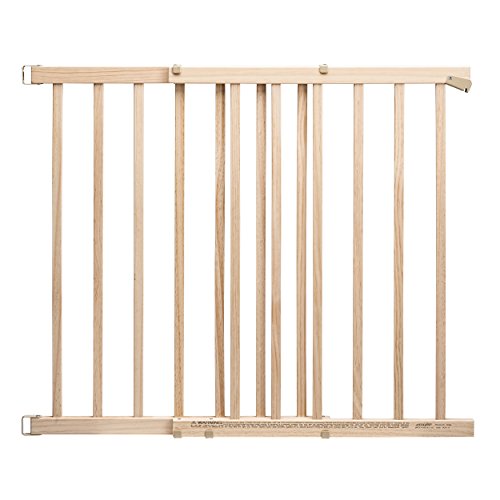
Evenflo designed this gate specifically for the position that matters most. The Walk-Thru Top of Stairs gate is hardware mounted, and its mounting hardware is engineered so the gate can be installed on angled walls and banister posts with the right adapters, a common problem in real staircases where the wall and the newel post do not line up neatly. It fits openings from about 30 inches to 48 inches wide, wider than many mounted competitors, and stands about 32 inches tall.
The door swings in one direction only, which is deliberate: a gate at the top of stairs should never swing out over the steps. A red and green lock indicator shows at a glance whether the latch is fully engaged, a small detail that matters during one-handed closes with a baby on a hip. The gate can be removed from its mounts for open-plan entertaining and reattached afterward. Evenflo also sells a banister adapter kit for post-to-post installations, so measuring should include checking whether the staircase needs that accessory. For a straightforward, safety-first top-of-stair pick with a wide fit range, this is the model built for exactly that job.
Evenflo Position & Lock Baby Gate
The Position & Lock gate is the simple end of the Evenflo range and serves a different purpose from the walk-through models. It is a pressure-mounted panel gate with no door: the rubber bumpers grip the doorway, the panel locks into position, and adults step over it or lift it out to pass. The Farmhouse finish version adds a wood-tone look that blends into living spaces better than plain white plastic, and the gate fits openings roughly from 26 inches to 42 inches wide and stands about 23 inches tall.
That lower height and step-over design make it best for younger babies, for blocking a room during short stretches, or as a pet barrier in a doorway. It is not a top-of-stairs gate, and it becomes less practical once a toddler can climb or an adult is passing through many times a day. What it offers is speed and simplicity: no tools, no frame to assemble, and a panel that can move from room to room as needed. Families often pair one inexpensive panel gate like this for occasional use with a proper walk-through gate in the main doorway, which is a sensible way to cover several openings without buying five premium gates.
Some openings defeat a straight gate entirely: wide great-room spans, angled walls, fireplace hearths, and the bottom of a staircase with no clean mounting points. The Toddleroo 3-in-1 Superyard answers with six hinged metal panels that configure as a freestanding play yard, a long barrier, or a wall-mounted enclosure when the included mounting hardware is used. As a barrier it spans up to about 144 inches, and extra panels can be added for larger areas. One panel contains a walk-through door with a childproof latch, so the barrier does not have to be dismantled for adults to pass.
The panels adjust at angles, which lets the barrier follow the geometry of a room instead of demanding a straight run. As a freestanding enclosure it creates a contained play space on hard floors or carpet, and the whole unit folds for storage or travel. Because it can be wall mounted, it can also serve at wide stair bottoms where a standard gate cannot reach. The trade-offs are footprint and price relative to a single doorway gate, plus more assembly time. For open-plan homes, it solves problems the other four picks simply cannot.
How to choose
Start with the location, because location decides the mounting style. The top of stairs always calls for a hardware-mounted gate with a door that swings away from the steps, never a pressure-mounted model. Doorways and stair bottoms can use pressure mounting, especially in rentals, but screwing in the wall cups improves stability. Next, measure the opening at its narrowest point, including baseboards, and check the gate’s width range with and without extensions. Note whether banisters, angled walls, or quarter-round trim sit inside the opening, since those may need adapter kits.
Then think about daily traffic. A walk-through door is close to essential in a main hallway; a step-over panel only makes sense in a low-traffic spot. Check the latch style against one-handed use, look for a lock indicator on top-of-stair models, and confirm the gate carries current safety certification from a recognized body such as JPMA and meets the ASTM standard for expansion gates. Finally, match height to the child: taller gates buy more time with climbers, and any gate should be retired once a child can climb over it or reaches the manufacturer’s stated age and height limits.
Who should skip
Skip a dedicated baby gate purchase if the opening is temporary and a closed, latched door already separates the space safely, or if the child is already able to climb over a standard-height gate, at which point a gate gives a false sense of security and other childproofing steps matter more. Skip pressure-mounted models entirely for the top of stairs regardless of budget. Also skip the configurable play yard approach if the need is one narrow doorway; it is oversized for that job. Anyone unwilling to drill should not buy a hardware-mounted gate and then pressure-fit it as a workaround, since that defeats the design. Renters in that position should gate doorways and stair bottoms only, and use a different plan, such as a closed door, for the stair top.
FAQ
Can a pressure-mounted gate be used at the top of stairs?
No. Pressure-mounted gates rely on friction against the walls and can be pushed out by a child leaning or falling against them, and many include a threshold bar that is itself a trip hazard on a landing. The top of stairs needs a hardware-mounted gate screwed into studs or solid framing, with a door that swings toward the landing rather than out over the steps.
What width gate do most homes need?
Standard interior doorways usually fall between 28 and 36 inches, which most walk-through gates cover with their included extensions. Stair openings and open-plan gaps vary much more, so measuring the exact opening, including trim and baseboards, matters more than averages. Very wide spans, roughly beyond 48 inches, usually point toward extension kits or a configurable panel barrier like a play yard gate.
When should a baby gate be installed?
A sensible time is before a baby starts crawling, often around five to six months, so the barrier is familiar before it is needed. Gates at the top of stairs are worth installing even earlier because carrying an infant up and down stairs is when adults most appreciate a one-handed latch. Any gate should be removed or retired once a child can climb it or manipulate the latch.
Are baby gates also suitable for pets?
Many are, and panel barriers are commonly used to separate dogs from rooms or stairs. Check the bar spacing and height against the size of the animal: a small dog may slip through wide spacing, and a large, determined dog can challenge a pressure-mounted gate. Hardware-mounted and metal panel models hold up better to pet use than lightweight plastic panels.
Final verdict
Match the gate to the opening and the job becomes easy. The Evenflo Walk-Thru Top of Stairs and the Munchkin Loft cover the critical top-of-stair position, the Regalo Easy Step handles everyday doorways, the Evenflo Position & Lock is the simple movable panel for occasional blocking, and the Toddleroo Superyard solves wide and angled spaces. Measure carefully, mount the stair-top gate into solid framing, and check latches as part of the daily routine.
Find the best razors for women for legs, underarms and sensitive skin. Compare five cartridge, disposable and shave-kit options and choose a smooth shave.
We compared the best comforters for every sleeper, from light all-season inserts to plush king-size picks, so you can find the right warmth for your bed.
We compared the best calculators for students, professionals, and home offices, covering scientific, graphing, financial, printing, and desktop models.

 Regalo Easy Step Extra Wide Walk-Thru Baby Gate
 Munchkin Loft Hardware Mounted Baby Gate
 Evenflo Walk-Thru Top of Stairs Gate
 Toddleroo by North States 3-in-1 Metal Superyard











Write Your Review
No reviews yet. Be the first to share your experience!