Disdik Picks is reader-supported. When you buy through links on our site, we may earn a commission at no extra cost to you. As an Amazon Associate, we earn from qualifying purchases. Learn more ›
Best Back Stretchers for Posture and Everyday Relief
Five back stretchers compared on levels, padding, materials, and weight capacity, with adjustable boards, foam arches, and cushioned picks for daily use.
Nov 18, 2026
Updated Nov 20, 2026
13 min read
0 views
Five back stretchers compared on levels, padding, materials, and weight capacity, with adjustable boards, foam arches, and cushioned picks for daily use.
⭐ Key Takeaways
Quick answer: Our top pick is MINOLL Back Stretcher, with Magic Back Support Back Stretching Device as a strong alternative.
The short answer: for most people, the MINOLL Back Stretcher is the safest buy, because its three arch angles (15, 28, and 42 degrees) let you begin gently and deepen the stretch over time, and its frame carries the highest published weight capacity in this group at 400 pounds. If a hard board sounds uninviting, the RESTCLOUD Back Stretcher swaps the rigid frame for a sea-shell shaped foam cushion with four intensity levels, while the Magic Back Support adds a memory foam pad and a strap so it doubles as seated lumbar support in a chair or car. Every pick below is a passive stretching device you lie over or lean against, and the five differ mainly in adjustability, padding, and how firm the surface feels.
As an Amazon Associate, we earn from qualifying purchases.
Table of Contents
Quick Answer
How Compared
MINOLL Back Stretcher
Magic Back Support Back Stretching Device
SOLIDBACK Lower Back Stretcher
RESTCLOUD Back Stretcher
ProsourceFit Arched Back Stretching Spike Device
Boards, Arches and Cushions Compared
How to Choose
Care and Cleaning
FAQ
Conclusion
Product and ASIN Reference
Quick Answer
Pick the MINOLL if you want control over stretch intensity, the Magic Back Support if you want the softest padded board, the SOLIDBACK if you prefer a firm one-piece foam arch, the RESTCLOUD if you want a cushion rather than a board, and the ProsourceFit if you want the simplest and lightest foam arch of the five. None of these devices is a medical treatment, and none promises to fix a diagnosed spinal condition. They are comfort tools for gentle, gravity-assisted stretching at home, and anyone with a recent injury, surgery, or a diagnosed disc or bone condition should talk with a clinician before using one.
How Compared
This guide compares the five stretchers on published specifications only: the number of arch levels, the angle or height of each level, frame and surface materials, padding type, published weight capacity, dimensions, and item weight. Listings were also checked for extras that change daily use, such as a chair strap or a removable insert that changes intensity. Where a listing leaves a field blank, the Specs block below says so rather than filling the gap with a guess. Each product sits in a budget, mid-range, or premium tier based on its feature set and build, so you can weigh a padded adjustable board against a plain foam arch without prices entering the picture.
The MINOLL is the most adjustable board in this group. Its arch locks into three angles, 15, 28, and 42 degrees, so a beginner can spend the first weeks on the shallowest setting and move up only when the lower setting feels easy. The frame is high-strength PP plastic, a rigid material that holds its curve under load, and the listing publishes a weight capacity of 400 pounds, the highest figure among these five picks. A strip of NBR foam runs along the spine channel to take the edge off the plastic, and the surface carries 102 acupressure contact points that press into the muscles on either side of the spine while you lie over the arch.
The listing suggests sessions of five to ten minutes, twice a day, which matches the general guidance for passive stretchers: short, regular sessions rather than one long one. Because the board comes apart at its lowest setting, it packs flatter than a one-piece foam arch and is easier to slide under a bed or into a closet. The trade-off is feel. Even with the foam strip, a rigid plastic board is the firmest surface in this roundup, and the acupressure points will feel strong to anyone new to back stretchers. Sensitive users may prefer the cushioned Magic Back Support or the all-foam RESTCLOUD below.
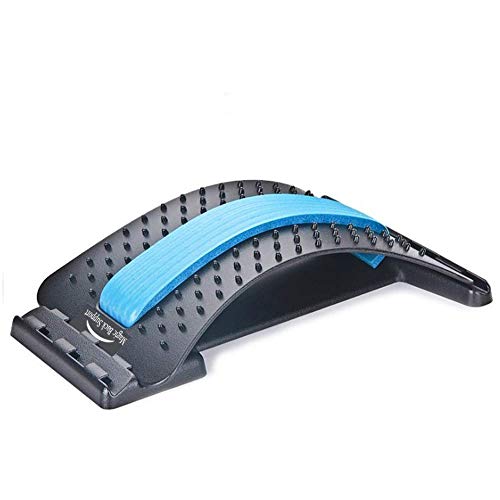
The Magic Back Support takes the same multi-level board idea and softens it. The ABS plastic frame adjusts through three settings, and a memory foam cushion sits on top of the board, which spreads pressure across the lower back instead of concentrating it on the plastic ridges. Published weight support is 320 pounds, second only to the MINOLL here. The board measures 38.5 by 25.4 centimeters, about 15.2 by 10 inches, so it covers the lumbar region without extending far up the back.
Its second talent is seated use. A strap secures the board to a chair or car seat, turning it into a firm lumbar support for desk work or driving, and the listing also names bed and floor use. That versatility suits someone who wants one device for a morning stretch on the floor and gentle support through the workday. The cushion is the comfort advantage and the upkeep item at the same time: foam pads compress over years of use and cannot be swapped as easily as a bare board can be wiped down.
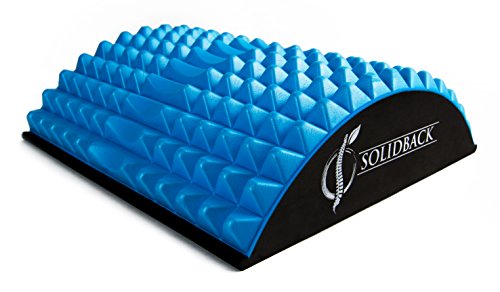
The SOLIDBACK takes the opposite approach to the adjustable boards: one fixed arch, molded from a single piece of dense EVA foam, with nothing to assemble and nothing to adjust. The arch is covered in raised nodes, 180 of them in the brand materials, which press into the back muscles as your body weight settles onto the curve. Published capacity is 300 pounds, and the brand suggests the arch suits users between 5 feet 4 inches and 6 feet tall, a useful sizing note that most listings in this category leave out.
At 12 by 11.3 by 3.7 inches and 1.2 pounds, it is compact enough to live beside a sofa or under a desk, and the foam build means it can also sit behind you in a chair as a firm lumbar cushion. The fixed arch is both the appeal and the limit. There is no gentler setting to retreat to during the first sessions, and no deeper setting to grow into later, so the stretch you get on day one is the stretch you keep. Buyers who want progression should look at the MINOLL or the Magic Back Support; buyers who want a firm, quiet, one-piece tool that never needs setting up will find this the most straightforward design here.
4. RESTCLOUD Back Stretcher
4. RESTCLOUD Back Stretcher
Design: Sea-shell shaped stretching cushion
Material: Polyurethane foam with memory foam fill
Levels: 4 intensity levels via removable ball
Use: Two directions, lower back or upper back orientation
The RESTCLOUD is the soft option in this group, a sea-shell shaped cushion rather than a board. It is molded from polyurethane foam with a memory foam fill, so the surface gives under your back instead of pushing a rigid curve into it. Intensity still adjusts: a removable ball inside the cushion changes the height and firmness of the arch, giving four intensity levels without any plastic frame or locking slots. The cushion also works in two directions, so flipping it end for end shifts the curve between the lower back and the area between the shoulder blades.
At about 2 pounds it is easy to carry from room to room, and the foam build stays quiet on hard floors. The compromises are support and information. A foam cushion cannot match the 400-pound published capacity of the MINOLL frame, and this listing does not publish a weight capacity or a full set of dimensions, so heavier users are better served by one of the framed boards above. For anyone who found rigid boards too aggressive, though, this is the gentlest route into a daily stretching habit, and the four ball settings still leave room to progress.
5. ProsourceFit Arched Back Stretching Spike Device
5. ProsourceFit Arched Back Stretching Spike Device
The ProsourceFit is the lightest and simplest pick here: a fixed foam arch weighing 8 ounces. It is molded from EVA foam, measures 12 by 11 by 3.75 inches, and its surface carries the raised spike texture named in the product title, which gives a firmer massage-style pressure than a smooth foam arch. There are no levels to set and no parts to join, so it goes from a closet shelf to the floor in seconds, and its low weight makes it the easiest of the five to pack for travel.
That simplicity defines its limits as well. The listing does not publish a weight capacity, and the single fixed arch offers no way to soften the first sessions or deepen later ones. The spike texture will also divide opinion: users who like strong pressure on tight muscles tend to appreciate it, while sensitive backs usually do better on the smooth SOLIDBACK foam or the cushioned RESTCLOUD. As an inexpensive way to find out whether a daily stretching routine suits you, it covers the basics with the least bulk and the least fuss in this roundup.
Boards, Arches and Cushions Compared
Three designs run through this list. Adjustable boards like the MINOLL and the Magic Back Support use a rigid frame with locking settings, which gives the widest range of stretch intensity and the highest published weight capacities, at the cost of a firm surface. Fixed foam arches like the SOLIDBACK and the ProsourceFit trade that range for simplicity and a softer first contact, with one curve that never changes. The RESTCLOUD cushion sits between the two ideas, using foam for comfort and a removable ball to recover some adjustability. A useful rule of thumb: the more rigid the device, the more control you get over intensity and the more carefully you should approach the first sessions.
How to Choose
Begin with adjustability. If you have never used a back stretcher, a multi-level board or the four-setting RESTCLOUD lets you begin at the shallowest setting, and that first setting matters more than the deepest one. Next, check the published weight capacity against your own weight, and treat listings that leave the figure unpublished as a reason to choose a framed board instead. Padding comes third: a foam strip or memory foam cushion softens a plastic board, while an all-foam arch or cushion avoids hard surfaces entirely. Size matters too. Taller users should note the SOLIDBACK height guidance and the modest footprints of the foam arches, which cover the lumbar area rather than the whole back. Finally, think about where the device will live. A board with a chair strap earns its keep twice a day, while a light foam arch that travels easily suits someone who stretches in more than one room.
Care and Cleaning
Plastic boards wipe down with a damp cloth and mild soap, and they should be dried before storage so the locking slots stay free of grit. Foam arches and cushions should be spot cleaned only, since soaking EVA or polyurethane foam can break down the material and trap moisture inside. Keep every design out of prolonged direct sunlight, which hardens foam and fades plastic, and store adjustable boards at their lowest setting to reduce stress on the frame. Before each session, check for cracks along the arch or slots, and retire any board that flexes unevenly or shows a split, since a damaged frame can shift under body weight.
FAQ
How long should each stretching session last?
The listings for these devices point to short sessions, and the MINOLL guidance of five to ten minutes twice a day is a sensible pattern for the whole group. Longer sessions do not deepen the benefit in the way extra weight deepens a lift, and they can leave the lower back feeling strained. Begin at the low end of the range, and add time only when the current session feels easy from beginning to end.
Which back stretcher suits a beginner best?
A beginner does best with adjustability and padding, so the Magic Back Support with its memory foam cushion or the RESTCLOUD foam cushion makes the gentlest introduction. Fixed arches like the SOLIDBACK and the ProsourceFit offer a single intensity from the first session, which some new users find strong. Whatever you choose, the lowest setting and the shortest session are the right opening combination.
Can a back stretcher be used on a chair?
Some can. The Magic Back Support ships with a strap for chair and car seat use, and the SOLIDBACK foam arch is compact enough to sit behind the lower back in an office chair. Framed boards without a strap belong on the floor, since they can slide on a seat. Seated use gives gentle lumbar support through the day rather than a full stretch, so it complements floor sessions instead of replacing them.
How do adjustable levels change the stretch?
Each higher level raises the arch, which increases the curve your lower back bends over and deepens the stretch through the lumbar muscles. The MINOLL expresses its three levels as angles, 15, 28, and 42 degrees, while the RESTCLOUD changes intensity with a removable ball inside the cushion. Move up one level at a time, and give your back several sessions at each level before advancing.
Conclusion
The right back stretcher is the one whose intensity you can control and whose surface you can relax onto. The MINOLL earns the top spot for its three angles, 400-pound published capacity, and flat packing, while the Magic Back Support is the pick for anyone who wants padding and seated use in the same device. The SOLIDBACK and ProsourceFit cover the fixed foam arch in firm and light forms, and the RESTCLOUD shows that a cushion with a simple insert can still offer four levels of progression. Match the design to your sensitivity, respect the published capacities, keep sessions short, and a few minutes of stretching can become a steady part of the day.
D
Disdik Picks Editorial Team
We compare specs, materials and verified owner reviews before a product earns a spot. Rankings are never paid.
Affiliate disclosure. As an Amazon Associate we earn from qualifying purchases at no extra cost to you. Prices accurate as of the date shown.
Find the best razors for women for legs, underarms and sensitive skin. Compare five cartridge, disposable and shave-kit options and choose a smooth shave.
We compared the best comforters for every sleeper, from light all-season inserts to plush king-size picks, so you can find the right warmth for your bed.
We compared the best calculators for students, professionals, and home offices, covering scientific, graphing, financial, printing, and desktop models.


 4. RESTCLOUD Back Stretcher
 5. ProsourceFit Arched Back Stretching Spike Device










Write Your Review
No reviews yet. Be the first to share your experience!