Disdik Picks is reader-supported. When you buy through links on our site, we may earn a commission at no extra cost to you. As an Amazon Associate, we earn from qualifying purchases. Learn more ›
Best Latex Pillows: Five Picks for Cool, Responsive Sleep
Compare the best latex pillows by loft, latex type and cover, from zoned Talalay and grid-wrapped cores to adjustable fills for all sleepers.
Compare the best latex pillows by loft, latex type and cover, from zoned Talalay and grid-wrapped cores to adjustable fills for all sleepers.
⭐ Key Takeaways
Quick answer: Our top pick is Malouf Zoned Talalay Latex Pillow, King High Loft, Plush, with Purple Harmony Pillow, Standard, Medium as a strong alternative.
The best latex pillow for most sleepers is the Malouf Zoned Talalay Latex Pillow in King High Loft Plush, because it pairs a solid core of 100 percent natural Talalay latex with a zoned design that feels softer under the head and firmer under the neck, so the head sinks in while the neck stays supported through the night. The Purple Harmony Pillow in Standard Medium is the best pick for a sleeper who wants a latex core with extra cooling structure, because it wraps aerated Talalay latex in a honeycomb GelFlex Grid that spreads pressure and keeps air moving around the head. The Organic Textiles Natural Latex Pillow in Standard Medium is the best pick for a buyer who wants a simple solid latex pillow with an organic cotton cover, because it keeps the build to one latex core and one removable cover with nothing to adjust and nothing to refill. The JUVEA Elevate High-Profile Latex Pillow in Queen with a Tencel cover is the best pick for side sleepers who need height, because its high profile lifts the head far enough to fill the gap between ear and shoulder. The Coop Home Goods Adjustable Latex Pillow in King is the best pick for a sleeper who is still learning their loft, because its cross-cut Talalay latex and microfiber fill can be added or removed until the height feels right. The rest of this guide ranks them by support, loft, cooling, and ease of fitting, and it starts with the one warning that matters most: people with a latex allergy should avoid latex pillows entirely, and anyone unsure about a latex sensitivity should talk with a clinician before buying one, since a cover does not make a latex pillow safe for someone with a latex allergy.
As an Amazon Associate, we earn from qualifying purchases.
All five picks are latex pillows built to sleep on every night, and all five hold the head up with a springy lift instead of the slow sink of memory foam. The Malouf pick leads as the classic solid Talalay pillow, with a zoned core and a choice of loft and feel. The Purple Harmony pick is the engineered one, with a Talalay core wrapped in a grid that spreads pressure. The Organic Textiles pick is the simple one, with a single natural latex core and a removable organic cotton cover. The JUVEA pick is the tall one, with a high profile built for side sleepers. The Coop pick is the adjustable one, with loose fill that the sleeper adds or removes to set the loft.
What Makes a Good Latex Pillow
A latex pillow has four jobs, and a good one does all four without asking the sleeper to think about any of them. The first job is support: the pillow must hold the head at a height that keeps the neck in line with the spine, because a pillow that is too flat lets the head drop and a pillow that is too tall pushes the chin toward the chest. The second job is response: the pillow must push back when the sleeper moves, because latex is springy by nature, and a good latex pillow bounces back to shape instead of holding a dent where the head was. The third job is airflow: the pillow must let air move through it, because a pillow that traps heat wakes the sleeper up, and latex earns its reputation for sleeping cool through open cells and pin-hole ventilation rather than through any coating. The fourth job is durability: the pillow must keep its shape for years, because a latex pillow costs more than a fiber pillow, and the purchase only makes sense if the core resists flattening and clumping over time.
Support is the first quality that matters, and it comes from loft and firmness working together. Loft is the height of the pillow when nothing presses on it, and firmness is how much it gives way under weight, and a buyer needs both to be right for their sleep position. Side sleepers need the tallest loft, because the pillow has to fill the gap between the ear and the shoulder, which is why the JUVEA pick and the Malouf pick in high loft suit side sleepers best. Back sleepers need a medium loft, because the head rests closer to the mattress, which is why the Purple Harmony pick in medium height and the Organic Textiles pick in medium feel suit back sleepers well. Stomach sleepers need the lowest loft, because a tall pillow bends the neck backward, which is why the Malouf pick in low loft and the Coop pick with fill removed suit stomach sleepers best. A buyer who sleeps in more than one position should favor an adjustable pick like the Coop, since a fixed loft can only be right for one position at a time.
Response is the second quality, and it is what separates latex from memory foam most clearly. Memory foam softens with body heat and holds the shape of the head for a while after the sleeper moves, while latex springs back the moment the weight lifts, so a latex pillow feels lively under the head. All five picks here share that springy feel, and they differ in how it is delivered. The Malouf, Organic Textiles, and JUVEA picks use solid latex cores, so the response is even across the whole surface. The Purple Harmony pick adds a GelFlex Grid around its Talalay core, so the surface gives way in small honeycomb cells and the pressure spreads out instead of concentrating under the ear. The Coop pick uses cross-cut Talalay latex mixed with microfiber, so the response is softer and more moldable, and the sleeper can shape the fill by hand before lying down.
Airflow is the third quality, and it decides whether the pillow sleeps cool or warm. Latex foam has an open-cell structure, and solid Talalay cores are pierced with pin holes that let air pass through the slab, so heat escapes instead of pooling under the head. The Malouf, Organic Textiles, and JUVEA picks all rely on that pin-hole ventilation, and the Purple Harmony pick adds a mesh cover and an open grid that leaves air channels across the surface. The Coop pick breathes through loose fill, since air moves between the pieces of cross-cut latex and microfiber. A buyer who sleeps hot should favor a pick with pin-hole ventilation and a breathable cover, and should also use a breathable pillowcase, since a heavy case can undo the airflow the pillow was built to provide.
Durability is the fourth quality, and it is the reason latex pillows carry a higher tier than fiber pillows. A solid latex core resists the flattening that turns a fiber pillow into a pancake within a year, and makers describe latex as holding its loft far longer than shredded foam or fiber fill. The solid-core picks here, the Malouf, Organic Textiles, and JUVEA, should hold their shape longest, since there is nothing inside them to shift or clump. The Coop pick trades a little of that permanence for adjustability, since loose fill can settle and needs a shake now and then, and the Purple Harmony pick trades a little for its grid, which can wear at a different rate from the core. A buyer should still protect any latex pillow with a pillowcase and keep it out of direct sun, since latex breaks down faster under strong light and heat, and should never machine wash a solid latex core, since soaking a latex slab can damage the foam.
Talalay vs Dunlop Latex
Latex pillows are made by one of two processes, Talalay or Dunlop, and knowing which one a pillow uses tells a buyer most of what they need to know about how it will feel. The Talalay process whips the liquid latex, pours it into a mold, vacuum-expands it, and flash-freezes it before baking, which creates an even, open-cell structure that feels soft, springy, and consistent from edge to edge. The Dunlop process pours the liquid latex into a mold and bakes it without the vacuum step, which creates a denser foam that is firmer at the bottom of the slab than at the top and feels heavier and more grounded. Most solid latex pillows sold for sleeping use Talalay, because it runs cooler and feels more buoyant, and four of the five picks here are Talalay, with the Organic Textiles pick using natural latex in the same solid-core style.
Talalay suits a buyer who wants a light, bouncy feel and steady airflow. The Malouf pick is the clearest example, with a 100 percent natural Talalay core that the maker zones for softer support under the head and firmer support under the neck. The Purple Harmony pick uses an aerated Talalay core, which means the foam is made with extra air worked through it, and wraps it in a grid that adds pressure relief on top of the Talalay bounce. The JUVEA pick uses a 100 percent natural Talalay core made in the United States, with a high profile that keeps the bounce while adding height for side sleepers. The Coop pick uses cross-cut Talalay latex, which means solid Talalay foam cut into small pieces and blended with microfiber, so the sleeper gets the Talalay response in a loose, adjustable fill instead of a single slab.
Dunlop suits a buyer who wants a firmer, denser feel and does not mind a heavier pillow. Dunlop latex is the older process, and it produces a foam that supports strongly and resists bottoming out under a heavy head, which some back sleepers prefer. The Organic Textiles pick in this roundup is described by its maker as a natural latex pillow, and its solid core behaves in the Dunlop family of firm, steady support, with a medium feel that suits back and side sleepers. A buyer choosing between the two processes should start with feel: Talalay for bounce and breathability, Dunlop for density and firm support.
Certifications are the other language a buyer will meet on latex pillow listings. GOTS covers organic textiles, so a GOTS-certified cover means the cotton was grown and processed to an organic standard, which is what the Organic Textiles pick offers. OEKO-TEX covers the finished product against harmful substances, and the JUVEA pick carries OEKO-TEX Class 1, the strictest class. GreenGuard Gold covers low chemical emissions, and CertiPUR-US covers foam; the Coop pick carries both. None of these marks replaces the loft and firmness check, but they tell a buyer the materials were tested by an outside body.
1. Malouf Zoned Talalay Latex Pillow, King High Loft, Plush
Top Pick
1. Malouf Zoned Talalay Latex Pillow, King High Loft, Plush
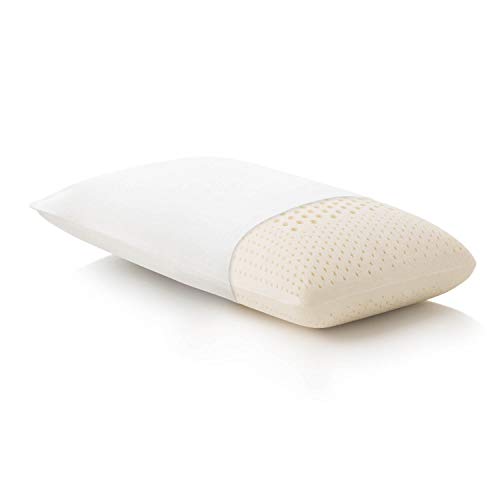
The Malouf Zoned Talalay Latex Pillow in King High Loft Plush is the best latex pillow for most sleepers because it pairs a solid core of 100 percent natural Talalay latex with a zoned design that feels softer under the head and firmer under the neck, so the head sinks in gently while the neck stays lifted through the night. The pillow comes in Queen and King sizes, and the maker offers it in high loft and low loft, in plush and firm feels, so a buyer can match the height and the firmness to their sleep position instead of accepting one fixed shape. The King High Loft Plush version here is the tallest and softest of the four combinations, which makes it the natural default for side sleepers and for back sleepers with broad shoulders, since both need height without hardness.
The zoned core is the feature that earns this pillow its place at the top. Most solid pillows support the head and the neck with the same foam, so a pillow that is soft enough for the head is too soft for the neck, and a pillow that is firm enough for the neck is too firm for the head. Malouf cuts the Talalay core into zones, with a softer zone where the head rests and a firmer zone where the neck rests, so each part of the sleeper gets the support it needs from one slab. The Talalay latex itself is pin-holed for ventilation, per the listing data, which lets air pass through the core and keeps the pillow from holding heat the way a solid memory foam slab does. The result is a pillow that feels buoyant rather than sinking, and that returns to shape the moment the sleeper lifts their head.
The range of sizes and feels is the second reason to choose this pillow. A buyer who sleeps on their side should favor the high loft, since the pillow has to fill the gap between ear and shoulder, while a buyer who sleeps on their stomach should favor the low loft, since a tall pillow bends the neck backward. A buyer who likes a soft landing should favor the plush feel, while a buyer who wants a firmer pushback should favor the firm feel, and the King size gives a taller sleeper more surface to move across. The cover is soft and removable, per the maker, so the sleeper can wash the cover while the latex core stays dry. A buyer who wants one pillow that can be tuned by size, loft, and feel before ordering should start here, since no other pick here offers as many combinations.
The limits of this pillow are the limits of a fixed solid core, and a buyer should know them before ordering. A solid core cannot be adjusted after it arrives, so the buyer has to choose the loft and the feel up front, and a buyer who guesses wrong will need to exchange the pillow rather than fix it at home. The King size is the largest of the five picks, so it needs a King pillowcase and a wide bed, and a buyer with a twin bed should weigh the Queen size instead. The plush feel suits most sleepers, but a buyer who wants a very firm pillow should weigh the firm version of the same pillow. A buyer who wants the most adjustable pillow should weigh the Coop pick instead, but a buyer who wants the classic solid Talalay pillow with zoned support should start here.
2. Purple Harmony Pillow, Standard, Medium
Runner-Up
2. Purple Harmony Pillow, Standard, Medium
Fill: Aerated Talalay latex core with GelFlex Grid
The Purple Harmony Pillow in Standard Medium is the best pick for a sleeper who wants a latex core with extra cooling structure, because it wraps an aerated Talalay latex core in a honeycomb GelFlex Grid that spreads pressure across the surface and leaves open air channels around the head. The Standard size fits a standard pillowcase and a normal bed, and the medium feel with medium height suits back sleepers and combination sleepers who move between their back and their side during the night. The grid is the feature that makes this pillow different from every other solid latex pillow here, and it is the reason a hot sleeper should look at it first.
The GelFlex Grid is a layer of flexible honeycomb cells that sits around the Talalay core, and it works by collapsing under weight in small, separate cells instead of pressing down as one flat sheet. When the sleeper lies down, the cells under the heaviest part of the head give way while the cells around them stay upright, so the pressure spreads out instead of concentrating under the ear and the cheek. The grid also leaves open space between the cells, so air moves across the surface instead of being trapped under the head, and the cover is a moisture-wicking mesh, per the listing data, which pulls dampness away from the skin. The Talalay core underneath provides the springy lift that latex is known for, so the pillow pushes back when the sleeper moves.
The medium height is the second reason to choose this pillow. A medium-height pillow suits a back sleeper, because the head rests close to the mattress and a tall pillow would push the chin toward the chest, and it suits a combination sleeper, because it is tall enough to support the head on the side for part of the night without being so tall that it strains the neck on the back. The Standard size fits a standard pillowcase, so the buyer does not need to buy new cases, and the pillow works on any bed, from a twin to a king. A buyer who wakes up hot should favor this pillow over a plain solid latex core, since the grid and the mesh cover add airflow that a solid slab alone cannot match, and a buyer who likes a pillow that feels different from anything else on the bed should start here, since no other pick here has a grid layer.
The limits of this pillow are the limits of an engineered design, and a buyer should know them before ordering. The grid adds weight and structure, so the pillow feels heavier and less simple than a plain latex slab, and a buyer who wants the lightest pillow should weigh the Organic Textiles pick instead. The medium height suits back and combination sleepers, but a dedicated side sleeper with broad shoulders may find it too short, and should weigh the JUVEA pick or the Malouf pick in high loft instead. The grid layer also means the pillow has two parts that can wear at different rates, and the buyer should check the cover and the grid for wear now and then instead of assuming the whole pillow ages as one piece. A buyer who wants the most cooling structure in a latex pillow should start here, and a buyer who wants the simplest solid latex pillow should weigh the Organic Textiles pick instead.
3. Organic Textiles Natural Latex Pillow, Standard, Medium
The Organic Textiles Natural Latex Pillow in Standard Medium is the best pick for a buyer who wants a simple solid latex pillow with an organic cotton cover, because it keeps the build to one latex core and one removable cover with nothing to adjust and nothing to refill. The Standard size fits a standard pillowcase, and the medium feel suits back sleepers and side sleepers who want steady support without a hard pushback. The pillow is the plainest of the five picks, and that plainness is the point: a buyer who wants latex and cotton and nothing else will find nothing here to argue with.
The solid core is the feature that earns this pillow its place. A single slab of natural latex holds its shape from edge to edge, so the support is even wherever the head rests, and the core resists the flattening and clumping that turns a fiber pillow into a pancake within a year. The maker describes the pillow as hypoallergenic and free of harsh chemicals and heavy metals, and the fitted cover is made from 100 percent organic cotton, per the maker, with a GOTS-certified cover on the Talalay versions of the same line. The cover is removable, so the sleeper can wash it while the latex core stays dry, which matters because a solid latex core should never be soaked or machine washed. The pin-hole ventilation in the core lets air pass through the slab, so the pillow sleeps cooler than a solid memory foam pillow and the head does not wake up damp.
The simple build is the second reason to choose this pillow. There is no grid to learn, no fill to adjust, and no loft to set, so the buyer orders a Standard Medium pillow and sleeps on it the same night. The medium feel suits a back sleeper, because it holds the head at a steady height without pushing the chin up, and it suits a side sleeper with a narrower frame, because the core gives way enough to let the shoulder settle without dropping the head. The standard size fits a standard pillowcase and a normal bed, so the buyer does not need to buy new cases.
The limits of this pillow are the limits of a simple fixed pillow, and a buyer should know them before ordering. A fixed loft cannot be adjusted, so a buyer who needs a very tall pillow for broad shoulders should weigh the JUVEA pick or the Malouf pick in high loft instead, and a buyer who needs a very low pillow for stomach sleeping should weigh the Malouf pick in low loft instead. The medium feel suits most sleepers, but a buyer who wants a very soft pillow will find this one firmer than expected, and a buyer who wants a very firm pillow will find it softer than expected, which is the trade of any middle feel. The cover is organic cotton, which breathes well but wrinkles and shows wear sooner than a synthetic cover, so the buyer should expect the cover to look lived-in after a few washes. A buyer who wants the simplest latex pillow with the cleanest materials should start here.
Specs
Fill: Natural latex, solid core
Size: Standard
Feel: Medium
Cover: Removable 100 percent organic cotton cover, per the maker
Certification: GOTS-certified cover on the Talalay versions of the line
Ventilation: Pin-hole ventilation through the core
Care: Wash the cover, spot-clean the core, do not machine wash the latex
The JUVEA Elevate High-Profile Latex Pillow in Queen with a Tencel cover is the best pick for side sleepers who need height, because its high profile lifts the head far enough to fill the gap between ear and shoulder and keep the neck in line with the spine. The pillow measures about 24 x 15.7 inches, per the roundup data, with a loft of about 6.5 inches, which makes it the tallest pick here, and it is made from 100 percent natural Talalay latex in the United States, per the maker. The Tencel cover is removable and washable, and the pillow carries OEKO-TEX Class 1 certification.
The high profile is the feature that earns this pillow its place. A side sleeper needs a pillow tall enough to fill the space between the mattress and the ear, and that space is wider than most buyers guess, especially for a sleeper with broad shoulders. A pillow that is too short lets the head drop toward the mattress and bends the neck sideways all night, which is the most common reason a side sleeper wakes up stiff. The Elevate answers that with a loft of about 6.5 inches, taller than the medium-height picks here, and with a Talalay core that holds its height under weight instead of compressing flat. The core is springy, so it pushes back when the sleeper shifts, and the pin-hole ventilation lets air pass through the slab so the tall core does not trap heat.
The build quality is the second reason to choose this pillow. The Talalay latex is made in the United States, per the maker, and the OEKO-TEX Class 1 certification means the finished pillow was tested against a list of harmful substances at the strictest level in that system, which suits a product that spends eight hours a night against the face. The Tencel cover is soft and smooth, and it unzips for washing while the latex core stays dry. The Queen size fits a queen pillowcase and suits a sleeper who moves across the bed, and the maker also offers the same pillow in King and with an organic cotton cover, so a buyer who likes the height can match the size and the cover to their bed.
The limits of this pillow are the limits of a tall fixed pillow, and a buyer should know them before ordering. A high profile suits a side sleeper and a combination sleeper who spends most of the night on their side, but it is too tall for a stomach sleeper, whose neck would bend backward, and it may be too tall for a back sleeper with a narrow frame, who should weigh the Purple Harmony pick or the Organic Textiles pick instead. The pillow is also the tallest pick here, so it needs a pillowcase with room to spare and a bed where a tall pillow looks right, and a buyer who shares a bed with a partner who uses a low pillow should expect the two pillows to look uneven. A buyer who wants the tallest latex pillow with the strictest certification should start here, and a buyer who wants an adjustable height should weigh the Coop pick instead.
5. Coop Home Goods Adjustable Latex Pillow, King
5. Coop Home Goods Adjustable Latex Pillow, King
Fill: Cross-cut Talalay latex and microfiber blend, adjustable
Size: King
Feel: Medium firm
Cover: Quilted outer cover, 64 percent cotton, 35 percent polyester, 5 percent spandex, per the listing data
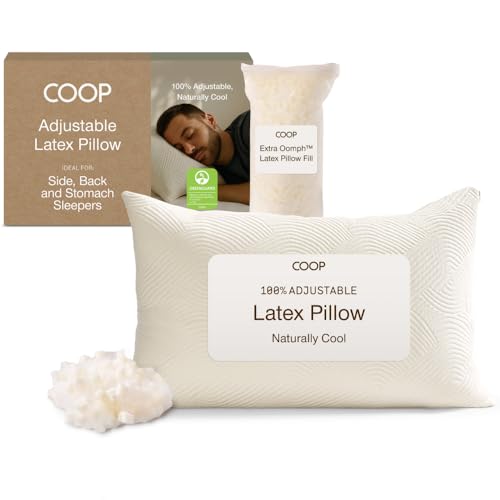
The Coop Home Goods Adjustable Latex Pillow in King is the best pick for a sleeper who is still learning their loft, because its cross-cut Talalay latex and microfiber fill can be added or removed until the height feels right, and the pillow comes with a bag of extra fill so the adjustment can go in both directions. The King size suits a taller sleeper and a larger bed, and the medium firm feel suits back, side, and stomach sleepers alike, since the sleeper sets the loft to match the position instead of accepting a fixed height. The pillow is the only adjustable pick here, and it is the right choice for a buyer who has never found a fixed-loft pillow that fits.
The adjustable fill is the feature that earns this pillow its place. The pillow is filled with cross-cut Talalay latex blended with microfiber, which means solid Talalay foam cut into small pieces and mixed with soft fiber, so the fill is springy like latex and moldable like down. The sleeper unzips the inner liner, adds fill to raise the loft or removes fill to lower it, and the pillow comes with an extra half-pound bag of fill, per the review data, so the buyer can top the pillow up after a few weeks if the fill settles. The cover is a quilted cotton blend, with an outer cover of 64 percent cotton, 35 percent polyester, and 5 percent spandex, per the listing data, and the inner liner is 100 percent polyester. The pillow carries GreenGuard Gold certification for low chemical emissions and CertiPUR-US certification for the foam, per the listing data, and it comes with a 5-year warranty, per the review data.
The moldable feel is the second reason to choose this pillow. A solid latex core holds one shape all night, but a sleeper who moves will find the Coop pillow easier to shape by hand before lying down, since the loose fill can be pushed toward the neck or spread flat under the head. The cross-cut latex keeps the fill from clumping the way plain fiber fill does, and the microfiber adds softness that pure latex pieces would lack, so the pillow feels plush on the surface and supportive underneath. The King size gives a taller sleeper more surface to move across, and the quilted cover feels smooth and breathable.
The limits of this pillow are the limits of a loose-fill design, and a buyer should know them before ordering. Loose fill settles, so the pillow needs a shake and a fluff now and then to redistribute the fill, and a sleeper who hates maintenance should weigh a solid-core pick like the Malouf or the Organic Textiles instead. The fill is a blend of latex and microfiber rather than pure latex, so a buyer who wants a 100 percent latex core should weigh the Malouf, JUVEA, or Organic Textiles picks instead, and a buyer with a latex allergy should avoid this pillow as surely as any other latex pillow, since the latex is in the fill itself. The adjustable design also means the pillow arrives firmer and fuller than most sleepers will keep it, so the buyer should expect to remove some fill on the first night and keep the extra bag for later. A buyer who wants to dial in their loft by hand should start here, and a buyer who wants a pillow that never needs adjusting should weigh a solid-core pick instead.
Latex Allergy and Safety Checks Before You Buy
The latex allergy warning belongs at the front of any latex pillow guide, and it belongs here in full. Natural latex comes from the sap of the rubber tree, and the proteins in that sap can trigger an allergic reaction in some people, from skin irritation to breathing difficulty. A person with a latex allergy should not buy a latex pillow, and a person who is unsure about a latex sensitivity should talk with a clinician before ordering one. A cover does not make a latex pillow safe for someone with a latex allergy, since the latex is the core of the pillow and the sleeper spends hours with their face against it, and a pillowcase does not change that. A buyer who has reacted to latex gloves, balloons, or elastic bands should treat that as a reason to choose a different pillow material entirely, and a buyer who develops itching, redness, or breathing trouble after sleeping on a latex pillow should stop using it and seek medical advice.
No federal recall covers latex pillows as a class, and none of the five picks in this roundup appears in any recall notice. That statement is worth making plainly, because home product recalls do exist, and a buyer should know which ones touch this category and which ones do not. Latex pillows are simple sleep products: foam cores and fabric covers with no heat, no motor, and no electrical parts, so the recall families that touch heated and powered bedding do not reach them. A buyer who owns a heated blanket or a heated mattress pad should check that product against its own recall record, and a buyer who owns a latex pillow should check the pillow itself for crumbling foam, torn covers, and flattened spots instead. Recalls attach to a model and a production window, not to a brand as a whole, so a buyer should search the exact model on the federal safer products database before first use and again if the pillow is handed down to someone else.
Two other cautions are practical rather than regulatory. Latex foam breaks down faster under strong light and heat, so keep the pillow out of direct sun and away from radiators, and store a spare latex pillow in a cool, dry place rather than in a hot attic. A solid latex core should never be machine washed or soaked, since soaking a latex slab can damage the foam and leave it damp inside; wash the cover, spot-clean the core with a damp cloth, and let it air dry fully before putting the cover back on. A tall pillow can also strain the neck if the loft is wrong for the sleeper, so a buyer who wakes up stiff after switching to a latex pillow should first check the loft against their sleep position, and a buyer with an ongoing neck problem should talk with a clinician about pillow height rather than treating a new pillow as a cure.
How to Choose the Right Latex Pillow
Start with your sleep position. Loft decides whether a latex pillow supports the neck or strains it, so match the height to the position first and worry about the brand second. Side sleepers need the tallest loft, which points to the JUVEA pick at about 6.5 inches or the Malouf pick in high loft. Back sleepers need a medium loft, which points to the Purple Harmony pick in medium height or the Organic Textiles pick in medium feel. Stomach sleepers need the lowest loft, which points to the Malouf pick in low loft or the Coop pick with fill removed. A buyer who sleeps in more than one position should favor the Coop pick, and a buyer who stays in one position all night should favor a solid-core pick matched to that position.
Choose solid core or adjustable fill. A solid core, like the Malouf, Organic Textiles, and JUVEA picks, holds one shape all night and keeps its loft for years, so it suits a buyer who knows their loft and wants a pillow that never needs attention. An adjustable fill, like the Coop pick, lets the sleeper set the loft by hand and change it later, so it suits a buyer who is still learning their loft. A grid-wrapped core, like the Purple Harmony pick, sits between the two: a fixed pillow with extra pressure relief built into the surface. A buyer who hates maintenance should favor a solid core, and a buyer who has returned pillows for wrong height should favor the adjustable fill.
Check the latex type and the cover. Talalay latex feels lighter and bouncier than Dunlop latex, and it breathes better through its open cells and pin holes, which is why four of the five picks here are Talalay. A buyer who wants the most buoyant feel should favor a Talalay pick, and a buyer who wants the densest, firmest feel should look for a Dunlop pick. The cover matters as much as the core: an organic cotton cover, like the Organic Textiles pick, breathes well and suits a buyer who wants natural fibers, while a Tencel cover, like the JUVEA pick, feels smooth and wicks moisture, and a mesh cover, like the Purple Harmony pick, moves the most air. A buyer should also check whether the cover unzips for washing, since a washable cover is the only practical way to keep a latex pillow clean.
Mind the allergy check before you order. This is not a step to skip, and it comes before the loft check for anyone with a history of latex sensitivity. A person with a latex allergy should not buy any pillow in this roundup, and a person who is unsure should talk with a clinician first. A buyer who has no latex sensitivity can order with confidence, and should still read the listing for the latex type, since some pillows blend latex with other fills and the blend changes both the feel and the care routine. A buyer who wants a latex-free pillow with a similar bounce should look at a different material entirely rather than hoping a cover will block the latex inside.
Frequently Asked Questions
Are latex pillows good for side sleepers?
Yes, when the loft is tall enough. A side sleeper needs a pillow that fills the gap between the ear and the shoulder, which is why the JUVEA pick at about 6.5 inches and the Malouf pick in high loft suit side sleepers best. A medium-height pillow can work for a side sleeper with a narrower frame, but a dedicated side sleeper with broad shoulders should favor a high-profile pick and check the loft before ordering.
Do latex pillows sleep cool?
Latex sleeps cooler than memory foam because its open-cell structure and pin-hole ventilation let air pass through the core instead of trapping heat under the head. The Purple Harmony pick adds a grid and a mesh cover for extra airflow, and the solid-core picks rely on pin holes through the slab. A breathable pillowcase helps, since a heavy case can undo the airflow the pillow was built to provide.
Can I wash a latex pillow?
Do not machine wash a solid latex core and do not soak it, since soaking can damage the foam and leave it damp inside. Wash the removable cover according to its care label, spot-clean the core with a damp cloth, and let it air dry fully before putting the cover back on. The Coop pick is the exception in routine only: its cover washes the same way, while its latex fill should be spot-cleaned rather than soaked.
How long does a latex pillow last?
A solid latex core holds its shape far longer than a fiber pillow, and makers describe latex as one of the most durable pillow materials, resisting the flattening and clumping that retire a fiber pillow within a year or two. The solid-core picks here should keep their loft for years with basic care, while the adjustable Coop pick needs a shake now and then to redistribute its loose fill. Replace any latex pillow that has crumbling foam, a torn cover, or a flat spot that no longer springs back.
Conclusion
A latex pillow is a simple idea done well: a springy core that lifts the head, pushes back when the sleeper moves, and lets air pass through instead of trapping heat, and the best latex pillow is the one whose loft matches the sleeper. The Malouf Zoned Talalay Latex Pillow in King High Loft Plush leads this roundup because it pairs a solid core of 100 percent natural Talalay latex with a zoned design that supports the head and the neck differently, and it is the safest default for a first latex pillow purchase. The Purple Harmony pick is the best engineered pick for hot sleepers, the Organic Textiles pick is the best simple pick for a buyer who wants latex and organic cotton and nothing else, the JUVEA pick is the best tall pick for side sleepers, and the Coop pick is the best adjustable pick for a sleeper who is still learning their loft. Check the latex allergy warning first, match the loft to the sleep position, and any of the five will leave the bed bouncier, cooler, and more supportive than it is today.
D
Disdik Picks Editorial Team
We compare specs, materials and verified owner reviews before a product earns a spot. Rankings are never paid.
Affiliate disclosure. As an Amazon Associate we earn from qualifying purchases at no extra cost to you. Prices accurate as of the date shown.
Find the best razors for women for legs, underarms and sensitive skin. Compare five cartridge, disposable and shave-kit options and choose a smooth shave.
We compared the best comforters for every sleeper, from light all-season inserts to plush king-size picks, so you can find the right warmth for your bed.
We compared the best calculators for students, professionals, and home offices, covering scientific, graphing, financial, printing, and desktop models.



 5. Coop Home Goods Adjustable Latex Pillow, King










Write Your Review
No reviews yet. Be the first to share your experience!