Disdik Picks is reader-supported. When you buy through links on our site, we may earn a commission at no extra cost to you. As an Amazon Associate, we earn from qualifying purchases. Learn more ›
Best Walking Canes for Balance, Support and Travel
Compare the best walking canes for balance and mobility, including offset and quad-base designs, adjustable heights and folding canes for travel.
Nov 19, 2026
Updated Nov 20, 2026
10 min read
5 views
A well-chosen walking cane does more than take weight off a sore leg. The right base steadies your balance on uneven ground, the right handle protects your wrist over thousands of steps, and the right height keeps your posture upright instead of hunched. Canes range from simple offset singles to four-pronged quad designs that stand on their own, plus folding models that disappear into a bag. This guide compares five dependable canes across those styles, explains how to size and use one correctly, and helps you match the level of support to your mobility, your home, and your travel habits.
As an Amazon Associate, we earn from qualifying purchases.
Quick Answer
The Medline Aluminum Offset Walking Cane is the best simple choice for everyday balance, with a wide height range from a trusted medical brand. The Drive Medical Foam Grip Offset Handle Cane adds grip comfort. For maximum stability, the Hugo Adjustable Quad Walking Cane and the RMS Quad Cane stand on their own, while the KingPavonini Adjustable Walking Cane folds for travel with a quad base and a second handle.
How to Choose
Start with the base, because it decides how much stability you get. A standard single-tip cane suits people who need light balance help and can bear most of their own weight. An offset cane keeps the same single tip but shifts the shaft so your weight passes straight down through the tip, which feels steadier and supports more load. A quad cane spreads support across four rubber-tipped feet, stands on its own when you let go, and helps most on flat indoor floors, though it feels heavier and slower on stairs.
Height fit is non-negotiable. Stand in your usual shoes with your arm hanging naturally; the cane’s handle should reach the crease of your wrist. Most adjustable canes cover a range from roughly twenty-eight to thirty-eight inches, so check that your measurement falls comfortably in the middle of a model’s range rather than at its very end. Your elbow should bend slightly when you grip the handle.
Handle style shapes daily comfort. Foam and gel grips cushion the palm for arthritic hands, offset handles align the wrist over the shaft to reduce strain, and classic T or derby handles hook over a forearm when you need both hands free. If you will use the cane for hours, grip comfort matters as much as the base.
Consider weight and folding. Aluminum canes are light enough to lift without thinking about it, and folding models collapse into sections that fit a tote, car door pocket, or suitcase, which frequent travelers value. Finally, confirm the weight capacity matches the user with room to spare, and plan to replace rubber tips when their tread wears smooth.
Medline is one of the most familiar names in medical mobility, and this aluminum offset cane is its straightforward everyday model. The offset shaft centers your weight over the tip for a more planted feel than a traditional crook cane, while the contoured handle and foam grip keep the palm comfortable on longer walks. Push-button adjustment covers a generous height range that fits shorter and taller adults alike.
Specs
Feature
Detail
Type
Offset handle, single tip
Material
Lightweight aluminum
Height
Adjustable across a wide range
Capacity
Supports up to 300 pounds
Extras
Wrist strap, replaceable rubber tip
The build is deliberately plain: no electronics, nothing to charge, and a finish that wipes clean. It is light enough to carry up stairs without noticing it, and the locking mechanism clicks positively into each height setting so there is no play in the shaft. Replacement tips and accessories are easy to find because the design follows standard sizing.
A single tip will never match a quad cane for standing stability, and the foam grip, while comfortable, is less plush than a thick gel handle. For someone who needs dependable light-to-moderate support from a brand hospitals know, this Medline cane is the sensible default recommendation.
Drive Medical’s foam grip offset cane takes the same proven formula and leans into comfort. The handle is wrapped in a soft foam grip that cushions the hand and absorbs some of the vibration from hard pavement, and a wrist strap keeps the cane from clattering to the floor when you reach for a door handle or your wallet.
Specs
Feature
Detail
Type
Offset handle, single tip
Grip
Soft foam with wrist strap
Material
Anodized aluminum shaft
Height
Push-button adjustable
Extras
Locking ring reduces rattle
Height adjusts with a push button, and a locking ring snugs the two shaft sections together to prevent the faint rattle that loose canes develop. The anodized finish resists scratches and corrosion, and the silver styling looks clean and neutral in any setting. The cane supports everyday users up to a typical medical-cane capacity while staying light in the hand.
As with any single-tip model, it will not stand on its own and offers less help on very uneven ground than a quad base. The foam grip can also wear over years of daily use, though it is inexpensive to replace the whole cane when that day comes. For comfort-focused daily support at home and around town, it is an easy recommendation.
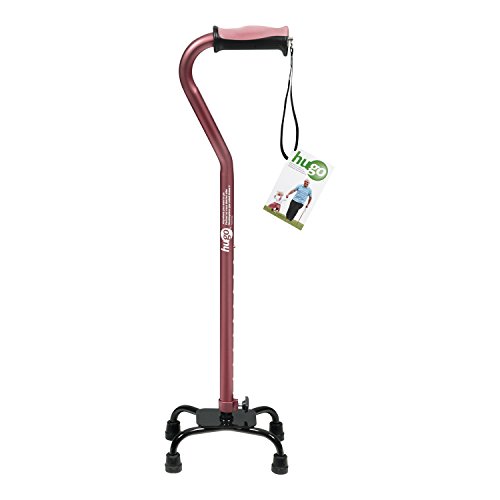
Hugo’s quad cane is built for people who want the cane to wait patiently beside them. Its four-pronged base stands upright on its own at a chair, bedside, or restaurant table, so there is no hunting for somewhere to lean it. The base uses a K-shaped design that rotates and locks to suit right- or left-handed use, and the flared rubber tips grip the floor at every step.
Specs
Feature
Detail
Type
Quad cane, small base
Base
Rotating K-shaped base for either hand
Height
Eleven push-button settings
Capacity
Supports up to 300 pounds
Extras
Self-standing, reflective strap
Eleven height settings across a wide range make a precise fit easy, and the offset handle keeps weight flowing down through the base rather than tipping it. Despite the four feet, the aluminum build stays light enough for daily use, and the rose finish gives it a warmer look than clinical chrome. A reflective strap adds a small safety touch for evening walks.
Quad canes ask for a slower, flatter walking rhythm: all four tips should land together, which takes a little practice on stairs and uneven pavement. The base is also wider than a single tip, so it needs a bit more floor clearance. For indoor confidence and hands-free standing, the Hugo design is one of the most practical quads available.
RMS Quad Cane
The RMS Quad Cane pairs a large four-pronged base with a foam-padded offset handle, aiming squarely at maximum everyday stability. The base can be rotated for right- or left-handed users, stands on its own between uses, and plants four nonslip rubber tips on tile, hardwood, and pavement alike. The anodized aluminum shaft keeps the whole cane around a pound and a half, light for a quad.
Specs
Feature
Detail
Type
Quad cane, large base
Base
Four-pronged, self-standing
Height
Adjustable from 28 to 37 inches
Capacity
Supports up to 250 pounds
Extras
Foam-padded offset handle
The lower end of its height range dips below many rivals, which makes this a notably good fit for shorter users who often find medical canes start too tall. The foam-padded handle is gentle on the palm and wrist, and the offset geometry keeps your weight centered over the base. Corrosion-resistant materials suit it to bathroom and kitchen floors where splashes happen.
The capacity ceiling is lower than some competitors, so heavier users should pick a higher-rated model, and like all quad canes it rewards a deliberate pace. Within its limits, the RMS offers the steadiest, most confidence-building support in this roundup for flat everyday surfaces.
The KingPavonini cane answers a specific problem: how to travel with real stability. It folds down for a bag or suitcase, then opens into a cane with a four-pronged base for extra steadiness at the other end of the trip. A foam-padded offset handle softens the grip, and a second lower handle gives you something to push against when rising from a chair, which is when many people feel least steady.
Specs
Feature
Detail
Type
Folding cane with quad base
Handle
Foam-padded offset plus second handle
Height
Adjustable across several settings
Base
Four-pronged for extra stability
Extras
Second handle aids standing up
The folding sections snap together quickly and the assembled cane feels solid rather than spindly, a common fear with collapsible designs. The four-pronged base grips hotel lobbies, airport floors, and sidewalks with more confidence than a folding single-tip cane, and it can stand briefly on its own while you handle luggage or documents.
Folding joints add a little weight and need an occasional check to stay snug, and the base is smaller than a full home quad cane. As a travel companion that does not ask you to give up stability at your destination, though, the KingPavonini design is genuinely clever and very usable.
Who Should Skip It
Skip a cane entirely and talk to a clinician about a walker or rollator if you cannot bear weight on one leg, feel dizzy when standing, or have fallen repeatedly; a cane may not provide enough support. Skip quad canes if your main walking happens on stairs, trails, or deeply uneven ground, where a single tip is easier to place safely. Skip folding canes if you want the absolute stiffest, simplest shaft with no joints. And skip fashion-first wooden canes without height adjustment if fit matters, because an incorrectly sized cane can strain your wrist, shoulder, and back.
FAQ
How do I know if my cane is the right height?
Stand tall in your regular shoes with your arms relaxed at your sides. The top of the handle should line up with the crease of your wrist. When you hold the cane, your elbow should bend slightly, roughly a gentle angle, rather than staying locked straight or sharply bent.
Which hand should hold the cane?
Hold the cane in the hand opposite the weaker or injured leg. Move the cane and the weak leg forward together, then step through with the stronger leg. This pattern shares the load and keeps your balance centered as you walk.
Are quad canes better than single-tip canes?
Quad canes offer more stability and stand on their own, which helps people with significant balance concerns on flat surfaces. Single-tip canes are lighter, faster, and easier on stairs and uneven ground. The better choice depends on where you walk and how much support you truly need.
How often should cane tips be replaced?
Check the rubber tip monthly. When the tread looks smooth, cracked, or worn unevenly, replace it, since a worn tip is the most common cause of a cane slipping. Tips are inexpensive and usually pull off and push on without tools.
Final Verdict
Choose the Medline Aluminum Offset Walking Cane for simple, trusted everyday support, or the Drive Medical Foam Grip model if hand comfort leads your list. Step up to the Hugo Adjustable Quad Walking Cane or the RMS Quad Cane when standing stability and balance confidence matter most at home. Take the KingPavonini Adjustable Walking Cane when you travel and refuse to leave stability behind. Fit the height carefully, hold the cane on the strong side, and replace worn tips promptly.
D
Disdik Picks Editorial Team
We compare specs, materials and verified owner reviews before a product earns a spot. Rankings are never paid.
Affiliate disclosure. As an Amazon Associate we earn from qualifying purchases at no extra cost to you. Prices accurate as of the date shown.
Find the best razors for women for legs, underarms and sensitive skin. Compare five cartridge, disposable and shave-kit options and choose a smooth shave.
We compared the best comforters for every sleeper, from light all-season inserts to plush king-size picks, so you can find the right warmth for your bed.
We compared the best calculators for students, professionals, and home offices, covering scientific, graphing, financial, printing, and desktop models.

 Medline Aluminum Offset Walking Cane
 Drive Medical Foam Grip Offset Handle Cane
 Hugo Adjustable Quad Walking Cane
 KingPavonini Adjustable Walking Cane










Write Your Review
No reviews yet. Be the first to share your experience!