Disdik Picks is reader-supported. When you buy through links on our site, we may earn a commission at no extra cost to you. As an Amazon Associate, we earn from qualifying purchases. Learn more ›
Best Cotton Blankets: Five Woven Picks for All Seasons
Compare the best cotton blankets by weave, fabric weight and size, from the Madison Park basketweave to the budget Utopia thermal pick here.
Nov 19, 2026
Updated Nov 20, 2026
28 min read
8 views
The best cotton blanket for most buyers is the Madison Park Freshspun Basketweave, because it is the most completely specified blanket in this group: a 100 percent cotton cloth at a published 250 GSM, woven in an open basketweave that breathes in summer and layers cleanly under a comforter in winter, cut at a full 90 x 90 inches for a full or queen bed, and certified under the OEKO-TEX standard, with the certification printed in the maker’s own listing copy rather than implied. The Threadmill Luxury Cotton Blanket is the long-staple pick, a combed cotton herringbone with the heaviest published drape story in the group and a generous 90 x 92 inch queen cut. The Bedsure Cotton Blanket is the waffle pick, a 100 percent cotton waffle weave in a twin XL that suits dorm beds and single sleepers. The Vellux Cotton Blanket is the dense thermal pick, the heaviest cloth here at a published 360 GSM in a herringbone chevron. The Utopia Bedding Cotton Thermal Blanket is the budget classic, a 350 GSM thermal weave at queen size from the maker that has sold this category longer than anyone else in the group.
As an Amazon Associate, we earn from qualifying purchases.
The first separator is the weave, because in an unfilled woven blanket the weave is the insulation. A cotton blanket has no batting and no loft of its own; what warmth it gives comes from the air the weave traps and the air it lets escape. Three weave families divide this group. The thermal weave, carried by the Utopia and in denser form by the Vellux, is a raised, open construction full of small pockets that hold still air, which is why thermal blankets feel warmer than their weight suggests and why hospitals and hotels standardized on them. The waffle weave, carried by the Bedsure, pushes the same idea further in one direction: deep square cells that ventilate freely, so the blanket covers without sealing, the right shape for a hot sleeper who still wants a layer over the sheet. The basketweave, carried by the Madison Park, is the flattest and most open of the three, a plain checker of interlaced yarns that drapes like a heavy sheet and is bought as much for layering and for looks as for warmth. The herringbone twills, carried by the Threadmill and the Vellux, are the densest and smoothest, with fewer air pockets and more cloth per square inch, and they read as bedspreads as much as blankets. None of these is the correct weave in the abstract. The correct weave is the one matched to the sleeper: open weaves for warm rooms and warm bodies, dense twills for cool rooms and for buyers who want one layer to do more.
The second separator is fabric weight, and it is the spec this category publishes worst. GSM, grams per square meter, is the only honest cross-brand measure of how much cotton is actually in the blanket, and only three of these five makers print it: the Madison Park at 250 GSM, the Utopia at 350 GSM and the Vellux at 360 GSM. The Threadmill and the Bedsure publish no GSM figure in the listing data reviewed, so their weight can only be judged by the item weights their listings print, which mix the blanket with its packaging and vary by size. Two cautions follow. First, GSM compares cloth, not warmth: a 250 GSM basketweave with an open structure can sleep cooler than a 350 GSM thermal, because the weave decides how much of the cloth’s air stays trapped. Second, a missing GSM is not a defect in the blanket, but it is a gap in the listing, and a buyer comparing two blankets on paper should treat the one that publishes its weight as the one that can be held to it. The checks section below returns to this gap, because it is the single most common place a cotton blanket listing asks to be taken on trust.
The third separator is the cotton itself, and here the listings divide into those that say what kind and those that say only the fiber name. Every pick here is 100 percent cotton, with no polyester blended into the cloth, which is the baseline a buyer in this category is usually shopping for: cotton breathes, absorbs moisture instead of trapping it against the skin, and washes without the static and pilling behavior of synthetics. Beyond that baseline, the Threadmill goes furthest on paper, specifying combed, long-staple cotton, the grade whose longer fibers spin into smoother, stronger yarn with fewer loose ends to shed. The Madison Park specifies upland cotton in its listing copy, the standard American cotton grade, and pairs it with an OEKO-TEX certification that speaks to the finished cloth’s chemical testing rather than to the fiber. The other three listings say cotton and stop there. That difference matters most in the wash over years rather than on the first night: longer, combed fibers are the published reason one blanket keeps a smooth face while another fuzzes, and a buyer who washes weekly is buying the fiber grade whether the listing names it or not.
The fourth separator is size honesty, and it is where cotton quietly differs from synthetics. Cotton shrinks, most of it in the first wash, and a blanket’s printed dimensions are its dimensions off the loom, not after a year of laundry. The five picks here are pinned to one size each in the reference table, because cotton blanket listings run wide size ladders and the identifier follows the size: the Madison Park and the Utopia are pinned at full/queen, 90 x 90 inches, the Threadmill at queen, 90 x 92 inches, the Vellux at twin in ivory, and the Bedsure at twin XL, 66 x 90 inches, the long twin that dormitories and split kings actually use. A 90 inch width on a queen bed leaves drape on both sides; the same blanket bought a size down becomes a cover that ends at the mattress edge, and no weave quality compensates for a blanket that does not reach. Buyers between sizes should size up in cotton specifically, because the first wash will take some of the surplus back.
The fifth separator is care, because a cotton blanket is a laundry commitment in a way a fleece throw is not. All five picks are machine washable according to their makers, which is the category’s great practical advantage: a woven cotton blanket can be washed hot enough to matter, dried, and put back on the bed the same day, with no dry cleaning and no special detergent. The differences are in the details the listings print. Cotton lint is real: a new woven cotton blanket sheds loose fiber in its first washes, and the dryer filter, not the blanket, takes the loss. Dense twills like the Threadmill and the Vellux shed least after the first cycle or two; open thermals shed most visibly at the start. Colors matter too, since cotton takes dye less permanently than polyester, and the pinned colors in this roundup, blue, grey, ivory and sage green, are the pale, forgiving end of each maker’s range. A buyer who wants a dark cotton blanket should expect the first washes to lighten it slightly and should wash it alone.
1. Madison Park Freshspun Basketweave Cotton Blanket
Top Pick
1. Madison Park Freshspun Basketweave Cotton Blanket
Material: 100 percent cotton, per the Madison Park listing data
The Madison Park is the default pick, and its case is specification completeness in a category that usually sells on photographs. The Freshspun line is a 100 percent cotton blanket woven in a basketweave, a flat checkerboard of interlaced yarns that gives the cloth a visible farmhouse texture and an open, breathable hand. The maker’s listing data prints the figures most rivals leave out: a fabric weight of 250 GSM, a full/queen cut of 90 x 90 inches, and an OEKO-TEX certification for the finished cloth. The variant in the reference table is the full/queen size in blue, read from the Amazon product information for this exact listing, which prints its material, its fabric weight and its certification consistently, and the Freshspun line is carried in current cotton blanket offer roundups published within days of this writing, in several colors and all three of its sizes.
The basketweave shape decides who should buy it. Of the three weave families here it is the most open and the least insulating per inch, which makes the Madison Park the layering pick: over a sheet in summer it is a complete cover for a warm sleeper, and under a comforter in winter it adds the cotton layer that keeps a synthetic duvet fill off the skin. It is also the most decorative cloth in the group, the one that can sit folded at the foot of a made bed or over a sofa arm without reading as bedding that escaped the bedroom. The cautions are the weave’s own. An open basketweave snags more readily than a tight twill, on jewelry, on pet claws and on rough laundry loads, and at 250 GSM it is the lightest cloth here, so a cold sleeper in an unheated room will find it a layer, not a solution. The listing’s upland cotton is the standard grade rather than a long-staple fiber, so its long-term smoothness rests on the weave’s tightness rather than on premium yarn. Choose the Madison Park if you want the cotton blanket whose paper trail is complete, whose weave is the classic open basketweave, and whose job is to layer and to breathe rather than to insulate alone.
2. Threadmill Luxury Cotton Blanket
Runner-Up
2. Threadmill Luxury Cotton Blanket
Material: 100 percent combed cotton, long staple, per the Threadmill listing data
Fabric weight: GSM not stated in the listing data reviewed; item weight about 2.11 kg per the maker’s regional listing data
The Threadmill is the fiber pick, the blanket in this group whose listing argues from the yarn outward. The maker specifies combed, long-staple cotton, the grade spun from longer fibers that have had their short fibers combed away, which is the published basis for the blanket’s two practical claims: a smoother face that resists the fuzzing and pilling that plain cotton develops, and a stronger cloth at the same weight. The weave is a herringbone, a dense twill whose broken zigzag gives the surface its quiet pattern and its bedspread-like drape, and the queen cut pinned in the reference table is a generous 90 x 92 inches, the longest blanket in this group by two inches. The identifier in the reference table was read from an Amazon listing record for this exact queen blanket, and the blanket is carried as a current Amazon offer in bedding deal coverage published in November 2026, which is the freshest stock evidence available for it.
The cautions are about paper rather than cloth. Threadmill publishes no GSM figure for this blanket in the data reviewed, so its weight story rests on the maker’s item weight, about 2.11 kilograms as printed in the maker’s regional listing data for the same blanket, and on the long-staple specification itself. A crawl of the maker’s United States listing also showed the recurring summary artifact that reports no featured offers, while current deal coverage lists the blanket as a live Amazon offer in the same month; the checks section below takes up that conflict directly, and a buyer should confirm the live offer on the listing before ordering, as with any single-source identifier. The herringbone density cuts both ways: it is the warmest-feeling weave shape here relative to its openness, and the least ventilating, so the committed hot sleeper should look at the waffle and basketweave picks instead. Choose the Threadmill if fiber grade is your deciding spec, if you wash your bedding hard and often, and if you want the cotton blanket that presents as a woven bedspread rather than as a utility layer.
3. Bedsure Cotton Blanket, Twin XL
3. Bedsure Cotton Blanket, Twin XL
Material: 100 percent cotton, per the Bedsure listing data
Fabric weight: Not stated in the listing data reviewed
The Bedsure is the waffle pick and the size specialist of the group. Its cloth is a 100 percent cotton waffle weave, the deep-celled construction whose raised squares and recessed channels move air across the skin, which is why waffle is the weave warm sleepers reach for when a sheet alone feels like nothing and every other blanket feels like too much. The variant in the reference table is the twin XL in grey, 66 x 90 inches, the long twin that standard bedding ranges chronically underserve: it is the dormitory size, the split king half size, and the right size for a tall single sleeper in a regular twin bed. The identifier in the reference table was read from a current Amazon listing record for this exact variant, with a United States price record dated November 19, 2026, the freshest stock evidence in this entire roundup, and the maker’s cotton waffle line is covered as a current Amazon pick in bedding coverage published the same week.
The name on this pick needs one clarification, which the checks section states in full: Bedsure is the brand whose heated blankets and heating pads were recalled in March 2023 over a controller fire hazard, and that recall covers the maker’s electric products only. This blanket has no cord, no controller and nothing to plug in; it is an unheated woven cloth, a different product from the recalled line in every way that matters to the hazard. On the cloth itself, the cautions are the waffle’s own. The deep cells that ventilate so well also compress flat under a heavy comforter, so the Bedsure works best as the top layer or the only layer rather than buried mid-stack, and the listing publishes no GSM, so its substance must be judged by the weave and the size rather than by a weight figure. Its color range is wide, and the pinned grey is the listing variant tied to the identifier in the table; other colors in the same line are separate listings. Choose the Bedsure if you sleep warm, if your bed is a twin XL that queen blankets swamp and twin blankets shortchange, and if you want the most ventilated weave in the group.
4. Vellux Cotton Blanket, Twin
4. Vellux Cotton Blanket, Twin
Material: 100 percent cotton, per the Vellux listing data
The Vellux is the dense thermal pick, from the maker whose name the blanket category has carried for decades. WestPoint Home’s cotton blanket is a 100 percent cotton cloth at a published 360 GSM, the heaviest fabric weight printed anywhere in this group, woven in a herringbone chevron that gives the surface its zigzag texture. Where the thermal weave is usually an open, lofty construction, the Vellux pairs the thermal idea with density, so it is the pick for the buyer who wants a cotton blanket with real substance to it, a single layer that registers as a blanket rather than as a heavy sheet. The variant in the reference table is the twin size in ivory, read from the Amazon product information for this exact listing, which prints its material, its 360 GSM weight and its manufacturer consistently, and the maker’s cotton blanket line remains a standing part of its current bedding range.
The cautions are about size and about evidence. The pinned variant is a twin, because that is the variant whose listing data could be read in full; the line is made in larger sizes, but their identifiers were not verified for this roundup, and a buyer who needs this cloth at queen size should shop the maker’s range by name rather than assume the table’s identifier stretches. The listing record for the pinned variant is also older than the freshest records in this group, so while nothing in the maker’s current range suggests the line has been withdrawn, this is the pick whose live offer most deserves a glance at the listing before ordering, as the checks section notes. In the cloth itself, 360 GSM of cotton is a commitment in the laundry: it washes perfectly well, but it dries slowly, and a twin of it is a full dryer load’s worth of patience. Ivory is the forgiving color for a blanket that will be washed often, since cotton’s gradual lightening shows least on it. Choose the Vellux if you run cold, if your bedroom is the room every other blanket has failed to keep up with, and if you want the heaviest published cotton cloth in the group from the category’s longest-standing maker.
5. Utopia Bedding Cotton Thermal Blanket, Queen
5. Utopia Bedding Cotton Thermal Blanket, Queen
Material: 100 percent cotton, per the Utopia Bedding listing data
Fabric weight: 350 GSM, per the listing data
Weave: Thermal dobby weave with checkered waffle pattern, per the maker
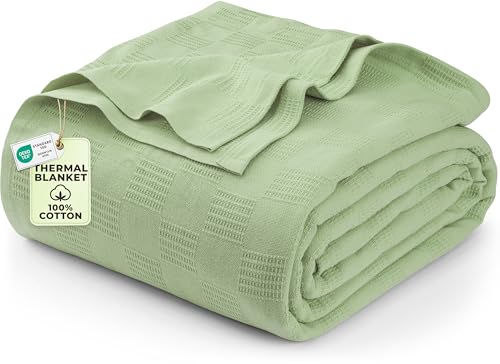
The Utopia is the budget classic and the category’s reference design, the thermal blanket against which the rest of the shelf is priced and compared. Its cloth is 100 percent cotton at a published 350 GSM, woven in the raised thermal construction, a dobby weave with a checkered waffle pattern whose pockets hold still air against the body, which is how a blanket this light insulates the way it does. The variant in the reference table is the queen size in sage green, 90 x 90 inches, read from a current Amazon listing record with a United States price record dated November 19, 2026, so its stock evidence is as fresh as any in this roundup. Utopia sells this blanket in a wide color range and in twin, full, queen and king cuts, and the thermal line has been a standing part of its range for years, which is the practical meaning of calling it the classic: the listing a buyer lands on today is the same product, in the same construction, that the category’s older reviews describe.
The cautions are the thermal weave’s own, plus one about expectations. An open thermal construction is the most delicate cloth here: it snags more readily than the twills, it sheds the most lint in its early washes, and its raised texture flattens over years of hard laundry in a way a dense herringbone does not. The maker itself notes, and buyers should plan around, the blanket arriving oversized and settling after the first wash, which is normal cotton behavior stated honestly in the listing copy. At the budget tier the finishing is plainer than the premium picks, with a self-bound edge rather than a decorative hem, and the sage green pinned here will lighten gradually across many washes as cotton does. None of that displaces it from its role. Choose the Utopia if you want the proven thermal design, a published fabric weight, a full queen cut, and the lowest commitment in the group, whether as a first cotton blanket, a guest bed layer, or a spare that lives in the linen closet.
Safety and Accuracy Checks Before You Buy
The recall record for this category needs sorting, because the word blanket sits on several very different products and only some of them have ever been recalled. The blanket recalls of recent years are electric products and children’s products, and no pick in this roundup is either. The heated blanket recalls, including the September 2026 recall of JKMAX heated blankets and heating pads and the July 2026 recall of OCTROT electric throws and blankets, cover corded, heated products whose elements and controllers are the hazard; every pick here is an unheated woven cloth with no cord and no heating element. One name in this roundup does appear in a recall notice, and it should be read precisely: Bedsure’s maker recalled its heated blankets and heating pads in March 2023 over a controller fire hazard. That action covers the electric line only. The Bedsure pick in this roundup is an unpowered cotton waffle blanket, a different product that shares a brand and nothing else, and it is not part of the recall. The other blanket recall a buyer may meet in search results is the December 2022 recall of Pillowfort children’s weighted blankets, about 204,000 units, recalled because a child could unzip the cover and become trapped inside. That is a children’s weighted product, a category this roundup does not cover; nothing here is weighted, filled or made for children. A buyer who confirms those two scopes has covered the recall landscape for woven adult cotton blankets, for which no recall was found against any of the five makers’ cotton lines.
The accuracy checks matter as much as the safety ones in this category, because cotton blanket listings are loose with the three numbers that decide a purchase. The first is GSM. Only three of these five makers publish a fabric weight, and the two that do not, Threadmill and Bedsure, cannot be compared on paper against the three that do. Where a roundup or a listing summary assigns a GSM to a blanket whose maker does not print one, treat the figure as unverified; this roundup prints GSM only where the maker’s own listing data states it. The second number is size. Every dimension printed here is the maker’s nominal pre-wash figure, and cotton shrinks, mostly in its first wash; the Utopia listing says so outright, and the same physics applies to the other four whether their listings say it or not. Measure your mattress, add the drape you want, and buy the size that still covers after settling, not the size that covers on the day it arrives. The third check is the identifier itself. Cotton blanket listings run long ladders of sizes and colors, and the identifier in a reference table follows one exact variant: the Madison Park in blue at full/queen, the Bedsure in grey at twin XL, the Utopia in sage green at queen. Changing the size or the color on the listing changes the product identifier, and a buyer who wants a different variant should confirm they are still looking at the same construction and fabric weight on the variant they choose.
Two listing-data conflicts surfaced while this roundup was assembled, and both are disclosed rather than smoothed over. The Threadmill’s United States listing showed, in one crawl, the summary artifact that reports no featured offers available, while bedding deal coverage published in November 2026 lists the same blanket as a current Amazon offer; the artifact is a known listing-data pattern and does not by itself mean a product is not selling, but a buyer should confirm the live offer on the listing before ordering that pick. The Vellux’s listing record for the pinned twin variant is older than the current records behind the Bedsure and Utopia picks; the maker’s cotton blanket remains in its standing range, and the same confirm-the-offer advice applies. Neither conflict changes the cloth, the weave or the published specs of either blanket, and both are stated here so the buyer hears them from this page rather than discovering them at checkout.
How to Choose the Right Cotton Blanket
Start with the weave, because it decides the blanket’s temperature behavior more than any other spec. If you sleep warm and want a layer that covers without sealing, choose the waffle or the basketweave: the Bedsure’s deep cells ventilate the most, and the Madison Park’s open checker is close behind it while doubling as the layering and decorative pick. If you sleep cool and want one cotton layer to do real insulating work, choose the thermal or the dense twill: the Utopia’s raised thermal pockets are the classic solution, and the Vellux’s 360 GSM herringbone is the heaviest version of the idea in this group. If your priority is the cloth itself, its smoothness now and its condition after years of washing, choose by fiber: the Threadmill’s combed long-staple cotton is the only listing here that specifies its fiber grade, and that specification is the one most likely to still be visible in the blanket’s face after a hundred washes.
Then check the two numbers that can be checked. Where a maker publishes GSM, use it to place the blanket: around 250 GSM is a light layering cloth, and 350 GSM and above is a substantial single layer. Where a maker does not publish it, weigh the listing’s item weight against the size you are buying and accept that the comparison is approximate. For size, measure the bed, decide how much drape you want over each side, and then buy with shrinkage in mind: cotton gives up some of its dimensions in the first wash, so a blanket that exactly fits on arrival will fit slightly less forever after. Twin XL is its own size, neither twin nor a small queen, and the Bedsure is here precisely because that size is underserved; a dorm bed or a split king half dressed in a standard twin blanket is two inches short at the foot every night.
Finally, match the blanket to the laundry it will actually get. A household that washes bedding weekly in hot water should favor the dense weaves, the Threadmill and the Vellux, whose tight twills shed least and hold their faces longest, and should expect open thermals like the Utopia to look their age sooner under the same regime. A guest bed or a lightly used layer can wear any weave here. Colors deserve one thought: cotton lightens gradually, so pale shades, the ivory, grey and sage pinned in this roundup, age the most gracefully, while a saturated color should be bought with its future, slightly softer self in mind. And if the bed is shared by a warm sleeper and a cold one, the oldest solution in this category is still the practical one: a light open weave across the whole bed, the Madison Park or the Bedsure, with a folded denser blanket, the Utopia or the Vellux, on the cold sleeper’s half.
Frequently Asked Questions
Are cotton blankets warm enough for winter on their own?
It depends on the weave and the room, and the honest answer divides this group in two. The dense picks, the Vellux at a published 360 GSM and the Utopia’s 350 GSM thermal weave, are genuine single layers for a normally heated bedroom, because their constructions trap still air, which is where a woven blanket’s warmth comes from. The open picks, the Madison Park basketweave at 250 GSM and the Bedsure waffle, are layers rather than winter solutions on their own: over a sheet in summer they are complete covers, and in winter they belong under a comforter, where the cotton contributes breathability and a natural-fiber layer against the skin. In an unheated or very cold room, no unfilled woven blanket in this group replaces a comforter; cotton’s winter role is to be the breathable part of a stack, not the whole stack.
Do cotton blankets shrink, and how much size should I allow?
Yes. Cotton shrinks, most of it in the first wash, as the woven yarns relax and tighten, and every dimension in this roundup is the maker’s pre-wash figure. The Utopia listing states the behavior outright, noting the blanket arrives slightly oversized and settles after washing, and the same applies in kind to the other four. The practical allowance is to buy for the fit you want after settling: if a size barely covers your mattress on paper, the next size up is the safer purchase, and a queen blanket bought for a full bed simply gains drape. Washing in warm rather than hot water and drying on a moderate setting keeps the change at the smaller end of the range, and it is another reason the pinned sizes here are generous cuts, 90 inches wide at full/queen and queen, rather than exact mattress measurements.
What is the difference between a thermal weave, a waffle weave and a basketweave?
All three are ways of building air into a cotton cloth, and they differ in how much air and how openly. A thermal weave is a raised, textured construction full of small pockets, the classic hospital and hotel blanket, and it insulates best relative to its weight; the Utopia carries it here. A waffle weave pushes the texture deeper, into square cells with raised borders and recessed centers, which ventilate more freely, so the blanket covers and breathes at once; the Bedsure carries it, and it is the hot sleeper’s weave. A basketweave is the flattest of the three, a plain checkerboard of interlaced yarns with the least trapped air and the smoothest drape; the Madison Park carries it, and it is the layering and decorative choice. The herringbone twills carried by the Threadmill and the Vellux sit at the dense end of the same scale, with the fewest air pockets and the most cloth, which is why they present as bedspreads.
Which of these cotton blankets is best for a hot sleeper?
The Bedsure, for most warm sleepers, because its waffle cells move the most air of any weave here and its cloth is a complete cover that never seals against the skin. The Madison Park is the close alternative, and the better one if the blanket also has to layer under a comforter in the colder half of the year or sit visibly on the bed, since the basketweave is flatter and more decorative. Both are 100 percent cotton with no synthetic blend, which matters as much as the weave: cotton absorbs moisture and stays neutral against the skin, where a polyester layer of the same openness still feels warmer. The picks to steer away from, as a hot sleeper, are the dense ones, the Vellux’s 360 GSM herringbone and the Threadmill’s long-staple twill, which are built to hold warmth rather than shed it.
Conclusion
A cotton blanket is the simplest product in the bedding aisle and the one whose listings reward the closest reading, because everything that decides the purchase, the weave, the fabric weight, the fiber grade and the true size, is printed somewhere in the maker’s data or conspicuously absent from it. The Madison Park Freshspun Basketweave is the default pick for its complete paper trail: 100 percent cotton, a published 250 GSM, an open basketweave that layers and breathes, a full 90 x 90 inch cut and an OEKO-TEX certification in the maker’s own copy. The Threadmill is the fiber pick, combed long-staple cotton in a dense herringbone for buyers who wash hard and keep bedding for years. The Bedsure is the hot sleeper’s and the twin XL bed’s pick, a ventilating waffle with the freshest stock evidence in the group. The Vellux is the heavy pick, 360 GSM of cotton from the category’s longest-standing maker. The Utopia is the budget classic, the proven thermal design at a full queen cut. Match the weave to your temperature, the size to your mattress with shrinkage allowed for, and the fiber to your laundry, and any of the five will do the job its listing promises.
D
Disdik Picks Editorial Team
We compare specs, materials and verified owner reviews before a product earns a spot. Rankings are never paid.
Affiliate disclosure. As an Amazon Associate we earn from qualifying purchases at no extra cost to you. Prices accurate as of the date shown.
Find the best razors for women for legs, underarms and sensitive skin. Compare five cartridge, disposable and shave-kit options and choose a smooth shave.
We compared the best comforters for every sleeper, from light all-season inserts to plush king-size picks, so you can find the right warmth for your bed.
We compared the best calculators for students, professionals, and home offices, covering scientific, graphing, financial, printing, and desktop models.


 4. Vellux Cotton Blanket, Twin
 5. Utopia Bedding Cotton Thermal Blanket, Queen










Write Your Review
No reviews yet. Be the first to share your experience!