Disdik Picks is reader-supported. When you buy through links on our site, we may earn a commission at no extra cost to you. As an Amazon Associate, we earn from qualifying purchases. Learn more ›
Best Sunrise Alarm Clocks: Five Wake-Up Lights Compared
Compare the best sunrise alarm clocks by ramp length, brightness, sound and app control, from the Philips benchmark to the budget JALL pick here.
Nov 19, 2026
Updated Nov 20, 2026
30 min read
6 views
The best sunrise alarm clock for most buyers is the Philips SmartSleep Wake-Up Light, because it is the complete standalone package: a colored sunrise that climbs from deep red through orange to bright yellow across 20 brightness levels, a published output of 300 lux, a matching sunset to end the day, five natural wake-up sounds and an FM radio, all set with buttons on the clock and no app, no account and no phone in the bedroom. The Lumie Bodyclock Shine 300 is the long-ramp pick, the only clock here whose sunrise and sunset can stretch to 90 minutes, with 15 sounds and an FM radio behind physical controls. The Hatch Restore 3 is the routine pick, a sunrise clock and sound machine whose evenings and mornings are built as app-designed routines of light and audio. The REACHER Wood Grain Sunrise Alarm Clock is the sound-machine hybrid, pairing a full sunrise with 26 sleep sounds and a display that dims across its whole range. The JALL Wake Up Light Sunrise Alarm Clock is the budget classic, a dual-alarm clock with a colored light show, seven natural sounds and an FM radio at the simplest tier.
As an Amazon Associate, we earn from qualifying purchases.
What Separates One Sunrise Alarm Clock From Another
The first separator is the sunrise itself, and it has two halves: how long the ramp runs and how bright it ends. Ramp length is the spec every maker publishes. The shortest ramps here are the JALL’s fixed choices of 10, 20 or 30 minutes; the Philips runs 20 to 40 minutes; the REACHER runs 5 to 60 minutes; and the Lumie runs 15 to 90 minutes, the longest in this group by a wide margin. A longer ramp is not automatically better. It suits a heavy sleeper, a dark winter morning and a bedroom where the clock sits across the room, because the light has time to register before the sound starts. A shorter ramp suits a light sleeper who wakes at the first glow and would rather the sound arrive sooner. Final brightness is the second half, and it is where the category’s spec sheets go quiet: of these five makers, only Philips publishes a maximum light output, 300 lux measured at 45 centimeters, about 17.7 inches. Lumie, Hatch, REACHER and JALL publish no comparable figure in the listing data reviewed, so any claim that one of them is the brightest cannot be settled on paper, and the checks section below returns to that gap.
The second separator is color. A colored sunrise changes hue as it brightens, starting in deep red, passing through orange and ending in bright yellow or warm white, which imitates the sky rather than a dimmer switch. The Philips is the full colored performance, and the JALL offers seven fixed colors plus a warm white daylight mode, aimed more at mood lighting than at a graded dawn. The Lumie, the Hatch and the REACHER brighten in warm tones without the full red-to-yellow sequence. Neither approach is wrong, but they feel different at 6 in the morning: the colored ramp reads as morning arriving, while a plain brightening reads as a lamp turning itself up slowly, and buyers who have seen dawn simulation demonstrated usually know within one viewing which one they want next to the bed.
The third separator is sound, because the light is only half the alarm. Three sound philosophies divide this group. The radio clocks, the Philips, the Lumie and the JALL, pair a small set of built-in natural sounds with an FM radio, so the alarm can be birdsong or the morning news. The sound machine, the REACHER, inverts the emphasis: 26 sleep sounds for the night, a sleep timer that runs from 5 to 180 minutes, and 8 alarm sounds for the morning, in a clock bought as much for falling asleep as for waking. The app library, the Hatch, holds the largest catalog, sounds, meditations and sleep stories streamed to the clock through its app, with the full library sitting behind the maker’s subscription, a condition stated plainly in its section below. Speaker quality follows the same order in reverse: the radio clocks and the REACHER play through small clock speakers, adequate for birdsong and voices, while no pick here is a music speaker in any serious sense.
The fourth separator is control, and it is the fork buyers feel every day rather than once. Four of the five clocks are set entirely on the device, with buttons and dials, and work with no phone, no account and no network; the Philips and the Lumie are the purest form of that idea. The Hatch is the opposite design: setup and routine-building happen in its app over Wi-Fi, and while it carries a big button and side buttons for starting routines, toggling the alarm and snoozing, the clock is a peripheral to the app in a way the others are not. That buys the deepest routines in this group and costs the most friction when the network or the app misbehaves, and it ties part of the product’s value to a subscription and to the maker’s servers staying up. Neither philosophy is a defect; they are different products wearing the same name, and the choice between them should be made deliberately, not discovered on the first night.
The fifth separator is what the clock does to the room at night. A sunrise clock is also a glowing object on the nightstand for eight hours, and its display behavior matters as much as its dawn. The Philips display dims itself as the room darkens and offers four brightness levels down to off. The Lumie’s display auto-dims and can go completely dark, but it shows the time in 24-hour format only, a genuine fork for buyers who read 12-hour time by reflex. The REACHER’s display dims across a full 0 to 100 percent range, the widest published here. The JALL offers three display levels. The Hatch’s display is set in its app and can be dimmed to dark. Backup behavior divides them too: the Philips keeps its clock running for 4 to 8 hours through an outage on a time backup, the REACHER carries a built-in battery that holds settings, and the JALL keeps its memory on a button cell, but no pick runs its light show on backup power, a limit the FAQ takes up directly.
1. Philips SmartSleep Wake-Up Light
Top Pick
1. Philips SmartSleep Wake-Up Light
Form: Wake-up light alarm clock with colored sunrise simulation, per Philips
Sunrise: Adjustable 20 to 40 minutes, 20 brightness levels, red to orange to yellow, per the Philips data sheet
Maximum light output: 300 lux at 45 cm (17.7 in), per the Philips data sheet
Sunset: Yes, fading light over a set duration, per Philips
The Philips is the benchmark pick, the clock this category is measured against, and its case is completeness without connectivity. The variant in the reference table is the HF3520/60, the United States version, a round wake-up light whose colored sunrise climbs from red through orange to yellow across 20 brightness levels to a published 300 lux, over a ramp the buyer sets between 20 and 40 minutes, 30 by default. At the end of the ramp the sound arrives gradually rather than at full volume: a choice of five natural wake-up sounds or the FM radio. Two alarms can be set, a tap on top of the unit snoozes the sound for nine minutes, and the lamp doubles as a reading light. At night the performance reverses into a sunset simulation, a fading light over a set duration, and the display dims itself as the room darkens. The identifier in the reference table was read from the Amazon product information blocks for this exact United States listing, which print its model, its sound set and its radio consistently across the United States and Canadian stores, and the clock is carried as the benchmark pick in sunrise roundups updated within days of this writing.
The cautions are about what the Philips deliberately is not. There is no app, no Wi-Fi and no Bluetooth, so schedules are set on the clock’s buttons and there is no sleep tracking or content library; the maker’s app-connected sibling is a different product with a different identifier, and a buyer who wants the connected version should shop for it by name rather than assume this listing has it. The footprint is also the largest of the standalone clocks here, a disc about 7.8 inches across, which needs real nightstand room, and its published weight figures differ slightly between the maker’s data sheet and its manual, so the table prints the data sheet figure. The five built-in sounds are the full library, with the radio as the only expansion. Choose the Philips if you want the proven dawn, colored and measured, with a sunset to match, and you want it set with buttons and forgotten, with no account between you and your alarm.
2. Lumie Bodyclock Shine 300
Runner-Up
2. Lumie Bodyclock Shine 300
Form: Wake-up light radio alarm clock, per Lumie
Sunrise and sunset: Each adjustable from 15 to 90 minutes, with adjustable final intensity, per Lumie
Maximum light output: Not published by the maker in the data reviewed
Sound: 15 sleep and wake sounds plus FM radio with 5 presets, per Lumie
The Lumie is the long-ramp pick, built by the British maker that has specialized in dawn simulation longer than anyone else in this group, and its case is range. Both its sunrise and its sunset can be set anywhere from 15 to 90 minutes, with the final light intensity adjustable, so the same clock can run a quick 15-minute brightening in June and a slow hour-and-a-half dawn in January, and it is the only pick here that can. The audio side is the fullest of the radio clocks: 15 sleep and wake sounds, from blackbird and osprey to a steam train and purring kittens, plus an FM radio with five presets, and the sound can fade with the sunset as well as arrive with the sunrise. Alarms can be set daily or weekly, so a weekday dawn and a weekend dawn can differ, the display auto-dims and can go fully dark in a dark room, and a night light mode is built in. The identifier in the reference table was read from the Amazon product information for this exact listing, sold by the maker’s own United States storefront and shipped from Amazon, and the clock is carried as a current pick in sunrise roundups published within days of this writing.
The cautions are about format and about paper brightness. The display shows 24-hour time only, with no 12-hour option, which is a small spec that decides real purchases in the United States, and the button-driven menus take a night or two to learn because the controls are largely unlabelled icons. Lumie also publishes no maximum lux figure for this clock in the data reviewed, so while its long ramps and adjustable final intensity are documented, a claim that it outshines the Philips’ published 300 lux cannot be made from the maker’s own numbers, and this roundup does not make it. The maker certifies the clock as a Class I medical device under United Kingdom and European rules, which speaks to its light engine’s consistency, but in the United States it is sold as a wake-up light, not as a treatment device. Choose the Lumie if your mornings are dark for much of the year, you are a heavy sleeper who wants the longest, most adjustable ramp on offer, and 24-hour time does not bother you.
3. Hatch Restore 3, Putty
3. Hatch Restore 3, Putty
Form: Sunrise alarm clock, sound machine and smart light, per Hatch
Sunrise: Gradual brightening built into app-set wake routines, per Hatch
Maximum light output: Not published by the maker in the data reviewed
Sound: Sound machine library in the maker’s app, with meditations and sleep stories; the full library requires the maker’s subscription, per Hatch
The Hatch is the routine pick, the clock for a buyer who wants the whole evening and morning choreographed rather than a single alarm. The variant in the reference table is the Putty colorway of the Restore 3, a low, wide sunrise clock, sound machine and smart light whose routines are built in the maker’s app: an unwind sequence of calming light colors and audio at night, sound through the night from its library, and a sunrise that brightens ahead of a gentle alarm sound in the morning. The content library is the deepest here by a distance, soundscapes, guided meditations and sleep stories beside the plain noise, and the device itself is not a dumb terminal: a big button on top starts routines, adjusts volume or snoozes, and side buttons run the bedside light and the alarm toggle, so the phone can stay out of the bedroom once the routines exist. Its display is digital and auto-dimmable and can be set dark in the app. The identifier in the reference table was read from the Amazon product information block for this exact Putty listing, corroborated by the maker’s manual record under the same identifier, and the clock is the current generation carried across November 2026 sunrise coverage.
The cautions are structural, and they are the price of the ecosystem. Setup requires the app and a Wi-Fi connection, and the clock’s full functionality depends on both; a buyer who wants an alarm that answers to buttons alone should take the Philips or the Lumie. The full content library sits behind the maker’s subscription, with a smaller set of sounds included without it, so part of what the clock can do is an ongoing service rather than a finished purchase, and that condition should be weighed before the first night, not discovered after it. There is no FM radio, and the maker’s published dimensions and weight for this model are inconsistent across the records reviewed, so the table prints the product block’s width and height and declines to print a weight rather than borrow one. The colorways, Putty, Cocoa and Greige, are separate listings with separate identifiers; the pick here is Putty. Choose the Hatch if your problem is the whole routine, falling asleep as much as waking, and you are comfortable running your alarm clock from an app with a subscription behind its deepest library.
4. REACHER Wood Grain Sunrise Alarm Clock
4. REACHER Wood Grain Sunrise Alarm Clock
Form: Sunrise alarm clock and sound machine with night light, per the listing
Sunrise: Brightens from 1 to 100 percent over 5 to 60 minutes, per the listing
Maximum light output: Not published by the maker in the data reviewed
Sound: 26 sleep sounds and 8 alarm sounds, per the listing data
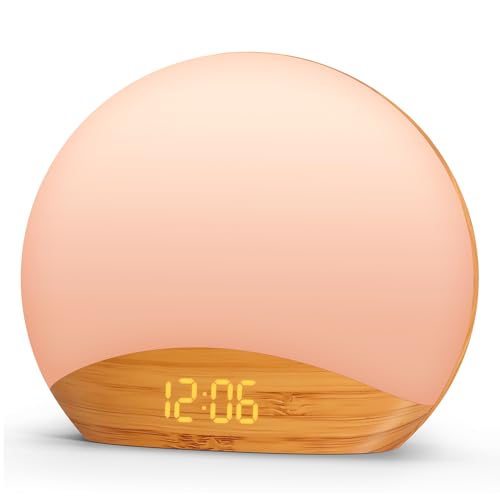
The REACHER is the sound-machine hybrid, the pick for a buyer whose night is the problem as much as their morning. Its sunrise brightens from 1 to 100 percent over a span the buyer sets between 5 and 60 minutes, and around that light it wraps the fullest built-in night audio in this group: 26 sleep sounds, white noise, ocean waves, rain and wind among them, on a sleep timer that runs from 5 to 180 minutes and takes the night light down with the sound. The night light itself offers eight colors at adjustable brightness, the clock display dims across a full 0 to 100 percent range so it can be run nearly dark, and eight alarm sounds handle the morning. A built-in battery holds the clock’s settings through an outage, per the listing, so a power cut does not erase the routine even though the light itself needs the mains. The wood grain finish is the design argument, a clock that reads as a small piece of furniture rather than a gadget. The identifier in the reference table was read from the Amazon product information block for this exact wood grain listing, sold by the maker’s own storefront and shipped from Amazon, and an ExpertBeacon product record for the same identifier, crawled within a day of this writing, carries the same listing copy and feature set.
The cautions are about depth rather than breadth. The sunrise has no published lux figure and no color sequence; it is a warm brightening, and a buyer who wants the graded red-to-yellow dawn should take the Philips. The maker’s line is a family of near-identical clocks, including a plain-finish sibling of this same design and charging-clock variants with different feature sets and different identifiers, so the identifier in the table, not the brand or the shape, is the check that the cart holds the wood grain sound-machine version reviewed here. The listing data reviewed does not print the clock’s dimensions, so its Specs block says so rather than estimate a footprint from photographs; in person it is a compact bedside unit in the same class as the JALL. Choose the REACHER if you fall asleep to sound every night, want one device to run the night and the morning, and prefer a wood finish and a fully dimmable display over a colored dawn.
5. JALL Wake Up Light Sunrise Alarm Clock
5. JALL Wake Up Light Sunrise Alarm Clock
Form: Wake-up light sunrise alarm clock, per the listing
Sunrise: 10 to 100 percent over a selectable 10, 20 or 30 minutes, per the instruction manual
Light: 7 colors plus warm white, 20 brightness levels, per the instruction manual
Sound: 7 natural sounds or FM radio, 16 volume levels, per the instruction manual
The JALL is the budget classic, the long-running, low-tier wake-up light that put this category on millions of nightstands, and its case is how much of the formula it covers at the simplest level. Its sunrise lifts the light from 10 to 100 percent over a ramp the buyer picks at 10, 20 or 30 minutes, in warm white or in any of seven fixed colors, at 20 brightness levels, and the sound that follows is one of seven natural sounds, birdsong, ocean waves, streams, a beep, wind bells, soft music or piano, or the FM radio, at 16 volume levels. Two independent alarms can be set, which makes it the only budget pick here that serves two wake times, and the snooze runs nine minutes and can be repeated up to five times. At night it runs in reverse as a sleep-aid light on a timer, and its display offers three brightness levels. The identifier in the reference table was read from the Amazon product information block for this exact listing, and the maker’s instruction manual for this design prints the same sound set, the same ramp choices and the same dimensions the table below uses.
The cautions are the honest limits of the tier. The sunrise is a brightening in a chosen color rather than a graded dawn, the speaker is a small clock speaker that flatters birdsong more than music, and the ramp tops out at 30 minutes, so a heavy sleeper who needs a long, bright build should step up to the Lumie or the Philips. The maker’s catalog is the widest trap in this roundup: newer JALL models add white noise libraries, Bluetooth speakers and full-screen panels under similar names, and they are different products with different identifiers, while this pick is the classic dual-alarm design; match the identifier, not the silhouette. Its memory backup is a button cell that holds the clock’s settings, not a battery that runs the alarm, so an overnight outage still needs a second alarm for a critical morning. Choose the JALL if you want to find out whether waking to light works for you, you need two alarms in one clock, and you accept a simpler light show as the terms of the experiment.
Safety and Accuracy Checks Before You Buy
Run five checks before ordering any sunrise alarm clock in this roundup. First, the recall check, and this category’s federal record is narrow and precise. No recall covers sunrise alarm clocks as a class, and none of the five picks appears in a federal recall in the records reviewed. The one adjacent record belongs to the Hatch name and must be scoped exactly: in July 2024, under recall 24-291, the Consumer Product Safety Commission announced the recall of about 919,400 power adapters sold with the maker’s Rest 1st Generation sound machines, the company’s baby sound machine, because the adapter’s plastic housing could come off when unplugged and expose the prongs, a shock hazard, with a free replacement adapter as the remedy. The recalled adapter is one model, identified on the adapter itself, sold with a different product between 2019 and 2022. The Hatch pick in this roundup is the Restore 3, an adult sunrise clock that is not a Rest sound machine and does not use that adapter, and it is included on its own listing’s merits. The rule the record teaches is the standing one for this site: a recall attaches to a model and a product type, not to a logo, so check the exact product in the table against the federal database, and never extend a recall past its stated scope or ignore it inside it.
Second, the brightness check, because this category’s numbers invite a specific misunderstanding. Only one maker here publishes a maximum light output: Philips, at 300 lux measured 45 centimeters from the lamp. Lumie, Hatch, REACHER and JALL publish no comparable figure in the data reviewed, so no honest ranking of the other four by brightness exists on paper, whatever a listing’s adjectives claim, and a buyer comparing across brands should judge by ramp length, final-intensity control and clock placement instead. The related trap runs the other way: a sunrise clock is not a light therapy lamp. Therapy devices are built to deliver around 10,000 lux at a stated distance for timed sessions, a different product class with a different purpose, and none of the five picks is one, is rated as one, or should be bought as one. These clocks are for waking gently; treat any listing that borrows therapy language for a bedside alarm as a claim to set aside.
Third, the connectivity check. Four picks, the Philips, the Lumie, the REACHER and the JALL, are complete on the device: every feature in their sections works with buttons, no account, no network and no subscription, forever. The Hatch is the exception by design: it needs its app and Wi-Fi to set up and to reach its full routine library, and the deepest part of that library sits behind the maker’s subscription, with a smaller sound set included without it. Neither design is a defect, but they age differently, because a button clock’s features cannot be paywalled or server-dependent after purchase and an app clock’s can change with the service. Decide which ownership model you want before the clock is on the nightstand, and if the answer is the app clock, read the subscription terms on the live listing as part of the purchase, the same as any spec.
Fourth, the display check, which is small print with nightly consequences. The Lumie shows the time in 24-hour format only; a buyer who reads 12-hour time by reflex will misread a dark bedroom clock at exactly the wrong moment, and no setting changes it. Every pick’s display can be dimmed, but the ranges differ: the REACHER dims across its full range to near darkness, the Philips dims itself automatically as the room darkens, the Hatch’s display is governed in its app, and the JALL offers three levels. A light sleeper should confirm on the live listing that the chosen clock’s display can go fully dark, because a display that only dims is a night light the buyer did not choose.
Fifth, the variant and evidence check. Every identifier in the reference table belongs to one model and, where it applies, one colorway. The Hatch sells the Restore 3 in Putty, Cocoa and Greige as separate listings, and the pick here is Putty. The Philips model suffix marks the region: the /60 in this pick’s name is the United States version, and /01 listings for other regions circulate beside it. The REACHER’s plain-finish sibling and its charging-clock variants are different listings again, and the JALL’s newer sound-machine models share its name and shape while carrying different identifiers and different features. Match the identifier, not just the name, on the live listing before paying. On evidence: the Philips, Hatch, Lumie and JALL identifiers were read from Amazon product information blocks for the exact listings reviewed, the REACHER’s from the Amazon product information block and an ExpertBeacon record for the same identifier crawled within a day of this writing, and each pick is carried as a current product in roundups published or updated within days of this writing. Some of the underlying Amazon blocks are months old, which is why the live listing remains the final authority at order time.
How to Choose the Right Sunrise Alarm Clock
Start with the sleeper, because it settles the ramp before any other feature matters. A heavy sleeper, or anyone waking in a dark room in winter, wants the longest build and the strongest finish available: the Lumie’s 90-minute ceiling and adjustable final intensity, or the Philips’ published 300 lux over 40 minutes. A light sleeper wants the opposite discipline, a short ramp that does not start glowing an hour before the alarm, which is the JALL’s 10-minute option or a Philips set to 20. Couples on different schedules should note that only the JALL here runs two fully independent alarms at the budget tier, the Philips runs two as well, and the Lumie’s daily and weekly alarms solve the weekday-weekend split rather than the two-people split.
Then choose the dawn’s shape. Take the Philips if the graded color performance, red to orange to yellow, is the point of the purchase, because it is the only full colored sunrise here with a published brightness behind it. Take the Lumie if duration range matters more than hue, the Hatch if the light is one act in a longer routine of sound and guided content, the REACHER if the light is the morning half of a sound machine that also runs the night, and the JALL if a single chosen color and a shorter ramp cover the brief.
Then choose the sound. Radio listeners are served by the Philips, the Lumie and the JALL, each with an FM tuner beside its built-in sounds, the Lumie adding presets and the fullest built-in library of the three at 15 sounds. Sound-first sleepers should compare the REACHER’s 26 built-in sleep sounds and long sleep timer against the Hatch’s app library, remembering that the REACHER’s library is finished at purchase and the Hatch’s deepest library is a subscription. Nobody in this group should buy expecting music fidelity; every speaker here is a clock speaker, voiced for birdsong, voices and noise, and a buyer who wants real audio should keep a separate speaker and let the clock be a clock.
Finally, decide the control philosophy and the display, the two choices that cannot be changed later. If the phone stays out of the bedroom, the choice narrows to the four button clocks, and among them the display decides: the Lumie only in 24-hour time, the REACHER dimmable across its whole range, the Philips self-dimming, the JALL at three levels. If routines and content are the point, take the Hatch with its terms understood. Then match the model, colorway and identifier in the reference table on the live listing, set the ramp longer than feels necessary for the first week, and move the clock closer to the bed than feels polite, because a dawn across the room is a dawn for the furniture.
Frequently Asked Questions
Do sunrise alarm clocks work better than a phone alarm?
They work differently, and for many sleepers that difference is the point. A phone alarm starts at full volume in a dark room; a sunrise clock spends 10 to 90 minutes raising the light first, so the sound, when it comes, arrives in a room that already reads as morning, and many sleepers find they surface during the light phase and wake before the tone. The honest limits are placement and expectation: the clock has to sit where its light reaches the bed, a heavy sleeper may still sleep through a short ramp, and no clock here is a medical device for a sleep disorder in the United States market. As a practical matter, the buyers who report the most from the switch are winter commuters and anyone whose bedroom has blackout curtains, because both groups otherwise wake in full darkness year-round.
How long should a sunrise simulation be?
Long enough to register, short enough to fit the morning. The middle of this group, 20 to 40 minutes, is where the Philips lives and where most buyers settle: long enough for the light to build through its colors, short enough that the early, dimmest phase is not wasted on deep sleep. Heavy sleepers and dark winter bedrooms argue for more, which is the Lumie’s case for ramps up to 90 minutes and a high final intensity. Light sleepers should start short, 10 or 20 minutes on the JALL or the Philips at its lowest setting, because a ramp that wakes them at its first glow has simply moved the alarm earlier. Treat the first week as calibration: begin at 30 minutes, and lengthen or shorten by how often the sound, rather than the light, is doing the waking.
What is the difference between a sunrise alarm clock and a light therapy lamp?
Brightness and purpose. A light therapy lamp is built to deliver around 10,000 lux at a stated distance, used awake, at a table, for a timed session. A sunrise alarm clock delivers a few hundred lux at most at pillow distance, Philips’ published 300 lux at 45 centimeters is the only figure in this group, and its job is timing rather than dose: to put gradually increasing light in front of closed eyes before the wake time. The products are not interchangeable in either direction. A therapy lamp makes a poor alarm, and none of the five clocks here is a therapy device, is rated as one, or should be bought to do that job, whatever adjectives a listing borrows.
Will a sunrise alarm clock still wake me if the power goes out?
Not with light, and the backups differ in ways worth knowing before the night it matters. The Philips keeps its clock running for 4 to 8 hours on a time backup, the REACHER’s built-in battery holds its settings, and the JALL’s button cell holds its memory, so an outage does not erase the routine, but no pick in this group runs its lamp or its full alarm on backup power. The Lumie and the Hatch publish no outage backup in the data reviewed. For an ordinary morning that is a fair trade; for a flight, an exam or a shift that cannot be missed, keep a phone alarm set as the second line, because the sunrise is a mains-powered performance and the grid is part of the cast.
Conclusion
Choose by the sleeper first, then by the dawn’s shape, then by sound. The Philips SmartSleep Wake-Up Light is the complete standalone clock, a colored, measured sunrise and sunset with radio and natural sounds and no app anywhere in it. The Lumie Bodyclock Shine 300 is the range pick, sunrise and sunset from 15 to 90 minutes with the fullest radio-clock sound set, in 24-hour time. The Hatch Restore 3 in Putty is the routine pick, an app-built evening and morning ecosystem with the deepest content library and a subscription behind it. The REACHER Wood Grain is the night pick, 26 sleep sounds and a full-range dimmer wrapped around a proper sunrise. The JALL is the experiment pick, the budget dual-alarm classic that proves whether waking to light suits you. Whichever you choose, match the model, colorway and identifier in the reference table on the live listing before you pay, give the ramp a week of calibration, and keep a second alarm for the mornings that cannot be missed.
D
Disdik Picks Editorial Team
We compare specs, materials and verified owner reviews before a product earns a spot. Rankings are never paid.
Affiliate disclosure. As an Amazon Associate we earn from qualifying purchases at no extra cost to you. Prices accurate as of the date shown.
Find the best razors for women for legs, underarms and sensitive skin. Compare five cartridge, disposable and shave-kit options and choose a smooth shave.
We compared the best comforters for every sleeper, from light all-season inserts to plush king-size picks, so you can find the right warmth for your bed.
We compared the best calculators for students, professionals, and home offices, covering scientific, graphing, financial, printing, and desktop models.


 4. REACHER Wood Grain Sunrise Alarm Clock
 5. JALL Wake Up Light Sunrise Alarm Clock










Write Your Review
No reviews yet. Be the first to share your experience!